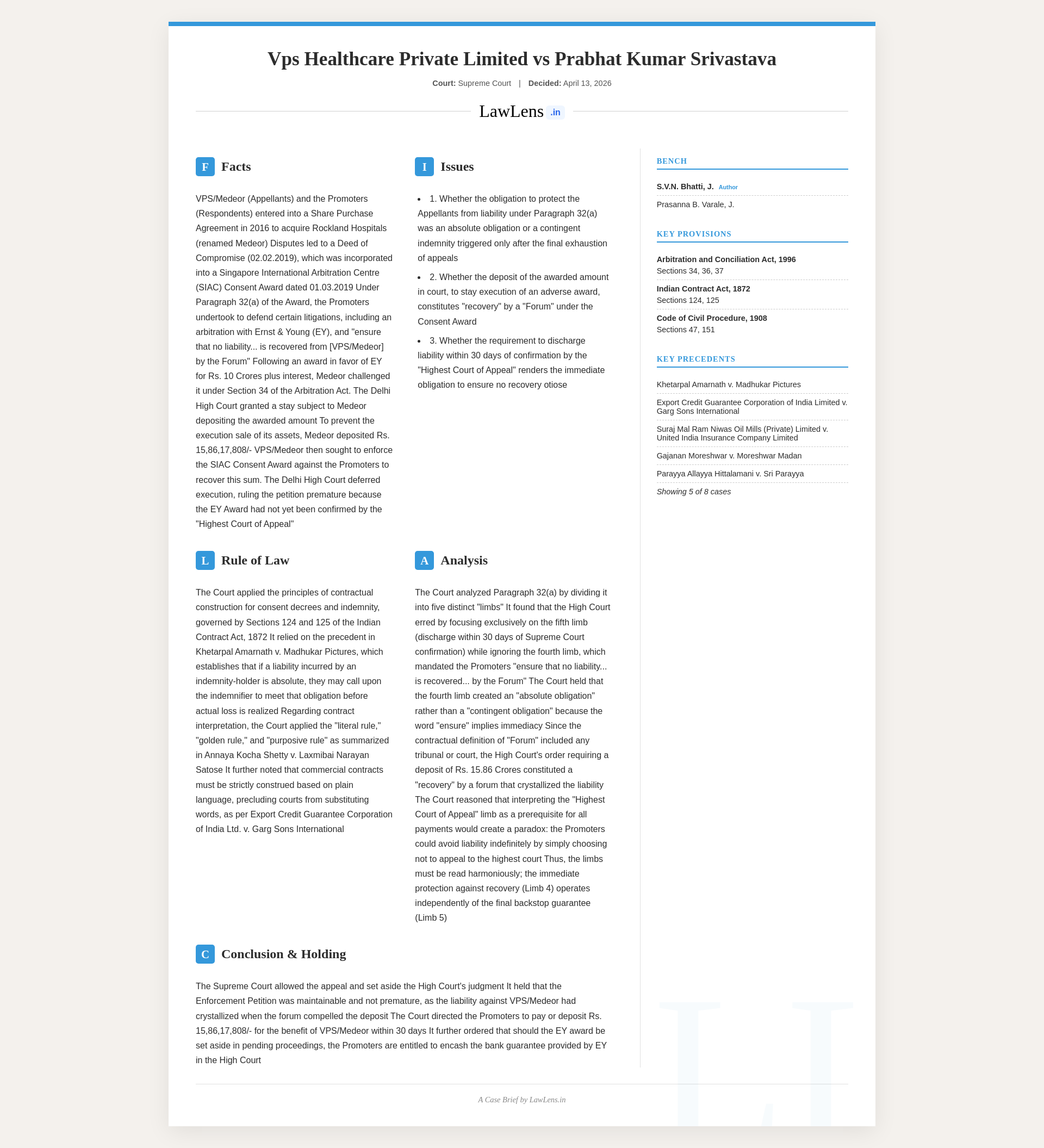
VPS Healthcare Private Limited v. Prabhat Kumar Srivastava 2026 INSC 361 - Consent Decree - Indemnity Contract
A Consent Decree is a contract between the parties with the Court’s seal super-added. A Consent Award is no different from a Consent Decree.

Code of Civil Procedure 1908 - Section 47- A Consent Decree is a contract between the parties with the Court’s seal super-added. A Consent Award is no different from a Consent Decree. The courts are under an obligation to limit their enquiries or interpret the agreed terms except in exceptional cases where enforcement or rejection of the Consent Award is necessary. The Executing Court, in its armchair, poses to itself the fundamental question: has the decree been satisfied or discharged, or is the decree a nullity? The answers to these questions set in motion the execution of a consent decree/award. We may not be understood as laying down a general proposition of law that the objections available under Section 47 CPC need not detain a court from conducting an enquiry, or, for that matter, any objection raised to the execution of an award/consent award is not enquired into. The executability of the Consent Award is limited to the clauses executed by the Decree Holder. (Para 17)
Contract Law - A Contract of Indemnity is perceived and implemented on the principle of a contract by which one party agrees to make good a loss suffered by the other. Another way of simplifying a Contract of Indemnity is to say that it is one whereby a party undertakes to save another party harmless from loss or damage arising from a particular transaction or claim. (Para 19) If the indemnity holder has incurred a liability, and that liability is absolute, he is entitled to call upon the indemnifier to save him from that liability and pay it off. (Para 24)
Contract Law - In commercial contracts, the exact words used by the parties must be given paramount importance, and courts are strictly prohibited from adding, deleting, or substituting words under the guise of interpretation. A Court’s endeavour should always be to interpret the words in which the contract is expressed by the parties rather than altering them(Para 27)
Case Info
Basic Case Information
Case name: VPS Healthcare Private Limited and Another v. Prabhat Kumar Srivastava and Another
Neutral citation: 2026 INSC 361
Court and coram: Supreme Court of India, Civil Appellate Jurisdiction; Bench of Justice S.V.N. Bhatti and Justice Prasanna B. Varale
Judgment date: 13 April 2026 (New Delhi)
Case laws and citations referred
- Khetarpal Amarnath v. Madhukar Pictures, 1955 SCC OnLine Bom 73
- Export Credit Guarantee Corporation of India Limited v. Garg Sons International, (2014) 1 SCC 686
- Suraj Mal Ram Niwas Oil Mills (Private) Limited v. United India Insurance Company Limited, (2010) 10 SCC 567
- Parayya Allayya Hittalamani v. Sri Parayya, (2007) 14 SCC 318
- Baldevdas Shivlal v. Filmistan Distributors (India) (P) Ltd., (1969) 2 SCC 201
- Hindustan Motors Ltd. v. Amritpal Singh Nayar & Anr, 2002 100 DLT 278
- Annaya Kocha Shetty (Dead) through LRs v. Laxmibai Narayan Satose (since Deceased) through LRs & Ors, 2025 INSC 466
Statutes / laws referred
The judgment expressly refers to and applies:
- Arbitration and Conciliation Act, 1996
- Section 34 (setting aside arbitral award)
- Section 36 (enforcement of arbitral awards)
- Indian Contract Act, 1872
- Sections 124 and 125 (contract of indemnity and rights of indemnity holder)
- Code of Civil Procedure, 1908
- Provisions relating to stay of money decrees
- Section 47 (scope of objections in execution), referred to conceptually
Three‑sentence brief summary
The case concerns enforcement in India of a SIAC Consent Award arising from a Deed of Compromise under which the promoters (respondents) undertook to defend and bear all liabilities in specified proceedings, including an Ernst & Young arbitration, so that no liability is recovered from VPS/Medeor. After Medeor was compelled by the Delhi High Court to deposit about Rs. 15.86 crores to secure a conditional stay of the EY award, the Supreme Court held that this deposit itself crystallised a liability, immediately triggering the promoters’ obligation under paragraph 32(a), which was an absolute undertaking to “ensure” that no liability is recovered from VPS/Medeor, and not merely a deferred indemnity payable only after confirmation by the Highest Court of Appeal. Setting aside the High Court’s order that had deferred enforcement, the Supreme Court allowed the enforcement petition and directed the promoters to pay or deposit Rs. 15,86,17,808 within 30 days, subject to the outcome of the pending EY proceedings and with corresponding rights to recover from EY if the underlying award is later set aside.