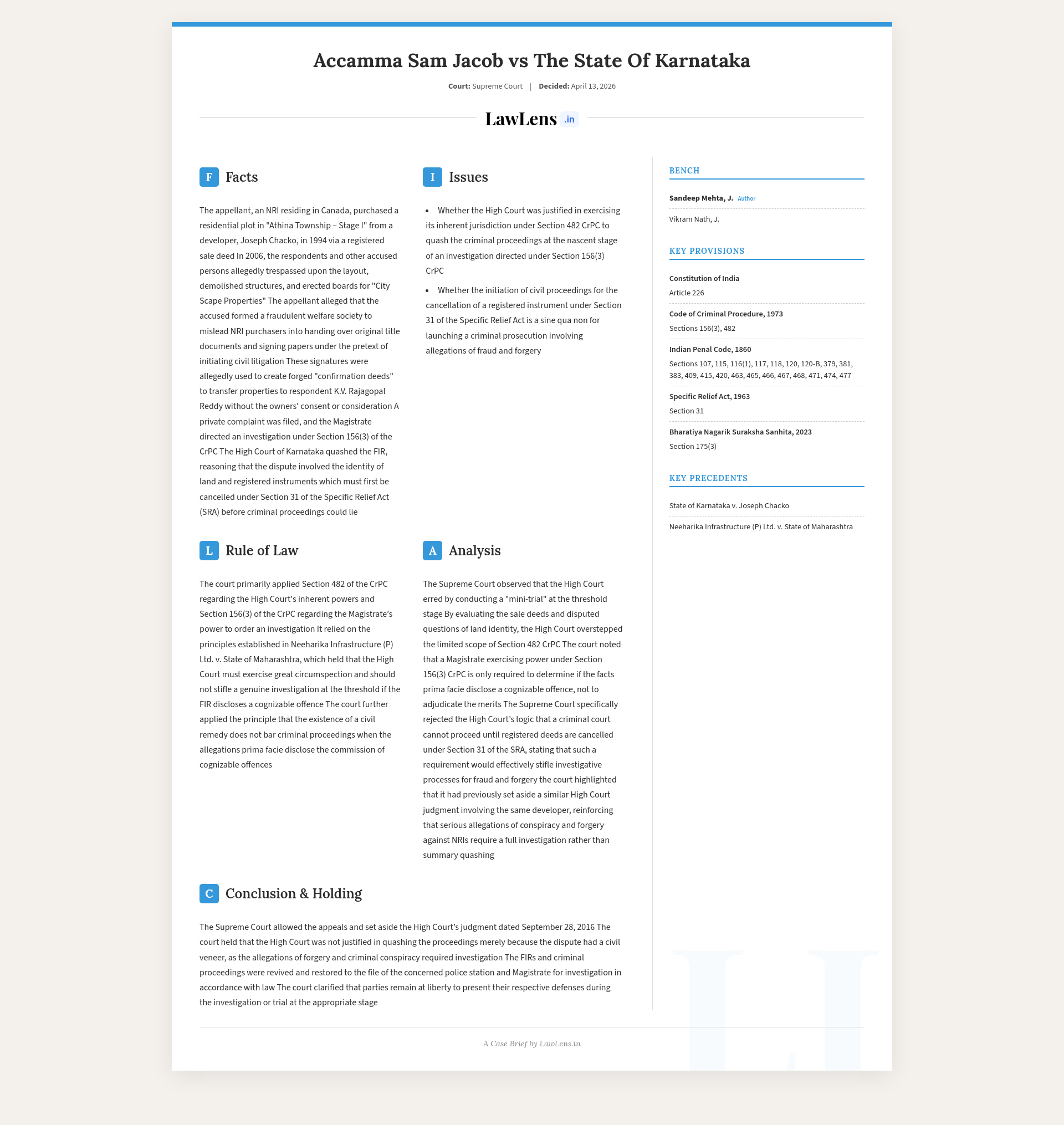
Accamma Sam Jacob v. State of Karnataka 2026 INSC 362 - S.482 CrPC - Civil Nature
The mere existence of a civil remedy does not by itself bar criminal proceedings where the allegations prima facie disclose commission of a cognizable offence.

Code of Criminal Procedure 1973 - Section 482 - The mere existence of a civil remedy does not by itself bar criminal proceedings where the allegations prima facie disclose commission of a cognizable offence - criminal investigation ought not to be scuttled at the threshold except in cases where the complaint ex facie does not disclose the commission of any cognizable offence or where continuation of the proceedings would amount to an abuse of the process of law. The power of the High Court under Section 482 of CrPC or Article 226 of the Constitution of India to interdict investigation is to be exercised with great circumspection, bearing in mind the statutory duty of the investigating agency to inquire into cognizable offences. (Para 55 -56)
Code of Criminal Procedure 1973 - Section 156(3) - While exercising jurisdiction under Section 156(3) of CrPC, the Magistrate is required to merely peruse the application filed by the complainant and examine whether the facts disclosed therein prima facie disclose the necessary ingredients of cognizable offences requiring investigation by police. The Magistrate is not expected to undertake an exhaustive evaluation of evidence. (Para 52)
Case Info
Here’s the extracted information from the judgment on your page.
Basic Case Details
Case name:Accamma Sam Jacob v. The State of Karnataka & Anr. Etc.
Neutral citation:2026 INSC 362
Coram (Bench):Justice Vikram Nath and Justice Sandeep Mehta (Mehta, J. authored the judgment)
Judgment date:13 April 2026 (New Delhi)
Case Laws and Citations Referred
The judgment expressly cites:
- Neeharika Infrastructure (P) Ltd. v. State of Maharashtra, (2021) 19 SCC 401
It also refers to a recent Supreme Court decision (without full SCC citation) as:
- The State of Karnataka v. Joseph Chacko and Anr., Criminal Appeal Nos. 5207–5221 of 2024(Order dated 28 November 2024, setting aside the Karnataka High Court’s judgment dated 25 October 2016 that had quashed FIRs against developer Joseph Chacko.)
Statutes / Laws Referred
The judgment refers to, and applies, among others:
- Code of Criminal Procedure, 1973 (CrPC)
- Section 156(3) – Magistrate’s power to order investigation
- Section 482 – Inherent powers of High Court
- It also notes the corresponding provision in Bharatiya Nagarik Suraksha Sanhita, 2023 (Section 175(3)).
- Indian Penal Code, 1860 (IPC) – multiple offences invoked in the FIR:
- Sections 379, 381, 383 (theft/extortion type offences)
- Sections 415, 420 (cheating)
- Sections 409 (criminal breach of trust)
- Sections 463, 465, 466, 467, 468 (forgery-related offences)
- Sections 471, 474, 477 (use/possession of forged documents, falsification of accounts)
- Sections 107, 115, 116(1), 117, 118, 120, 120-B (abetment and criminal conspiracy)
- Specific Relief Act, 1963 (SRA)
- Section 31 – cancellation of instruments (discussed in context of the High Court’s reasoning that sale deeds had first to be cancelled before criminal proceedings).
Three‑Sentence Brief Summary
This case concerns complaints by an NRI plot purchaser and similarly placed buyers alleging a large‑scale conspiracy involving forged GPAs, fraudulent confirmation deeds, and subsequent sale transactions over land in Survey No. 12, Doddagubbi Village, Bengaluru, to deprive them of their properties. The Karnataka High Court had quashed the FIRs and proceedings under Section 482 CrPC, treating the matter as purely civil and insisting that the registered sale deeds first be cancelled under Section 31 of the Specific Relief Act before criminal law could be set in motion. The Supreme Court holds that the High Court exceeded its jurisdiction at a nascent Section 156(3) stage, reaffirms the Neeharika Infrastructure principle that genuine criminal investigations should not be stifled on civil‑dispute grounds, sets aside the High Court’s order, and restores the FIRs and proceedings to be investigated and tried in accordance with law.