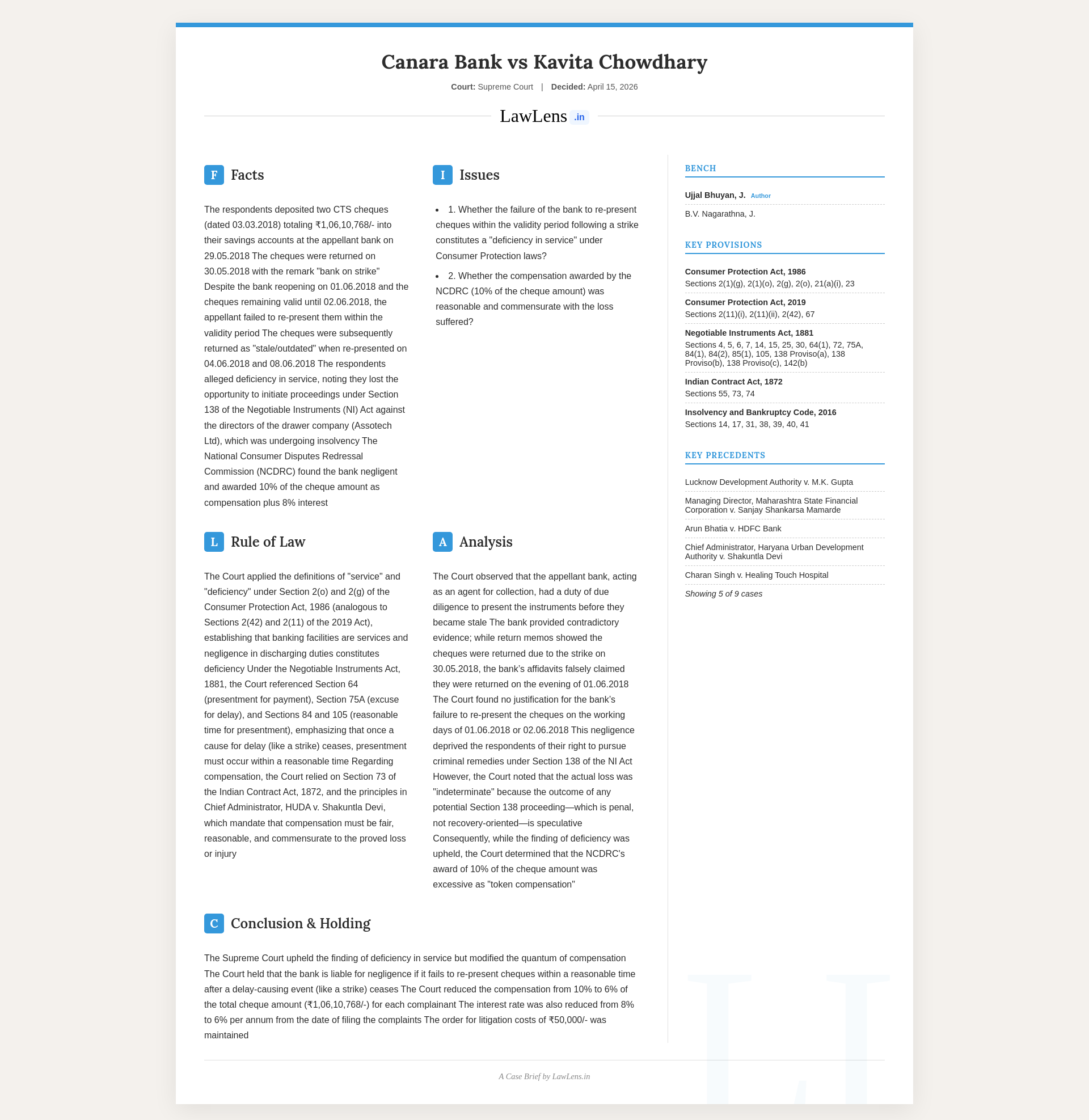
Canara Bank v. Kavita Chowdhary 2026 INSC 363 - Consumer Protection Act - Cheque - Banks
A bank receiving cheques for collection acts as an agent of the customer and is under an obligation to exercise due diligence in presenting the instruments within the prescribed validity period.

Consumer Protection Act 2019 - A bank receiving cheques for collection acts as an agent of the customer and is under an obligation to exercise due diligence in presenting the instruments within the prescribed validity period. Failure to do so resulting in the instrument becoming stale, in the absence of any reasonable explanation, would result in negligence in the discharge of banking duties which would constitute deficiency in rendering service within the meaning of the consumer protection law. (Para 59) [Context: The Supreme Court upheld the National Commission’s finding that Canara Bank was negligent in not re‑presenting two cheques within their validity period, causing them to become stale and thereby depriving the consumer of a potential Section 138 NI Act remedy against the drawer. ]
Negotiable Instruments Act, 1881 - Section 138 - The return of a cheque dishonoured simpliciter would not by itself create an offence under Section 138 of the NI Act. The cause of action would arise only when the demand notice is served and payment is not made pursuant to such demand notice within the stipulated period. (Para 68)
Case Info
Basic Case Details
Case name: Canara Bank v. Kavita Chowdhary & connected matter (Canara Bank v. Priya Chowdhary)Neutral citation: 2026 INSC 363Coram: Hon’ble Ms. Justice B.V. Nagarathna and Hon’ble Mr. Justice Ujjal BhuyanJudgment date: 15 April 2026
Statutes / Laws Referred
From the judgment:
- Negotiable Instruments Act, 1881
- Section 4 (Promissory note)
- Section 5 (Bill of exchange)
- Section 6 (Cheque)
- Section 7 (Drawer / Drawee)
- Section 14 (Negotiation)
- Section 15 (Endorsement / Endorser)
- Section 25 (Public holiday and maturity)
- Section 30 (Liability of drawer)
- Section 32 (implicitly via scheme of liability)
- Section 64 (Presentment for payment)
- Section 72 (Presentment of cheque to charge drawer)
- Section 75A (Excuse for delay in presentment)
- Section 84 (When cheque not duly presented and drawer damaged)
- Section 85 (Payment in due course)
- Section 105 (Reasonable time)
- Section 138 (Dishonour of cheque for insufficiency of funds)
- Section 142 (Cognizance of offences – referred via case law discussion)
- Consumer Protection Act, 1986
- Section 2(g) (Deficiency)
- Section 2(o) (Service)
- Section 21(a)(i) (Original jurisdiction of National Commission)
- Section 23 (Appeal to Supreme Court)
- Consumer Protection Act, 2019
- Section 2(11) (Deficiency)
- Section 2(42) (Service)
- Section 67 (Appeal to Supreme Court)
- Indian Contract Act, 1872
- Section 73 (Compensation for loss or damage caused by breach of contract)
- Sections 55 and 74 are discussed through case law (Consolidated Construction)
- Insolvency and Bankruptcy Code, 2016
- Section 14 (Moratorium)
- Section 17 (Management by interim resolution professional)
- General scheme of resolution / liquidation referred
- Other laws/instruments referred
- Right to Information Act, 2005 (only as factual background)
- RBI circulars/master circulars on cheque validity and re‑presentation (2011 Master Circular; 07.05.2013 circular on re‑presenting cheques returned for technical reasons)
Case Law Cited (with citations)
- Lucknow Development Authority v. M.K. Gupta, (1994) 1 SCC 243
- Managing Director, Maharashtra State Financial Corporation v. Sanjay Shankarsa Mamarde, (2010) 7 SCC 489
- Arun Bhatia v. HDFC Bank, (2022) 17 SCC 229
- Chief Administrator, Haryana Urban Development Authority v. Shakuntla Devi, (2017) 2 SCC 301
- Charan Singh v. Healing Touch Hospital, (2000) 7 SCC 668
- MSR Leathers v. S. Palaniappan, (2013) 1 SCC 177
- Ajay Kumar Radheyshyam Goenka v. Tourism Finance Corporation of India Ltd., (2023) 10 SCC 545
- Vishnoo Mittal v. Shakti Trading Company, (2025) 9 SCC 417
- Consolidated Construction Consortium Ltd. v. Software Technology Parks of India, 2025 INSC 574
Three‑Sentence Brief Summary
The Supreme Court upheld the National Commission’s finding that Canara Bank was negligent in not re‑presenting two cheques within their validity period, causing them to become stale and thereby depriving the consumer of a potential Section 138 NI Act remedy against the drawer. The Court held that such negligence amounts to deficiency in service under consumer law, since a collecting bank acts as agent of the customer and must exercise due diligence in timely presentment. However, treating the actual loss as indeterminate and the Section 138 outcome as uncertain, the Court reduced the token compensation from 10% to 6% of the total cheque amount with 6% interest per annum from the date of complaint, leaving the rest of the Commission’s order intact.