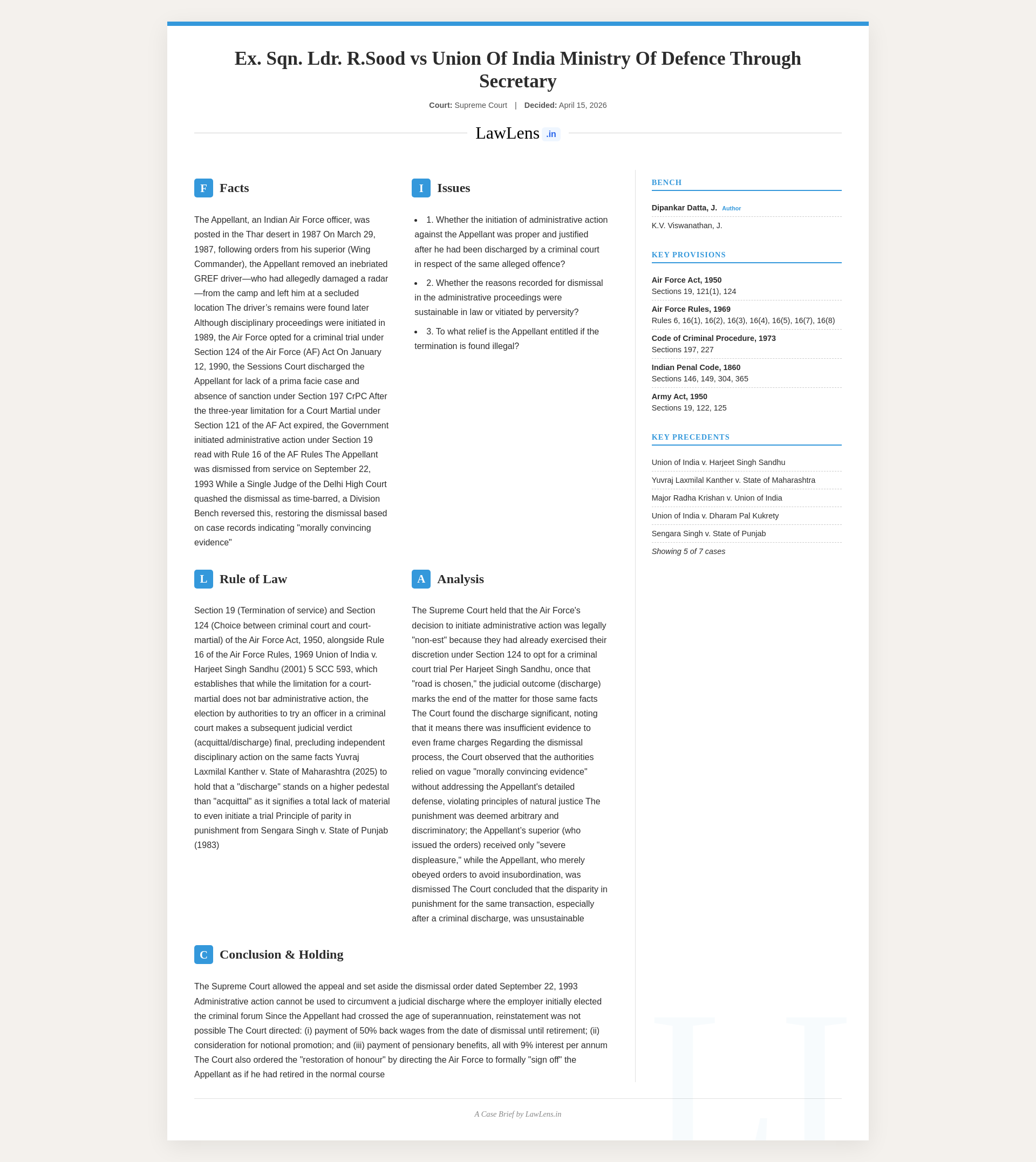
Ex. Sqn. Ldr. R. Sood v. Union of India 2026 INSC 366 -Disciplinary Proceedings - Criminal Trial - Discharge
Once an accused has been discharged, he is entitled to avail of all benefits that are otherwise available to an acquitted person and cannot be placed in a less advantageous position.

Disciplinary Proceedings - Criminal Trial - Discharge - Insufficient evidence to even frame charges for standing trial would lead to a discharge while evidence presented not proving guilt leads to acquittal. In that sense, an accused discharged of a criminal offence stands on a better footing than an accused who is finally acquitted after a full-fledged trial. It is not the law that an accused, unless he is acquitted, must still carry the label on his forehead that he is accused of a criminal offence. Once an accused has been discharged, he is entitled to avail of all benefits that are otherwise available to an acquitted person and cannot be placed in a less advantageous position. (Para 18)
Constitution of India - Article 226 - Disciplinary Proceedings - While courts ordinarily refrain from examining the sufficiency or adequacy of evidence in disciplinary matters, such restraint operates only where the finding of guilt is preceded by a duly conducted inquiry. In cases where no regular inquiry was conducted and the delinquent was deprived of the opportunity to test the evidence through cross-examination, the scope of judicial review necessarily becomes a bit more intrusive. In such circumstances, the show cause notice, the reply thereto and the final order assume critical importance as the primary safeguards of natural justice. Consequently, where the delinquent furnishes a detailed explanation which is not ex facie frivolous or untenable, the competent/disciplinary authority is under a legal obligation to consider the same and pass a reasoned order demonstrating due application of mind as to why the defence raised was perceived to be unacceptable. A cryptic or mechanical rejection, particularly one which does not even advert to the specific contentions raised, falls foul of the principles of natural justice and renders the decision arbitrary and unsustainable in law. (Para 33)
Disciplinary Proceedings - The principle of equality would be violated when a subordinate officer is meted out the harshest punishment for complying with a wrongful order of his superior, while the latter who issued it gets a lenient treatment leading to a reprieve of sorts. (Para 37)