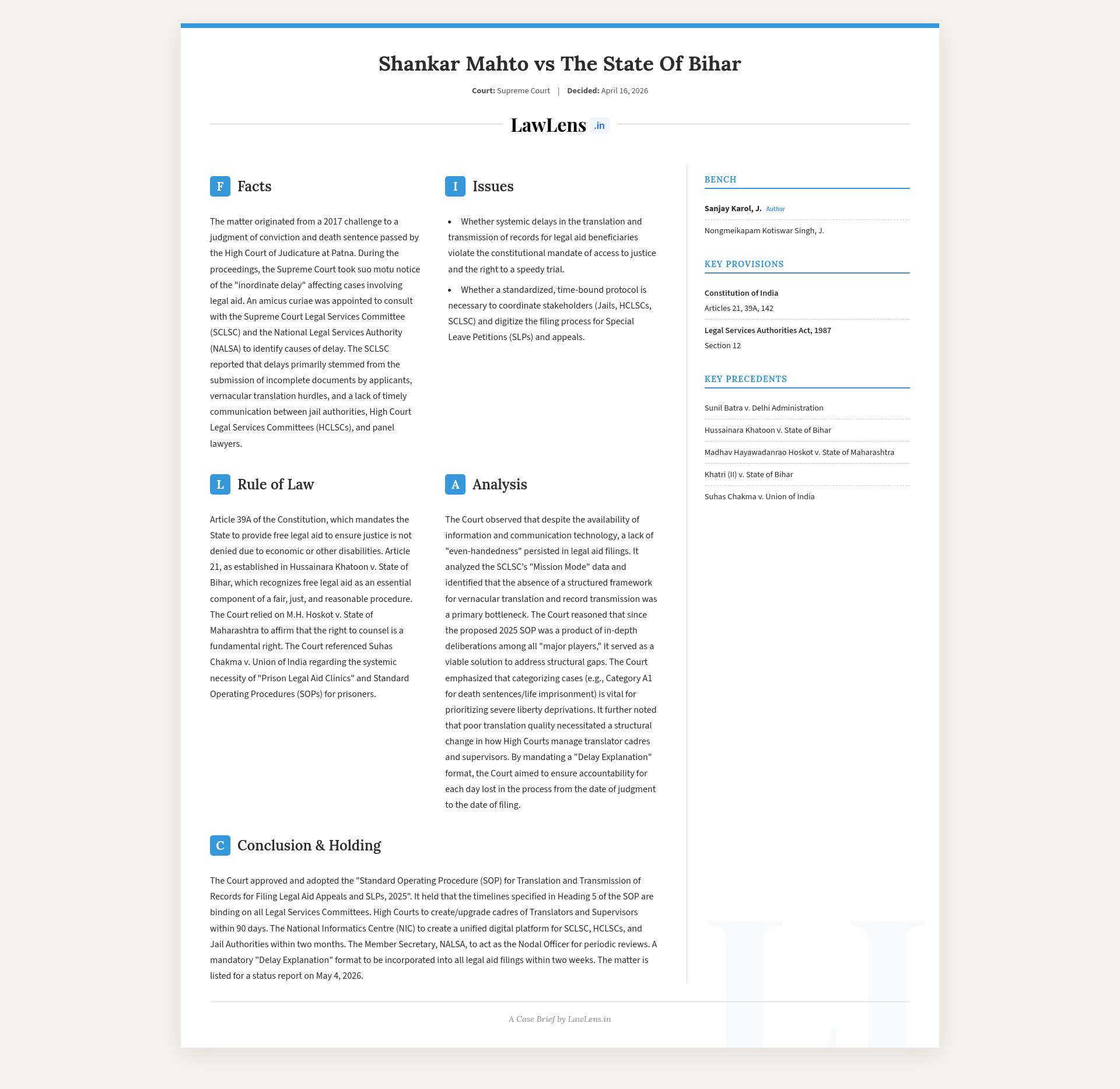
Shankar Mahto v. State of Bihar, 2026 INSC 369 - Legal Aid - Convicts In Custody
Legal aid in India is not merely a matter of policy, but a constitutional responsibility that advances the broader ideals of justice, equality, secularism, and fairness envisioned in the Preamble.

Legal Aid - Free legal aid is a fundamental right and that it attaches from the moment the accused is first produced before a Magistrate and not only at the commencement of the trial. The right to legal aid does not depend on a request to that effect from the accused, thereby placing a positive obligation on the State to provide the same. Legal aid in India is not merely a matter of policy, but a constitutional responsibility that advances the broader ideals of justice, equality, secularism, and fairness envisioned in the Preamble. (Para 6-7) [Context: Supreme Court examined systemic delays in filing legal aid appeals/SLPs and issued directions to streamline translation, digitisation and transmission of records, especially in criminal cases involving convicts in custody. The Court formally adopted and enforced the timelines under Heading 5 of a detailed Standard Operating Procedure (SOP) governing how High Court and Supreme Court Legal Services Committees, NALSA, SLSAs/DLSAs and jail authorities must act, while asking High Courts to consider broader structural measures like strengthening translator cadres and Monitoring Committees. ]
Case Info
Case Information Extracted
Case name and neutral citation:Shankar Mahto v. State of Bihar, 2026 INSC 369
Coram (Bench):Justice Sanjay Karol and Justice Nongmeikapam Kotiswar Singh
Judgment date:16 April 2026 (New Delhi)
Case laws and citations referred
- Sunil Batra v. Delhi Administration, (1978) 4 \text{ SCC } 494
- Hussainara Khatoon v. State of Bihar, (1980) 1 \text{ SCC } 81
- Madhav Hayawadanrao Hoskot v. State of Maharashtra, (1978) 3 \text{ SCC } 544
- Khatri (II) v. State of Bihar, (1981) 1 \text{ SCC } 627
- Suhas Chakma v. Union of India, 2024 INSC 813
Statutes / constitutional provisions referred
The judgment refers primarily to:
- Constitution of India:
- Article 21 – Right to life and personal liberty (including fair procedure and right to counsel)
- Article 39A – Directive Principle mandating free legal aid and equal access to justice
- Article 142 – Power of the Supreme Court to do complete justice
- Legal Services Authorities Act, 1987, especially:
- Section 12 – Categories of persons entitled to legal aid
- The National Legal Services Authority (Free & Competent Legal Services) Regulations, 2010 (Regulation 10 on Monitoring Committees)
Other instruments, schemes and SOPs referenced (by name, not as statutes):
- NALSA “Standard Operating Procedures” on Access to Legal Aid to Prisoners and Prison Legal Aid Clinics, 2022
- NALSA “Standard Operating Procedures for the smooth functioning of Under Trial Review Committees”
- NALSA “Early Access to Justice at Pre-Arrest, Arrest and Remand Stage Framework”
- Resolution dated 29.11.2014 under the Chairmanship of Justice T.S. Thakur (regarding High Court Legal Services Committees processing SC matters)
- NALSA/SCLSC circulars dated 19.02.2015 and 13.04.2015 on preparation of legal aid cases for the Supreme Court
Three‑sentence brief summary
The Supreme Court, in the pending matter arising from Shankar Mahto’s death‑sentence appeal, examined systemic delays in filing legal aid appeals/SLPs and issued directions to streamline translation, digitisation and transmission of records, especially in criminal cases involving convicts in custody. The Court formally adopted and enforced the timelines under Heading 5 of a detailed Standard Operating Procedure (SOP) governing how High Court and Supreme Court Legal Services Committees, NALSA, SLSAs/DLSAs and jail authorities must act, while asking High Courts to consider broader structural measures like strengthening translator cadres and Monitoring Committees. The judgment roots these directions in Articles 21, 39A and 142, treating access to timely and effective legal aid as a constitutional obligation and requiring compliance reports from all concerned institutions, including NIC, by 30 April 2026.