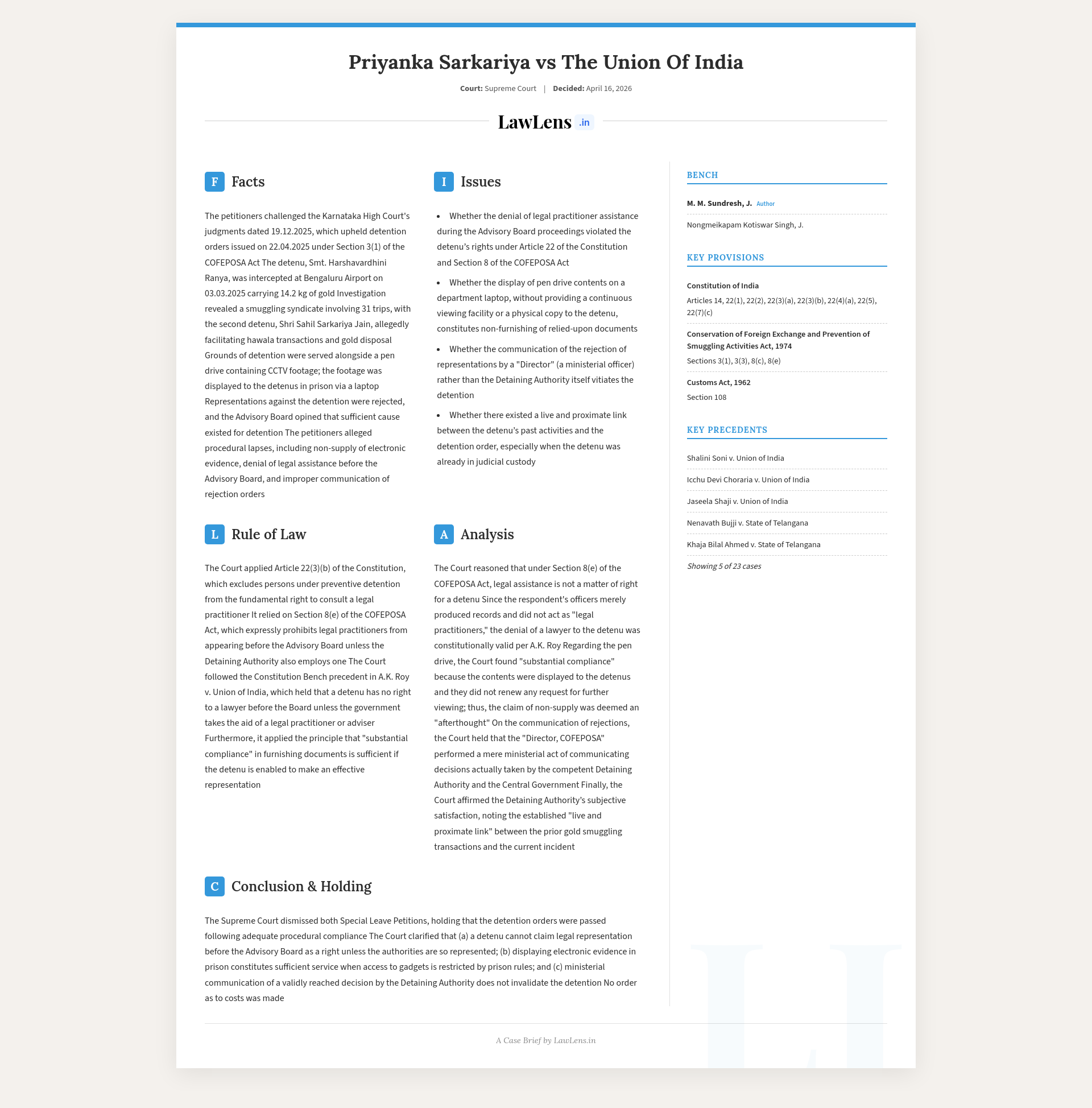
Priyanka Sarkariya v. Union of India 2026 INSC 371 - COFEPOSA - Legal Assistance
COFEPOSA detenu cannot seek legal assistance as a matter of right. Every document need not be supplied and the said requirement is only qua the relied upon documents.

Conservation of Foreign Exchange and Prevention of Smuggling Activities Act, 1974 (COFEPOSA) - Section 8 - A detenu cannot seek legal assistance as a matter of right. The hearing provided under Section 8(c) of the COFEPOSA Act is meant for the detenu alone and, therefore, an officer representing the Detaining Authority has no other role while participating in the proceedings, except for producing the records. It is only when a hearing takes place where there is an active participation of the Detaining Authority, and that too with the leave of the Advisory Board, does the question of affording an opportunity of being heard through a legal practitioner arise qua the detenu. (Para 19) Every document need not be supplied and the said requirement is only qua the relied upon documents. (Para 34)
Case Info
Case Information Extracted
Case name and neutral citation:Priyanka Sarkariya v. Union of India & Anr., 2026 INSC 371
Coram (Judges):Justice M. M. Sundresh and Justice Nongmeikapam Kotiswar Singh
Judgment date:16 April 2026 (New Delhi)
Statutes / Laws Referred
The judgment refers to and applies, among others:
- Article 22(1), 22(2) and Article 22(3)(b) of the Constitution of India
- Section 3(1) of the Conservation of Foreign Exchange and Prevention of Smuggling Activities Act, 1974 (COFEPOSA)
- Section 8(c) and Section 8(e) of the COFEPOSA Act
- Section 108 of the Customs Act, 1962
Case law and citations referred
The judgment cites a large set of precedents, including in particular:
From the petitioner for Sahil Sarkariya (SLP (C) 1484/2026):
- Shalini Soni (Smt) v. Union of India, (1980) 4 SCC 544
- Icchu Devi Choraria (Smt) v. Union of India, (1980) 4 SCC 531
- Jaseela Shaji v. Union of India, (2024) 9 SCC 53
- Nenavath Bujji v. State of Telangana, (2024) 17 SCC 294
- Khaja Bilal Ahmed v. State of Telangana, (2020) 13 SCC 632
- Sarabjeet Singh Mokha v. District Magistrate, Jabalpur, (2021) 20 SCC 98
- P.P. Rukhiya v. Joint Secretary, Government, (2019) 20 SCC 740
From the petitioner for Harshavardhini Ranya (SLP (CrL) 24/2026):
- A.K. Roy v. Union of India, (1982) 1 SCC 271
- State of A.P. v. Balajangam Subbarajamma, (1989) 1 SCC 193
- Choith Nanikram Harchandani v. State of Maharashtra, (2015) 17 SCC 688
- K.M. Abdulla Kunhi v. Union of India, (1991) 1 SCC 476
- Kamleshkumar Ishwardas Patel v. Union of India, (1995) 4 SCC 51
- Venmathi Selvam v. State of T.N., (1998) 5 SCC 510
- Harshala Santosh Patil v. State of Maharashtra, (2006) 12 SCC 211
- Ankit Ashok Jalan v. Union of India, (2020) 16 SCC 127
- Rama Dhondu Borade v. V.K. Saraf, Commissioner of Police, (1989) 3 SCC 173
- Icchu Devi Choraria (Smt) v. Union of India, (1980) 4 SCC 531 (referred again)
- Smitha Gireesh v. Union of India & Ors., 2016 SCC OnLine Del 3697
The Court itself particularly analyses:
- A.K. Roy v. Union of India, (1982) 1 SCC 271
- Icchu Devi Choraria (Smt) v. Union of India, (1980) 4 SCC 531
- Smitha Gireesh v. Union of India, 2016 SCC OnLine Del 3697
Three‑sentence brief summary
The Supreme Court upheld preventive detention orders passed under the COFEPOSA Act against detenus Harshavardhini Ranya and Sahil Sarkariya Jain in relation to alleged large‑scale smuggling and hawala-linked disposal of foreign‑marked gold. The Court held that there was substantial and timely compliance with constitutional and statutory safeguards under Article 22 and Section 8 of COFEPOSA, including supply of relied‑upon documents and pen‑drive contents, proper consideration of representations, and valid subjective satisfaction regarding likelihood of future smuggling even while the detenus were in custody. It rejected arguments about denial of legal assistance before the Advisory Board, non‑supply of electronic evidence, and incompetence of the officer communicating rejection of representations, finding that these did not vitiate the detention orders, and accordingly dismissed both Special Leave Petitions.