Rahul Gupta v. Station House Officer 2026 INSC 374 -Dowry Prohibition Act
Rahul Gupta v. Station House Officer 2026 INSC 374 -Dowry Prohibition Act - Giving Of Dowry

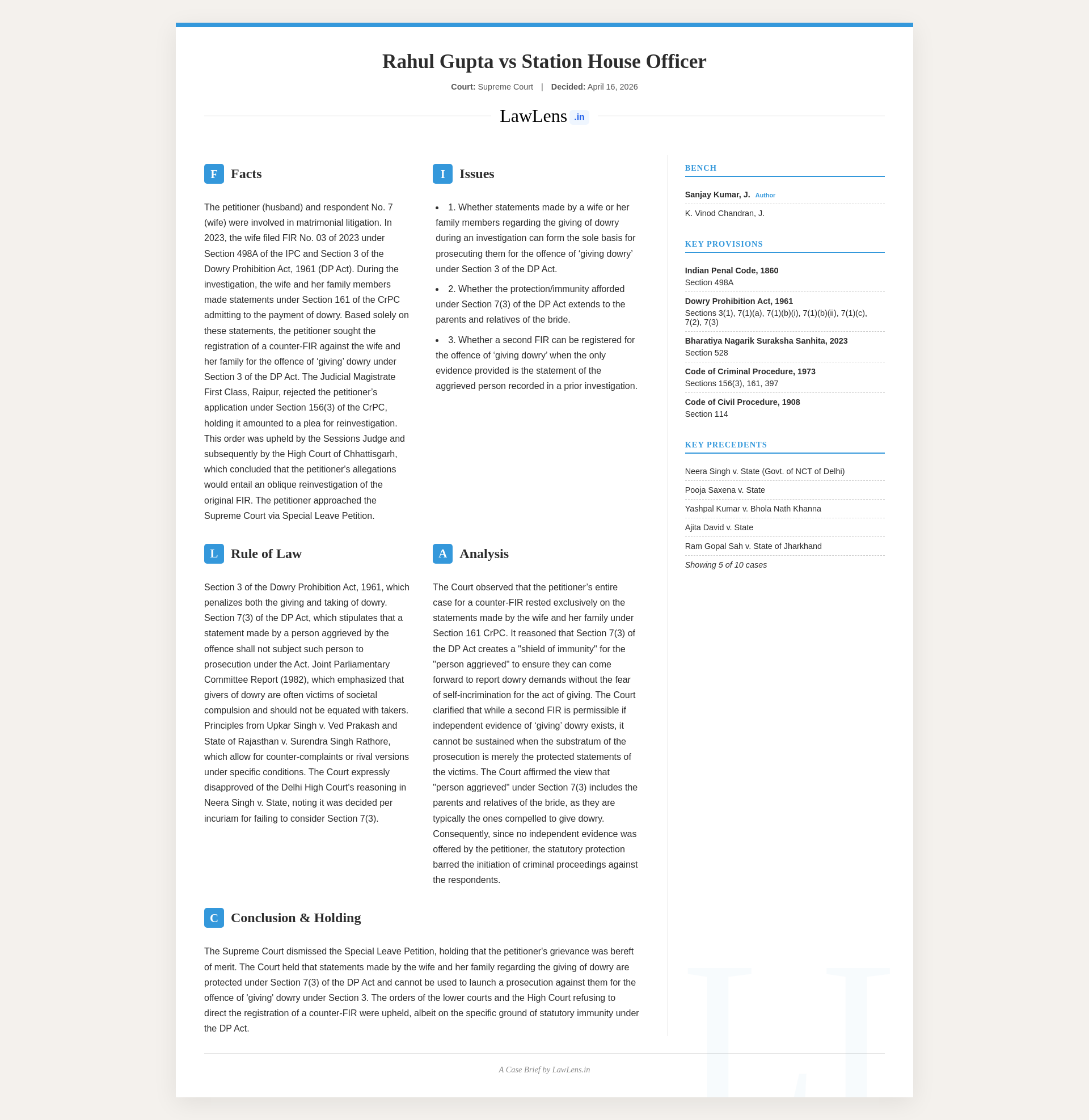
Dowry Prohibition Act 1961- Section 3,7 - Husband sought registration of a separate FIR under Section 3 of DP Act of the against his wife and her family, relying solely on her dowry‑harassment complaint and their statements under Section 161 CrPC as admissions of “giving” dowry -Had it been a case where independent evidence was presented with regard to the ‘giving’ of dowry and reliance was not placed only upon the complaint and statements made by the persons aggrieved, i.e., the wife and her family members, it would have been possible to register an FIR for the offence of ‘giving’ dowry under Section 3 of the DP Act as, in such a situation, the protection afforded to the ‘persons aggrieved’, under Section 7(3) of the DP Act, would not be available to them. However, if in a given case all that is projected to establish the offence of ‘giving’ dowry under Section 3 of the DP Act is the complaint and/or the statements made by the wife and her family members, it would invariably mean that they, being the ‘persons aggrieved’, would be fully covered by the shield of immunity raised under Section 7(3) of the DP Act and would not be liable to be prosecuted on the strength thereof. (Para 20)
Case Info
Basic Case Details
Case name: Rahul Gupta v. Station House Officer & Ors.Neutral citation: 2026 INSC 374
Coram:Sanjay Kumar, J.K. Vinod Chandran, J.
Judgment date: 16 April 2026 (New Delhi)
Statutes / Laws Referred
The judgment refers to and applies, among others:
- Indian Penal Code, 1860 – Section 498A
- Dowry Prohibition Act, 1961 – especially Sections 3 and 7(3)
- Code of Criminal Procedure, 1973 – Sections 156(3), 161, 397; Chapter XXXVI
- Code of Civil Procedure, 1908 – Section 114 (re: no review power in criminal process)
- Bharatiya Nagarik Suraksha Sanhita, 2023 – Section 528
Case Law and Citations Mentioned
- Neera Singh v. State (Govt. of NCT of Delhi) & Ors., (2007) 138 DLT 152 = ILR (2007) 1 Del 691
- Pooja Saxena v. State & Anr., 2011(1) Crimes 378 (Del) = 2010 SCC OnLine Del 3652
- Yashpal Kumar v. Bhola Nath Khanna & Anr., (2012) 2 DLT (Cri) 41
- Ajita David v. State by Inspector of Police & Anr., (2009) 2 MWN (Cri) 257
- Ram Gopal Sah v. State of Jharkhand, 2009 (1) JLJR 432 (HC)
- Haji Sayyad v. State of M.P. & Anr., ILR 2012 MP 2610
- Ram Charitra Tiwari & Ors. v. State of UP & Anr., ILR (2021) 7 All 379
- Upkar Singh v. Ved Prakash & Ors., (2004) 13 SCC 292
- Anju Chaudhary v. State of Uttar Pradesh & Anr., (2013) 6 SCC 384
- State of Rajasthan v. Surendra Singh Rathore, 2025 INSC 248 = 2025 SCC OnLine SC 358
Three‑Sentence Brief Summary
The husband sought registration of a separate FIR under Section 3 of the Dowry Prohibition Act against his wife and her family, relying solely on her dowry‑harassment complaint and their statements under Section 161 CrPC as admissions of “giving” dowry. The Supreme Court held that Section 7(3) of the Dowry Prohibition Act grants immunity to the “person aggrieved” (including the bride and her parents/relatives) from prosecution on the basis of such statements, and that Neera Singh was wrongly decided as it ignored this provision. Finding no independent evidence of giving dowry and no error in the concurrent orders of the Magistrate, Sessions Court and High Court, the Court dismissed the special leave petition while clarifying the general permissibility of counter‑FIRs where independently supported.