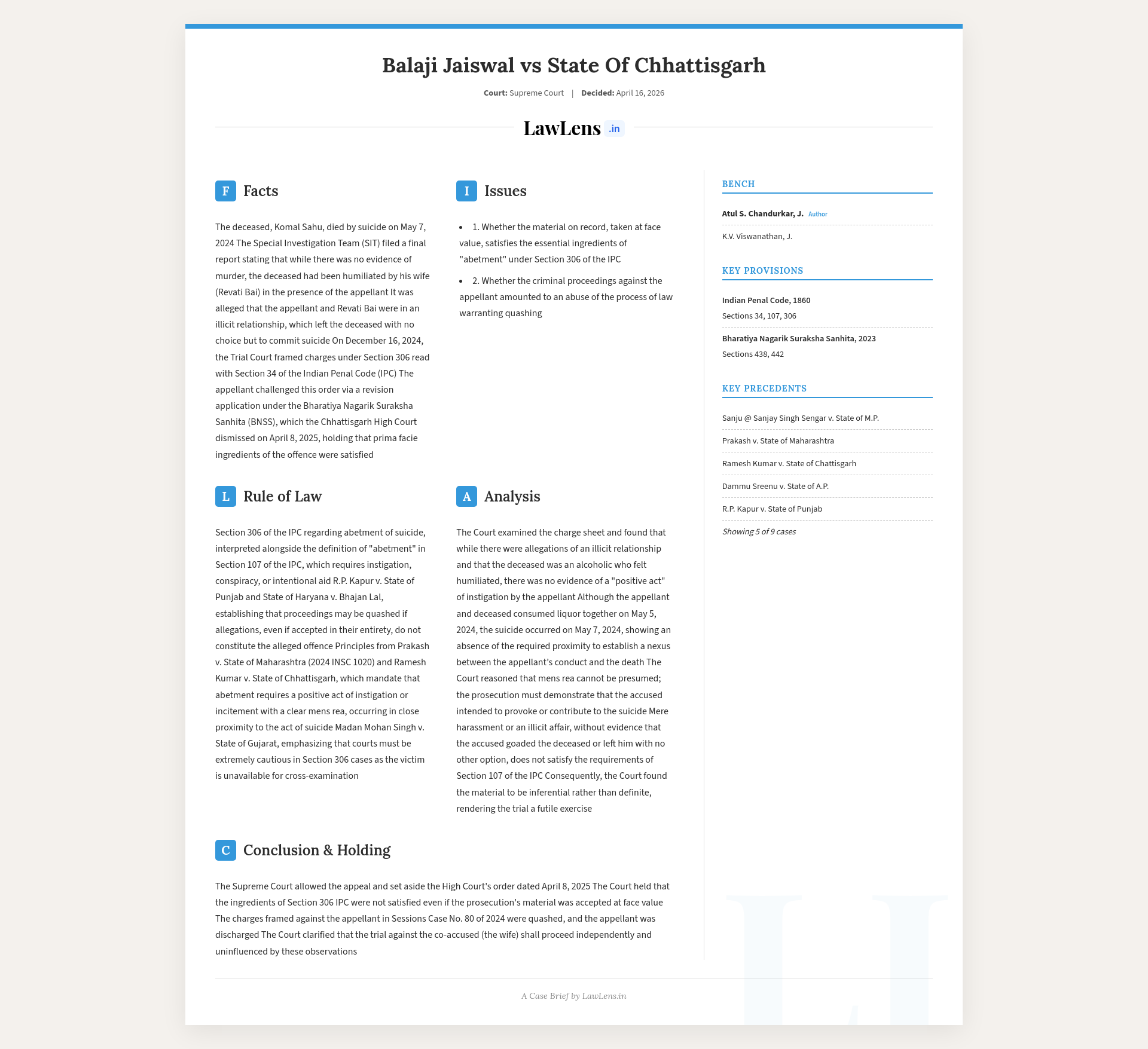
Balaji Jaiswal v. State of Chhattisgarh 2026 INSC 375 - S.306 IPC - Suicide Abetment
Instigation or incitement on the part of the accused person is the gravamen of the offence of abetment to suicide.

Indian Penal Code 1860 - Section 306,107 -For sustaining a charge under Section 306 of the Penal Code, it has to be shown that the accused persons had contributed to the suicide by the deceased through some direct or indirect act. There ought to be some instigation or incitement that would reveal a clear mens rea to abet the commission of suicide, thus, leading the victim to such a position that he/she would have no other option but to commit suicide. There ought to be some material to indicate a positive act of instigation, which is a crucial component of abetment. Instigation or incitement on the part of the accused person has been held to be the gravamen of the offence of abetment to suicide. The act of instigation also has to be in close proximity to the act of suicide so as to form the nexus or a chain to indicate that the act of suicide was the direct result of the act of instigation by the accused person. [Context: The Supreme Court held that even taking the prosecution material at face value, there was no act of instigation or abetment by appellant Balaji Jaiswal sufficient to attract Section 306 IPC for abetment of suicide. Allegations of an illicit relationship with the deceased’s wife and the deceased’s alcoholism only showed general background and suspicion, with no proximate, positive act or clear mens rea by the appellant that left the deceased with no option but to commit suicide]
Case Info
Case Information Extracted
Case name and neutral citation:Balaji Jaiswal v. State of Chhattisgarh and Another, 2026 INSC 375
Coram:Justice K.V. Viswanathan and Justice Atul S. Chandurkar
Judgment date:16 April 2026 (Supreme Court of India, Criminal Appellate Jurisdiction)
Case laws and citations referred
- R.P. Kapur v. State of Punjab, (1960) 3 SCR 388
- State of Haryana v. Ch. Bhajan Lal, 1990 INSC 363
- Ramesh Kumar v. State of Chhattisgarh, 2001 INSC 515 : (2001) 9 SCC 618
- Sanju @ Sanjay Singh Sengar v. State of M.P., 2002 INSC 250
- Madan Mohan Singh v. State of Gujarat and another, 2010 INSC 521
- Dammu Sreenu v. State of A.P., 2009 INSC 846
- Prakash and others v. State of Maharashtra and another, 2024 INSC 1020
- Jayedeepsinh Pravinsinh Chavda and Others v. State of Gujarat, 2024 INSC 960 : [2024] 12 SCR 439 : 2024 SCC OnLine 3679
- S.S. Chheena v. Vijay Kumar and another (referred through quotation in Jayedeepsinh Pravinsinh Chavda)
Statutes / laws referred
- Indian Penal Code, 1860
- Section 306 (Abetment of suicide)
- Section 34 (Common intention)
- Section 107 (Abetment – definition; applied via discussion of ingredients)
- Bhartiya Nyaya Suraksha Sanhita, 2023 (BNSS)
- Section 438
- Section 442
Three‑sentence brief summary
The Supreme Court held that even taking the prosecution material at face value, there was no act of instigation or abetment by appellant Balaji Jaiswal sufficient to attract Section 306 IPC for abetment of suicide. Allegations of an illicit relationship with the deceased’s wife and the deceased’s alcoholism only showed general background and suspicion, with no proximate, positive act or clear mens rea by the appellant that left the deceased with no option but to commit suicide. Applying the principles in R.P. Kapur, Bhajan Lal, Ramesh Kumar, Prakash and others, and related precedents, the Court set aside the High Court’s order, quashed the charge under Section 306/34 IPC against the appellant, and discharged him, while directing that the trial against co‑accused (the wife) proceed independently.