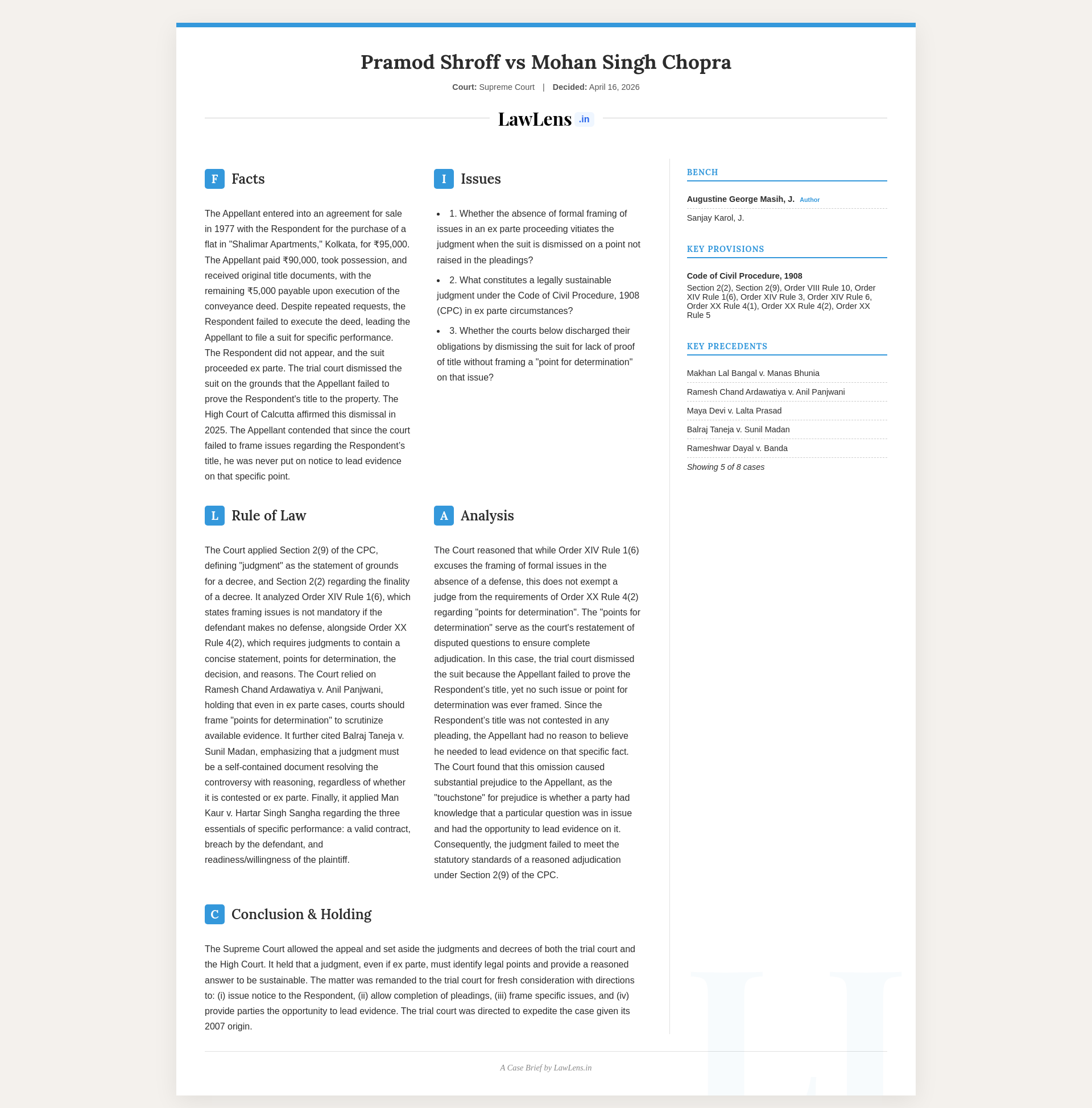
Pramod Shroff v. Mohan Singh Chopra, 2026 INSC 378 - CPC - Points For Determination - Ex Parte Suits
Even when a defendant fails to appear or file a written statement, the court cannot dispense with the points for determination altogether.

Code of Civil Procedure 1908 - Order XX Rule 4 - Even when a defendant fails to appear or file a written statement, the court cannot dispense with the points for determination altogether. Though the framing of issues in an ex parte suit is not mandatory by virtue of Order XIV Rule 6 of CPC, but the judgment must be in conformity with the provisions of the Code. Thus, Order XX Rule 4 of CPC comes into picture. The courts must determine “points for determination”, which are like issues, and answer them to resolve the matter of controversy between the parties. (Para 26-27)
Code of Civil Procedure 1908 - Order XX Rule 4 -The points for determination in a judgment are essentially the legal and factual issues the court must resolve. They correspond to the issues framed during trial (Order XIV), but in the judgment they are stated as the point(s) to be decided. (Para 21) In practice, the trial court first frames issues (points of controversy) after examination of pleadings, the judgment then recites these as “points for determination” and answers them. These points focus the judgment on the exact matters in controversy between the parties. By explicitly listing points, the judgment guides the parties and the Appellate court to see what questions were in contest. The court must give its finding on each point. A judgment that omits discussion of issues in dispute is defective. (Para 21-22)
Case Info
Case Information Extracted
Case name and neutral citation:Pramod Shroff v. Mohan Singh Chopra, 2026 INSC 378
Coram (Bench):Justice Sanjay Karol and Justice Augustine George Masih
Judgment date:April 16, 2026 (New Delhi)
Case laws and citations referred:
- Makhan Lal Bangal v. Manas Bhunia and Others, (2001) 2 SCC 652
- Ramesh Chand Ardawatiya v. Anil Panjwani, (2003) 7 SCC 350
- Maya Devi v. Lalta Prasad, (2015) 5 SCC 588
- Balraj Taneja and Another v. Sunil Madan and Another, (1999) 8 SCC 396
- Rameshwar Dayal v. Banda (dead) through his LRs and Another, (1993) 1 SCC 531
- Nagubai Ammal and Others v. B. Shama Rao and Others, (1956) 1 SCC 698
- Man Kaur (dead) by LRs v. Hartar Singh Sangha, (2010) 10 SCC 512
Statutes / provisions referred:
- Code of Civil Procedure, 1908 (CPC):
- Section 2(9) – definition of “judgment”
- Section 2(2) – definition of “decree”
- Order XIV Rule 1(6) (referred as Rule 6 in text) – framing of issues where defendant makes no defence
- Order XX Rule 4(2) – contents of judgments of courts other than Small Causes Courts
- Order XX Rule 5 – court to state finding with reasons on each issue
- Order VIII Rule 10 – decree on default of written statement
Three‑sentence brief summary
The Supreme Court held that even in an ex parte suit, while formal framing of issues is not mandatory where the defendant offers no defence, the court must still identify and answer clear “points for determination” and render a reasoned judgment in conformity with the CPC. In this specific performance suit, the trial court dismissed the claim for alleged lack of title in the defendant without having framed any issue or point on title and without giving the plaintiff an opportunity to lead evidence on that aspect, thereby causing prejudice. Consequently, the Supreme Court set aside the judgments and decrees of the trial court and the High Court and remanded the matter to the trial court for fresh trial with proper framing of issues and opportunity to both parties.