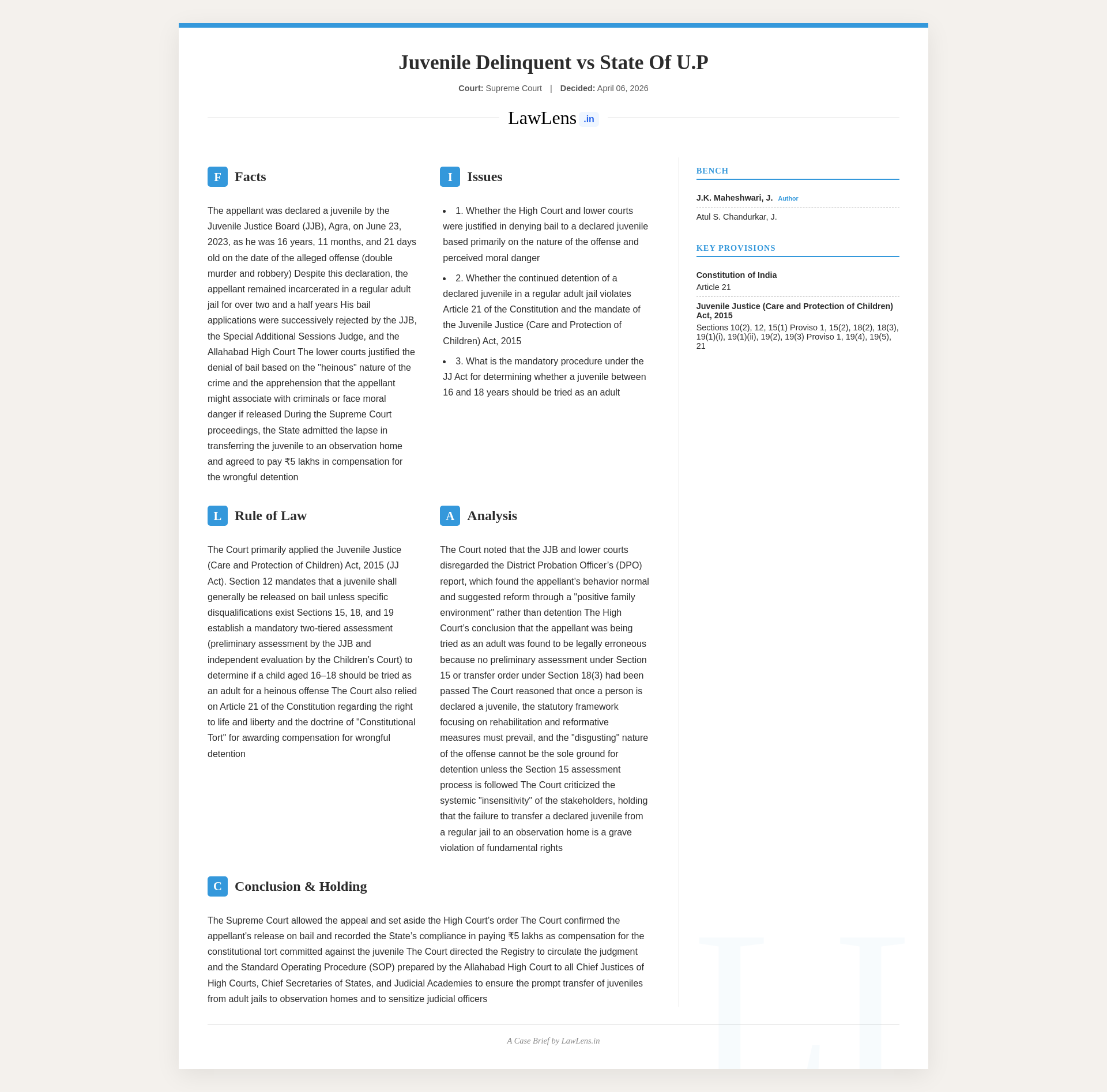
Juvenile Delinquent v. State of U.P. 2026 INSC 387 - JJ Act
Only in a situation where the CCL’s conduct is such that it would not be in his interest or that of other children, could the JJB consider sending him to other place of safety.

Juvenile Justice (Care and Protection of Children) Act, 2015 - The statutory mandate of the JJ Act is not merely procedural but also advances the guarantee under Article 21 of the Constitution of India, as expressed in its clause of object and reasons. Therefore, prompt and humane treatment of CCL is required to be undertaken in light of the objectives of the act. As such, any lapse in ensuring immediate transfer of a declared juvenile to an observation home from regular jail not only defeats the object of the legislation but also results in a serious infraction of the Juvenile’s right to life. In absence thereof, the ordinary statutory framework applicable to juveniles must prevail. (Para 22)
Juvenile Justice (Care and Protection of Children) Act, 2015 - Only in a situation where the CCL’s conduct is such that it would not be in his interest or that of other children, could the JJB consider sending him to other place of safety. The discretion vested under Section 18(2) is to be exercised in furtherance of reformative and rehabilitative objectives. Further, where, upon preliminary assessment under Section 15, it is found that the child ought to be tried as an adult, the matter is to be transferred to the Children’s Court in accordance with Section 18(3). In a case where the JJB has declined to declare the child as a juvenile and the matter thereafter comes before the Children’s Court under Section 18 read with Section 19 of the JJ Act, the said Court is first required to determine on its own whether the child should be tried as an adult. Such determination must be made while keeping in mind the mandate of Section 21 i.e., what orders may not be passed if the juvenile is declared CCL. It should be done while acknowledging the child’s special needs, the principles of fair trial, and the requirement of maintaining a child-friendly atmosphere. In case the Court finds that trial of the juvenile as an adult is not required, it is open to the Children’s Court to conduct an inquiry as a Board and pass appropriate orders in terms of Section 18. The scheme of the JJ Act, thus, envisages a comprehensive and robust procedure to ensure that the rights of the child are not thwarted at any stage. (Para 19-20)
Case Info
Basic Case Information
Case name: Juvenile Delinquent v. State of U.P. and Ors.Neutral citation: 2026 INSC 387Court & jurisdiction: Supreme Court of India, Criminal Appellate JurisdictionCoram: J.K. Maheshwari, J. and Atul S. Chandurkar, J.Judgment date: 06 April 2026Appeal: Criminal Appeal (arising out of SLP (Crl.) No. 16883 of 2025)
Statutes / Laws Referred
The judgment expressly discusses and applies the Juvenile Justice (Care and Protection of Children) Act, 2015, in particular:
- Section 10(2) – referred to in the Registrar General’s report (power regarding transfer from jail to observation home).
- Section 12 – bail of a juvenile and parameters of moral, physical, psychological danger.
- Section 15 – preliminary assessment in case of heinous offences by children above 16 years.
- Section 18 – orders regarding a child found to be in conflict with law, including transfer to Children’s Court under sub‑section (3).
- Section 19 – powers of Children’s Court, trial as adult and mandatory placement in a place of safety till 21 years.
- Section 21 – limitation on kinds of orders that may be passed against a child in conflict with law.
The Court also anchors its reasoning in Article 21 of the Constitution of India, treating the wrongful incarceration of a declared juvenile in an adult jail as a violation of the fundamental right to life and personal liberty and a “constitutional tort.”
Caselaws and Citations
The extracted pages of the judgment do not show any citation to other case law; the Court’s reasoning is primarily statutory (JJ Act) and constitutional (Article 21), plus factual criticism of the authorities’ conduct. There are no reported precedents mentioned by name in the provided text.
Brief 3‑Sentence Summary
The Supreme Court dealt with a juvenile who, despite being formally declared a child in conflict with law, was kept in an adult jail for over two and a half years and was repeatedly denied bail by the Juvenile Justice Board, the appellate court and the High Court. The Court held that, in the absence of any preliminary assessment and transfer order under Sections 15, 18(3) and 19 of the JJ Act, the boy could not be treated or tried as an adult, found that the authorities’ and courts’ approach showed a serious lack of sensitivity to the juvenile justice framework, and set aside the High Court’s order refusing bail. Treating the episode as a breach of Article 21, it recorded payment of Rs. 5 lakhs as compensation to the juvenile, approved a new Standard Operating Procedure for prompt transfer of declared juveniles from jail to observation homes, and directed circulation of the judgment and SOP to all High Courts, State Governments and Judicial Academies for systemic reform.