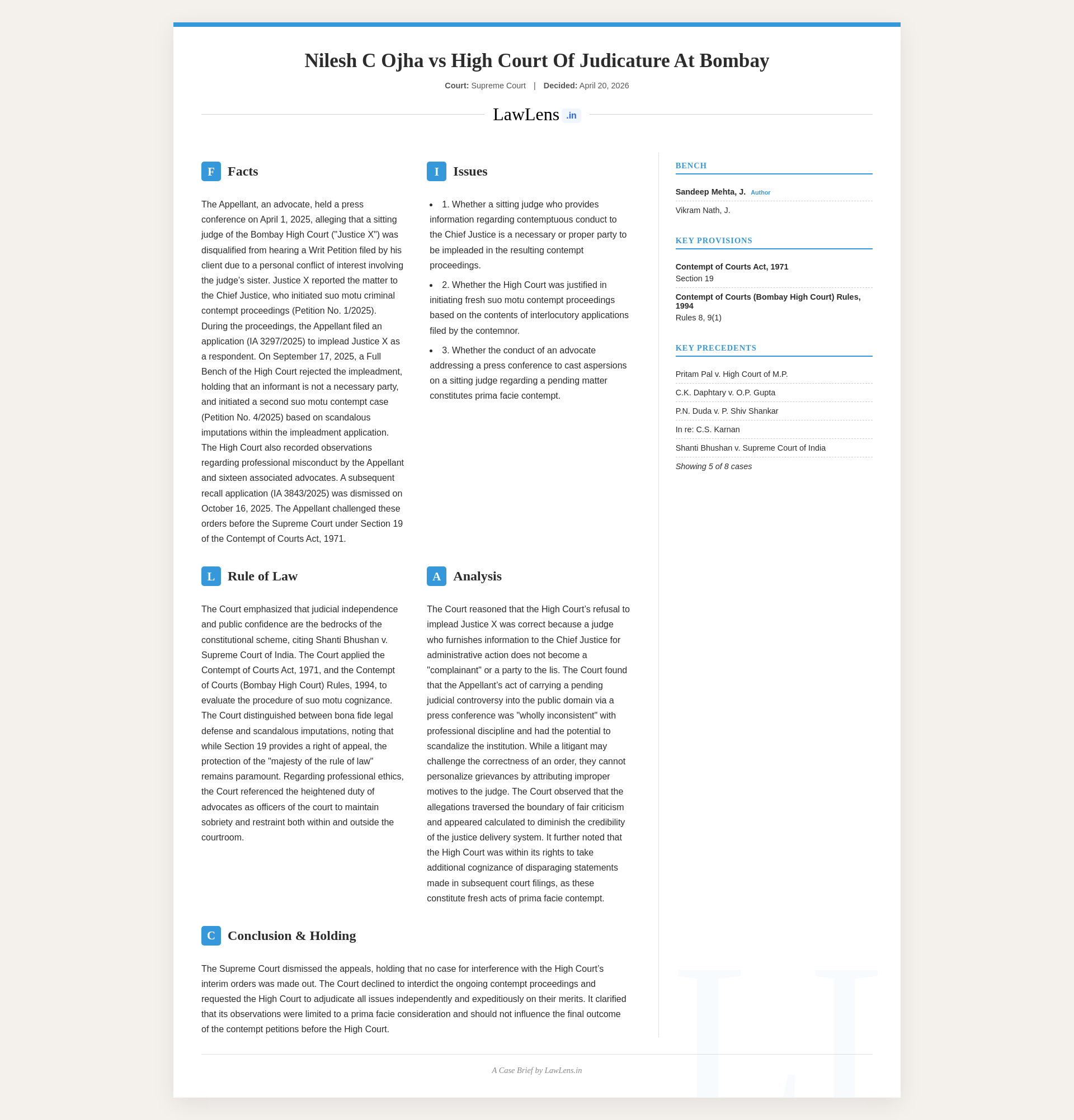
Nilesh C. Ojha v. High Court of Judicature at Bombay 2026 INSC 390 - Contempt - Unfounded Allegations Against Judges
Any unfounded or intemperate allegations impugning the integrity, motives, or impartiality of the judiciary, whether directed against the institution or an individual Judge, assume serious significance.

Contempt of Court -Any unfounded or intemperate allegations impugning the integrity, motives, or impartiality of the judiciary, whether directed against the institution or an individual Judge, assume serious significance. Such imputations, when made without substantiated basis and in a manner calculated to erode public faith, have the potential to diminish the credibility of the justice delivery system. While fair, reasoned, and bona fide criticism of judicial decisions remains a legitimate facet of democratic discourse, reckless aspersions strike at the very foundation of judicial independence by undermining the trust upon which the authority of the judiciary ultimately rests - A litigant aggrieved by a judicial order is undoubtedly entitled to question its correctness before a higher forum. However, the legitimacy of such challenge rests upon civilised and temperate criticism of the judicial determination and not upon insinuations directed at the integrity or neutrality of the Judge. A clear distinction must be maintained between assailing the correctness of a judicial decision and personalising the grievance by attributing motives to the Judge concerned. (Para 28-29) The act of carrying a pending judicial controversy into the public domain in a manner that tends to sensationalise the proceedings or scandalise the institution or its constitutional component, i.e., the Judges, is wholly inconsistent with the discipline expected of an advocate. Professional ethics require that grievances against judicial orders must be ventilated through established legal remedies before appropriate judicial forums, rather than through public commentary capable of influencing perception about the fairness or integrity of the judicial process. (Para 32) While accountability and scrutiny are integral to a constitutional democracy, imputations of personal nature against a Judge must rest on unimpeachable material and be pursued strictly in accordance with law, failing which, they risk undermining the very edifice of judicial independence. (Para 34)
Advocates - Members of the Bar occupy a position of privilege and responsibility in the administration of justice, and their conduct, both within and outside the courtroom, must reflect restraint, sobriety and fidelity to the ethical standards governing the profession. (Para 31) An advocate, more than any other stakeholder in the justice delivery system, bears a heightened duty to uphold the dignity of the institution and to act with circumspection in matters touching upon the administration of justice. Public confidence in the judiciary constitutes an indispensable foundation of the rule of law, and any attempt to scandalise or sensationalise judicial proceedings undermines that very foundation. (Para 32)
Case Info
Extracted Information
Case name and neutral citation:Nilesh C. Ojha v. High Court of Judicature at Bombay through Secretary & Ors., 2026 INSC 390
Coram:Justice Vikram Nath and Justice Sandeep Mehta
Judgment date:20 April 2026 (NEW DELHI)
Statutes / laws referred:
- Contempt of Courts Act, 1971 (including Section 19)
- Contempt of Courts (Bombay High Court) Rules, 1994 (Rules 8 and 9(1))
- Advocates Act, 1961
- Bar Council of India Rules
- Constitutional principles on judicial independence and public confidence in the judiciary (Articles not specified, but the discussion is clearly constitutional in nature)
Case laws and citations referred:
- Pritam Pal v. High Court of M.P., 1993 Supp (1) SCC 529
- C.K. Daphtary v. O.P. Gupta, (1971) 1 SCC 626
- P.N. Duda v. P. Shiv Shankar, (1988) 3 SCC 167
- In re: C.S. Karnan, (2017) 7 SCC 1
- Shanti Bhushan v. Supreme Court of India, (2018) 8 SCC 396
- State of Rajasthan v. Prakash Chand, (1998) 1 SCC 1
- S.P. Gupta v. Union of India, 1981 Supp SCC 87
- Supreme Court Advocates-on-Record Assn. v. Union of India, (1993) 4 SCC 441
Three‑sentence brief summary
The Supreme Court dismissed appeals filed by advocate Nilesh C. Ojha challenging Bombay High Court orders in suo motu criminal contempt proceedings arising from his press‑conference allegations questioning the impartiality of a sitting High Court judge (“Justice X”) and his applications to implead her and to recall the High Court’s orders. The Court held that the High Court’s refusal to implead the judge, its direction to register a fresh suo motu contempt case based on scandalous pleadings, and its prima facie observations about the advocates’ conduct did not warrant interference at this interlocutory stage, stressing that advocates have a heightened duty to uphold judicial dignity and that unfounded personal imputations against judges can erode public confidence in the judiciary. It left all issues on merits, including the alleged overruling or eclipse of earlier contempt precedents and the question of professional misconduct, to be examined independently by the High Court, clarifying that its own observations are only prima facie and should not influence the final adjudication.