Himakshi v. Rahul Verma 2026 INSC 391 - Public Employment - Recruitment - Qualifications
In matters of public employment, the Court must be circumspect in issuing positive directions for appointment unless the entitlement is clear, unambiguous, and flows directly from the applicable rules.

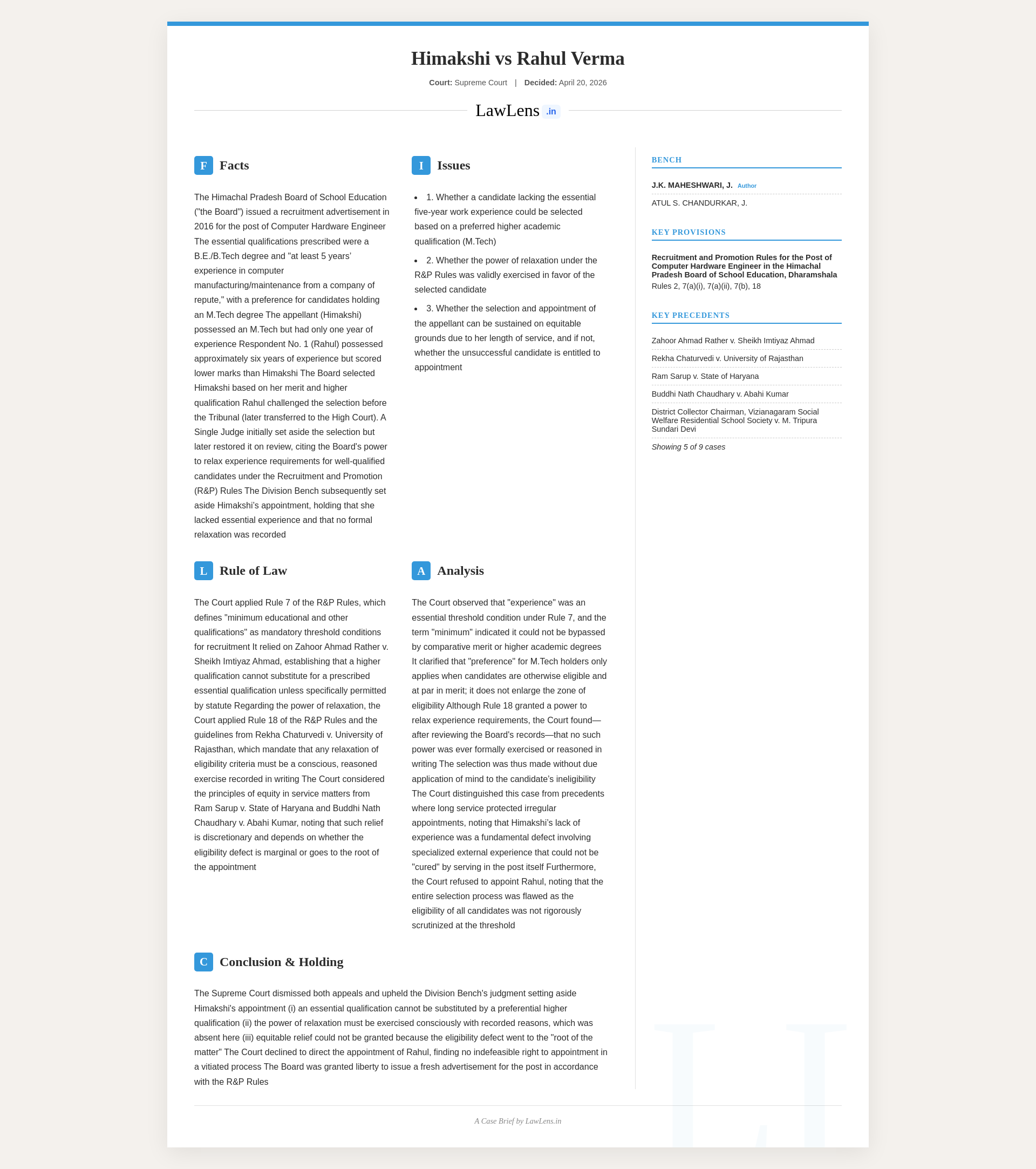
Public Employment - Recruitment - The impermissibility of substituting prescribed qualifications with higher degrees, in the absence of an express enabling provision -The terms of the recruitment rules and the advertisement form the basis of the selection process and are binding on both, the candidates as well as the recruiting agencies. Any departure therefrom, unless expressly permitted and properly exercised, would be arbitrary and violative of the principles of selection. (Para 21-27) In matters of public employment, the Court must be circumspect in issuing positive directions for appointment unless the entitlement is clear, unambiguous, and flows directly from the applicable rules. Where the selection process itself is found to be flawed, the appropriate course would ordinarily be to set aside the selection rather than to direct appointment of a particular candidate. (Para 54) [Context: The Supreme Court held that the post of Computer Hardware Engineer required an essential minimum of five years’ experience in a computer manufacturing/maintenance company of repute and that this threshold could not be bypassed merely because a candidate held an M.Tech degree, which was only a preferential qualification. Since Himakshi did not possess the required experience and there was no conscious, reasoned exercise of the Board’s power to relax eligibility, her selection was declared illegal, and the Court also declined to grant appointment to Rahul or any other candidate because the entire selection process was vitiated by non‑scrutiny of the essential experience requirement. ]
Practice and Procedure - The grant of relief on equitable considerations is not a matter of right. The exercise of such jurisdiction is discretionary and is invoked only in exceptional circumstances when the facts so warrant. (Para 47)
Case Info
Case details
Case name and neutral citation:Himakshi v. Rahul Verma & Ors.; Rahul Verma v. Himachal Pradesh Board of School Education & Ors., 2026 INSC 391
Coram:Justice J.K. Maheshwari and Justice Atul S. Chandurkar
Judgment date:20 April 2026 (as shown on the judgment PDF header/footer)
Case laws cited
From the text provided, the Supreme Court expressly refers to and relies on:
- Zahoor Ahmad Rather and Ors. v. Sheikh Imtiyaz Ahmad and Ors., (2019) 2 SCC 404 – on higher qualification not substituting prescribed essential qualification.
- Rekha Chaturvedi (Smt.) v. University of Rajasthan and Ors., 1993 Supp (3) SCC 168 – on how relaxation powers must be exercised and recorded in recruitment.
- Ram Sarup v. State of Haryana and Ors., (1979) 1 SCC 168 – on irregular appointment becoming regular once experience is later acquired.
- Buddhi Nath Chaudhary and Ors. v. Abahi Kumar and Ors., (2001) 3 SCC 328 – on not disturbing appointments after long service where experience deficiency was later cured.
- Bholanath Mukherjee and Ors. v. Ramakrishna Mission Vivekananda Centenary College and Ors., (2011) 5 SCC 464 – cited for moulding relief and protecting long‑standing appointments.
- Rajesh Kumar and Ors. v. State of Bihar and Ors., (2013) 4 SCC 690 – also on equitable relief in recruitment matters.
- Vikas Pratap Singh and Ors. v. State of Chhattisgarh and Ors., (2013) 14 SCC 494 – similar use of equity in service selections.
Statutes / rules / legal instruments referred
The judgment primarily interprets the recruitment rules rather than a central statute:
- Recruitment and Promotion Rules for the Post of Computer Hardware Engineer in the Himachal Pradesh Board of School Education, Dharamshala (“R&P Rules”), particularly:
- Rule 7 – Minimum educational and other qualifications (B.E./B.Tech plus at least 5 years’ experience; preference for M.Tech; desirable local knowledge).
- Clause 2 preceding Rule 7 – allowing relaxation of age and experience where the candidate is “otherwise well qualified”.
- Rule 18 – Power to relax, permitting the Board to relax any provision of the Rules, with reasons recorded in writing.
- Indirect reference to general principles governing public employment and judicial review of recruitment processes (no specific constitutional Article is singled out in the extracted text, but Articles 14/16 principles underlie the reasoning).
Three‑sentence brief summary
The Supreme Court held that the post of Computer Hardware Engineer required an essential minimum of five years’ experience in a computer manufacturing/maintenance company of repute and that this threshold could not be bypassed merely because a candidate held an M.Tech degree, which was only a preferential qualification. Since Himakshi did not possess the required experience and there was no conscious, reasoned exercise of the Board’s power to relax eligibility, her selection was declared illegal, and the Court also declined to grant appointment to Rahul or any other candidate because the entire selection process was vitiated by non‑scrutiny of the essential experience requirement. Upholding the Himachal Pradesh High Court’s Division Bench judgment, the Court dismissed both appeals, left the Board free to conduct a fresh recruitment strictly in accordance with the R&P Rules, and refused to regularise the appointment on equitable grounds.