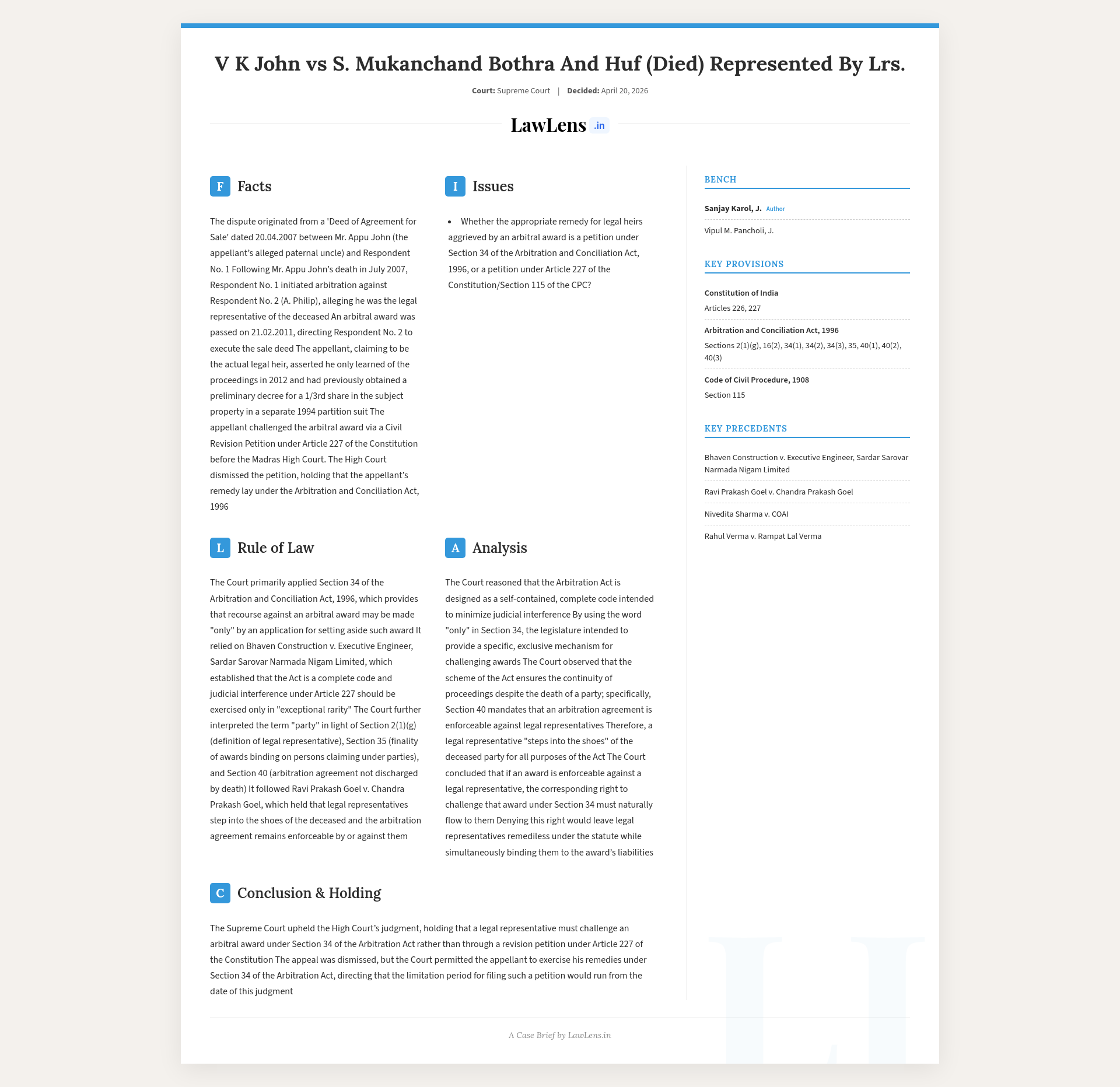
V.K. John v. S. Mukanchand Bothra and HUF (D) 2026 INSC 393. S.34 Arbitration Act - LRs Of Deceased Party
Denying a legal representative the right to challenge an award under Section 34, would defeat the very object of the Arbitration Act

Arbitration and Conciliation Act 1996 - Section 34 - When an award has been made enforceable against the legal representatives of a deceased party under the Act, the right to challenge such an award, which is available under the Act to the parties, also has to naturally flow to the said legal representatives - Denying a legal representative the right to challenge an award under Section 34, would defeat the very object of the Arbitration Act, and its purpose as a self-contained complete Code of dispute resolution - Legal representatives of a deceased party cannot be made remediless under the statute on one hand, and on the other hand being made liable to fulfill the award. (Para 19-20)
Arbitration and Conciliation Act 1996 - The scheme of the Arbitration Act, does not envision arbitration proceedings to cease with the death of a party. Section 35 of the Arbitration Act, extends the finality of an arbitral award not only to parties to the award, but also to ‘parties claiming under them’. (Para 17)
Case Info
Extracted information
Case name and neutral citation:V.K. John v. S. Mukanchand Bothra and HUF (Died) represented by LRs. & Ors., neutral citation 2026 INSC 393.
Coram:Justice Sanjay Karol and Justice Vipul M. Pancholi.
Judgment date:20 April 2026 (as indicated at the end of the judgment: “New Delhi, April 20, 2026”).
Caselaws and citations referred:
- Bhaven Construction v. Executive Engineer, Sardar Sarovar Narmada Nigam Limited and Anr., (2022) 1 SCC 75.
- Ravi Prakash Goel v. Chandra Prakash Goel, (2008) 13 SCC 667.
- Nivedita Sharma v. COAI, (2011) 14 SCC 337 : (2012) 4 SCC (Civ) 947.
- Rahul Verma and Ors. v. Rampat Lal Verma and Ors., 2025 SCC OnLine SC 578.
Statutes / laws referred:
- Arbitration and Conciliation Act, 1996, particularly:
- Section 2(1)(g) (definition of “legal representative”)
- Section 34 (application for setting aside arbitral award)
- Section 35 (finality of arbitral awards; binding on parties and persons claiming under them)
- Section 40 (arbitration agreement not discharged by death of party).
- Constitution of India:
- Article 227 (supervisory jurisdiction of High Courts).
- Code of Civil Procedure, 1908 (CPC):
- Section 115 (revisional jurisdiction of High Court).
Three‑sentence brief summary
The Supreme Court considered whether a legal heir, aggrieved by an arbitral award passed without being made a party, must challenge the award under Section 34 of the Arbitration and Conciliation Act, 1996, or can instead invoke the High Court’s revisional/supervisory jurisdiction under Article 227 of the Constitution or Section 115 CPC. Interpreting the scheme of the Arbitration Act—especially Sections 34, 35 and 40—and relying on precedents such as Bhaven Construction, Ravi Prakash Goel and Rahul Verma, the Court held that legal representatives “step into the shoes” of the deceased party, are bound by the award, and therefore must avail the statutory remedy under Section 34, with writ/revisional interference reserved for exceptional cases. Upholding the Madras High Court’s view and dismissing the appeal, the Court clarified that the appellant may still file a Section 34 petition, with limitation running from the date of this judgment.