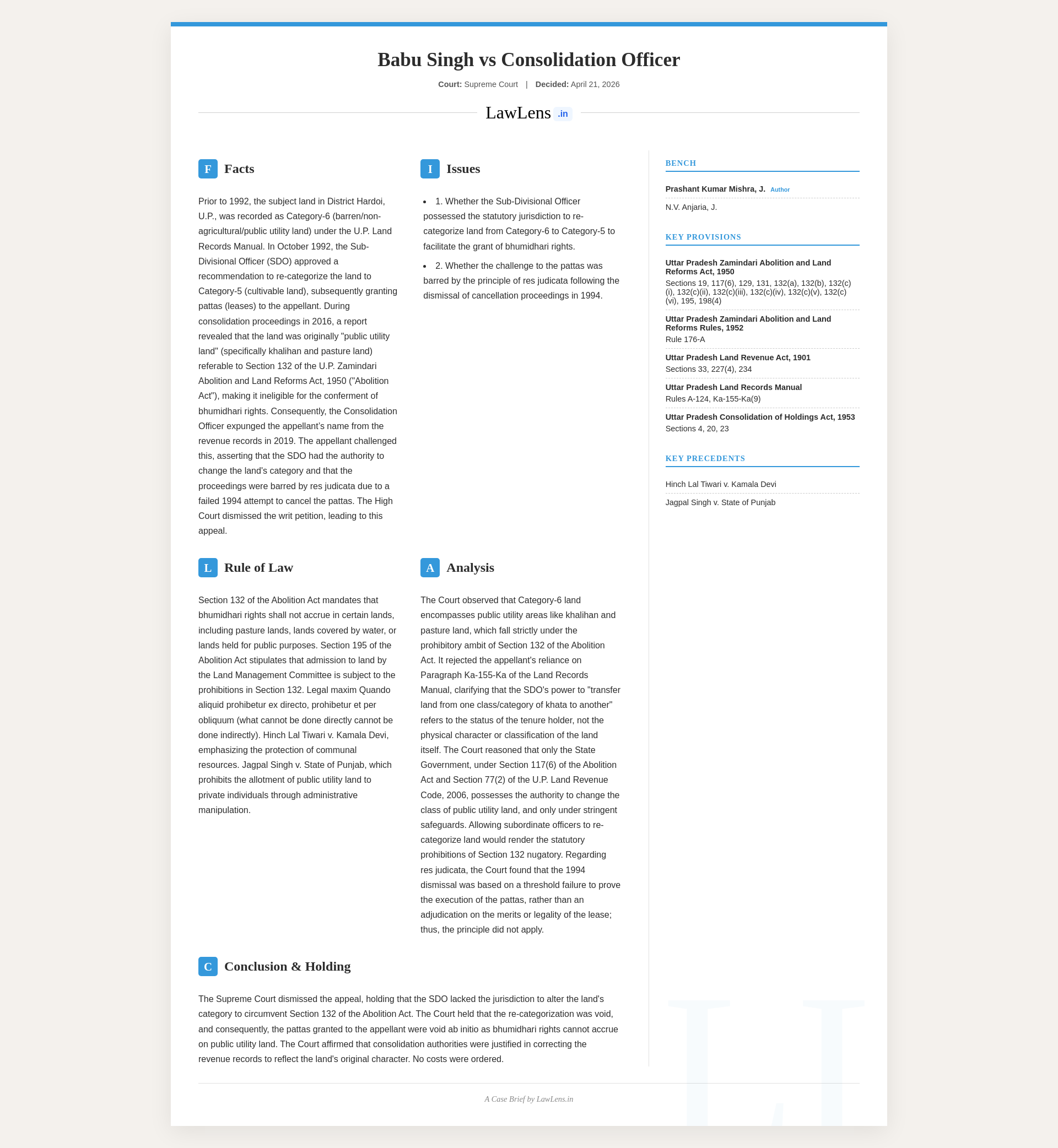
Babu Singh v. Consolidation Officer 2026 INSC 395 - Public Utility Lands
Lands meant for public utility and community purposes must be zealously protected and cannot be diverted for public use.

Legal Maxim -Quando aliquid prohibetur ex directo, prohibetur et per obliquum - What cannot be done directly cannot be done indirectly - An interpretation that would render the statutory prohibition nugatory and enable indirectly what the statute forbids directly must be rejected. (Para 29)
Public Lands - Lands meant for public utility and community purposes must be zealously protected and cannot be diverted for public use. Such resources constitute material assets of the community and are essentially for maintaining ecological balance and public welfare. Public utility land cannot be legitimately converted for private benefits through administrative manipulation, and that consolidation proceedings themselves cannot be employed as a vehicle to circumvent statutory protections afforded to communal resources. (Para 31-32)
Case Info
Basic Case Details
Case name: Babu Singh v. Consolidation Officer and Others
Neutral citation: 2026 INSC 395
Coram:Justice Prashant Kumar MishraJustice N.V. Anjaria
Judgment date: 21 April 2026 (New Delhi)
Statutes / Laws Referred
- Uttar Pradesh Zamindari Abolition and Land Reforms Act, 1950
- Section 129 (classes of tenure holders)
- Section 132 (land in which bhumidhari rights shall not accrue)
- Section 195 (admission as bhumidhar with non‑transferable rights)
- Section 117 and 117(6) (vesting/resumption of land in/ from Gaon Sabha)
- Section 198(4) (cancellation of pattas)
- Uttar Pradesh Zamindari Abolition and Land Reforms Rules, 1952
- Rule 176‑A (five‑year term of Asami patta)
- U.P. Land Revenue Act, 1901
- Section 227(4) (power to alter annual register)
- Section 234 (rule‑making power, under which the Manual is framed)
- U.P. Land Revenue Code, 2006
- Section 77(2) (State Government’s power to change class of public utility land)
- U.P. Consolidation of Holdings Act, 1953 / 2004 reference in text
- Section 4 (notification for consolidation)
- Section 20 (carving out chaks)
- Section 23 (consolidation proceedings; entries and possession)
- U.P. Land Records Manual
- Paragraph A‑124 (categories of land; Category‑5 and Category‑6)
- Paragraph Ka‑155‑Ka / K‑15‑K (competent officers for entries affecting khatedar’s rights)
Case Law and Citations
- Hinch Lal Tiwari v. Kamala Devi and Others, (2001) 6 SCC 496, para 13– Cited to emphasise protection of lands meant for public utility/community purposes and ecological/public welfare functions of such lands.
- Jagpal Singh and Others v. State of Punjab and Others, (2011) 11 SCC 396, paras 18–21– Cited for the principle that village common / public utility lands (like khalihan and pasture land) cannot be allotted to private individuals or diverted through administrative manipulation or consolidation proceedings.
Brief Three‑Sentence Summary
The Supreme Court held that the Sub‑Divisional Officer had no jurisdiction to change the categorisation of Gaon Sabha land recorded as Category‑6 khalihan and pasture (public utility land) to Category‑5 cultivable land, because such land falls under Section 132 of the U.P. Zamindari Abolition and Land Reforms Act where bhumidhari rights cannot accrue. Consequently, the pattas granted to the appellant based on this invalid re‑categorisation were declared void ab initio, and even treating them as Asami pattas, their five‑year term had long expired. The Court also ruled that earlier proceedings under Section 198(4) did not decide the validity of the pattas on merits, so res judicata did not apply, and it dismissed the appeal, upholding protection of public utility land in line with Hinch Lal Tiwari and Jagpal Singh.