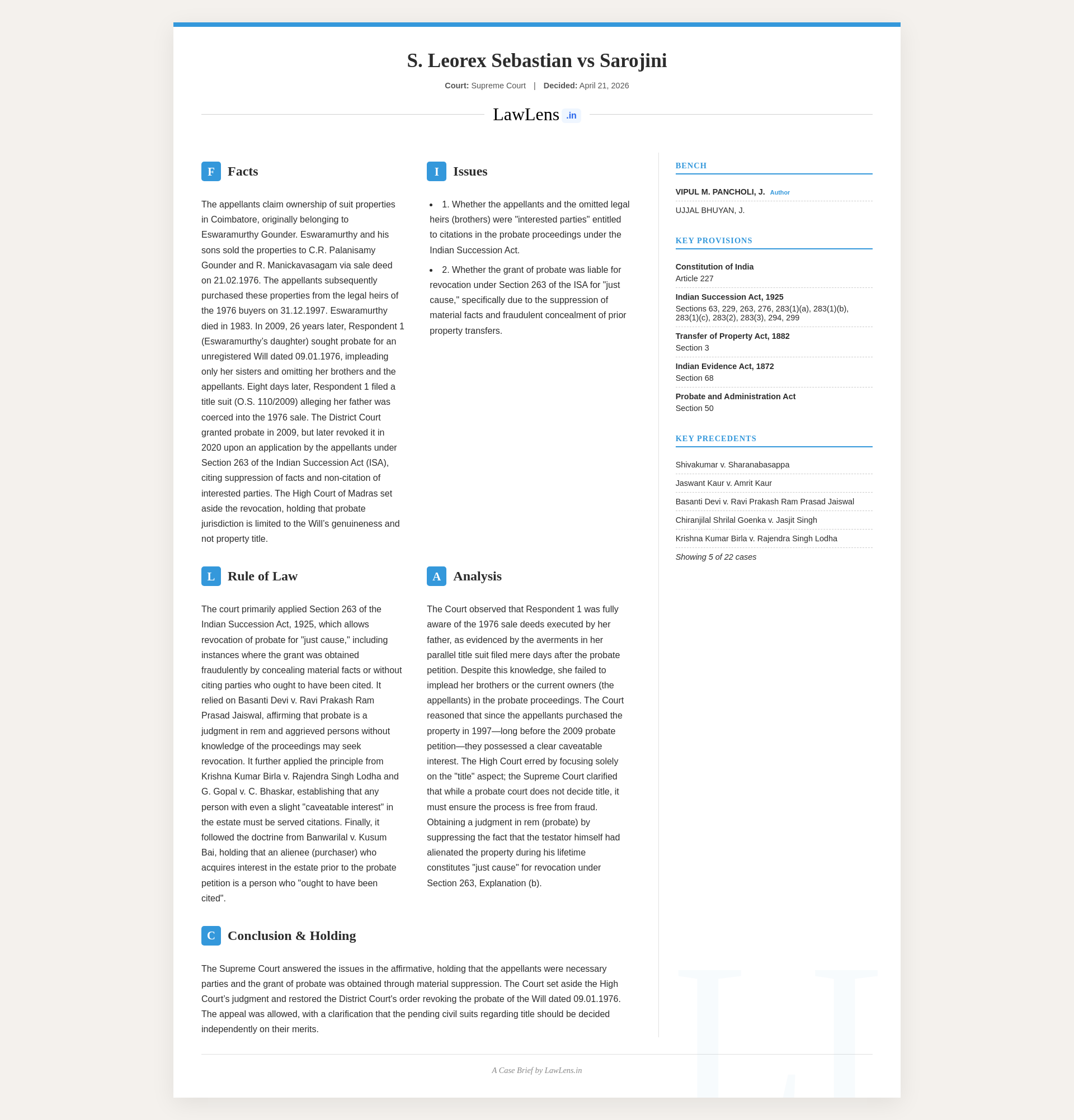
S. Leorex Sebastian & Anr. v. Sarojini 2026 INSC 400 - Probate - Indian Succession Act
An alienee who has acquired an interest in the estate of the deceased, prior to the filing of the probate proceedings, is an interested party.

Indian Succession Act, 1925 - Sections 263,283 - The grant of probate is a judgment in rem and conclusive and binds not only the parties but also the entire world and therefore, a person who is aggrieved thereby and had no knowledge about the proceedings and proper citations having not been made, is entitled to file an application for revocation of probate on such grounds as may be available to him. If a party has a caveatable interest in the estate of the deceased, it is entitled to be served before the final order is passed. Further, if a person who has even a slight interest in the estate of the testator, he is entitled to file a caveat and contest the grant of the probate of the will of the testator. An alienee who has acquired an interest in the estate of the deceased, prior to the filing of the probate proceedings, is an interested party. (Para 11-20)
Case Info
Here’s the structured information extracted from the judgment text:
Case Details
Case name: S. Leorex Sebastian & Anr. v. Sarojini & Ors.Neutral citation: 2026 INSC 400Coram: Hon’ble Mr. Justice Ujjal Bhuyan and Hon’ble Mr. Justice Vipul M. PancholiJudgment date: 21 April 2026 (New Delhi)
Case laws and citations referred
- Shivakumar & Ors v. Sharanabasappa & Ors, 2021 (11) SCC 277
- Jaswant Kaur v. Amrit Kaur, (1977) 1 SCC 369
- Basanti Devi v. Ravi Prakash Ram Prasad Jaiswal, (2008) 1 SCC 26
- Chiranjilal Shrilal Goenka v. Jasjit Singh, citation referred within Basanti Devi extract
- Krishna Kumar Birla v. Rajendra Singh Lodha, (2008) 4 SCC 300
- G. Gopal v. C. Bhaskar & Ors, (2008) 10 SCC 489
- Banwarilal v. Kusum Bai & Ors, 1972 SCC OnLine MP 55
- Seth Beni Chand v. Kamla Kunwar & Ors, (1976) 4 SCC 554
- Sunil Gupta v. Kiran Girhotra, (2007) 8 SCC 506
- Swaminathan & Ors v. Alankamony (Dead) through LRs, 2022 SCC OnLine SC 539
- (Within Banwarilal discussion: several older High Court/Privy Council decisions such as Rajah Nilmoni Singh Deo Bahadoor v. Umanath Mookerjee; Sarala Sundari Dassya v. Dinabandhu Roy Brajaraf Saha (Firm); Ramanandi Kuer v. Mt. Kalawati Kuer, etc., cited illustratively.)
Statutes / laws referred
- Indian Succession Act, 1925
- Section 263 (Revocation or annulment for just cause)
- Section 276 (Petition for probate)
- Section 283 (Powers of District Judge – citations)
- Section 294 (Custody of original will)
- Indian Evidence Act, 1872
- Section 68 (Proof of execution of document required by law to be attested)
- Transfer of Property Act, 1882
- Section 3 (Definition of “attested” etc., referred to in context of proof of Will)
- Constitution of India
- Article 136 (Supreme Court’s special leave jurisdiction)
- Article 227 (High Court’s supervisory jurisdiction)
Three‑sentence brief summary
This appeal concerned a challenge to a Madras High Court order that had restored probate of an unregistered 1976 Will allegedly executed by Eswaramurthy Gounder in favour of his daughter, Sarojini, despite earlier revocation by the District Court. The Supreme Court held that purchasers deriving title from the testator before the probate proceedings, as well as other legal heirs, had at least a slight, caveatable interest and were persons “who ought to have been cited” under Section 263 read with Section 283 of the Indian Succession Act; their non‑impleadment and suppression of material facts amounted to just cause for revocation. Consequently, the Court set aside the High Court’s order, restored the District Court’s revocation of probate, and clarified that pending civil suits on title must be decided independently of its observations on probate.