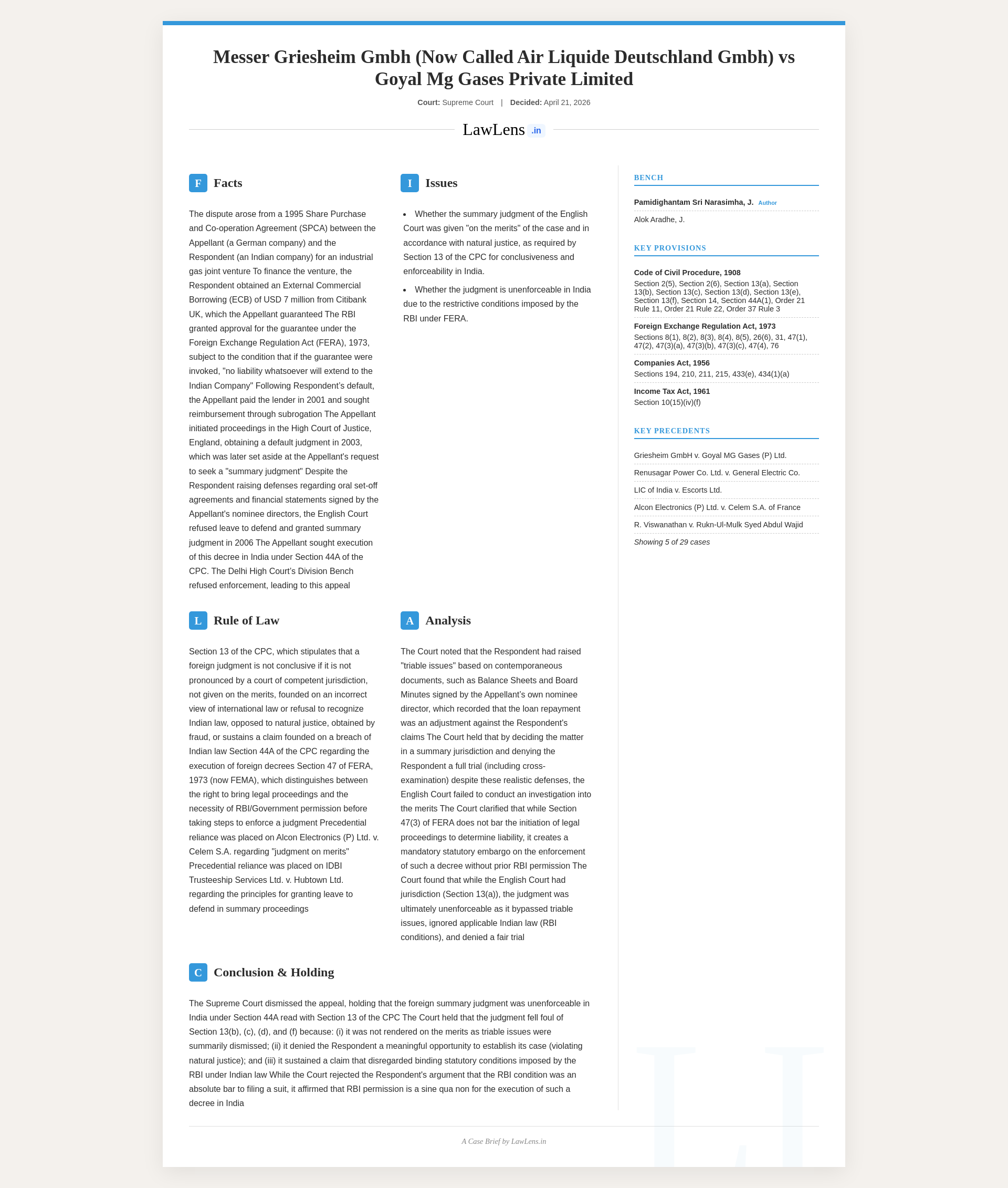
Messer Griesheim GmbH (now called Air Liquide Deutschland GmbH) v. Goyal MG Gases Private Limited 2026 INSC 401 - CPC - FERA - Foreign Judgment
Code of Civil Procedure 1908 - Section 13 ; Foreign Exchange Regulation Act, 1973 (FERA) - Section 47 -Without RBI approval, it is not possible to take steps for enforcement of a decree

Code of Civil Procedure 1908 - Section 13 ; Foreign Exchange Regulation Act, 1973 (FERA) - Section 47 -In the normal course, a party obtaining foreign judgment can seek enforcement in India if such a judgment qualifies the test laid down in Section 13 of CPC. The Central Government/RBI can exercise its regulatory power under Section 47(3) of FERA and grant its approval before any further steps are taken for implementing the judgment. (Para 83) There is no prohibition for initiation of proceedings and for a determination as regards the liability. However, after obtaining a declaration, for its implementation, obtaining permission from RBI is sine qua non. In other words, without RBI approval, it is not possible to take steps for enforcement of a decree. (Para 81)
Code of Civil Procedure 1908 - Section 13- The principles governing conclusiveness: (a) Court of competent jurisdiction: A foreign judgment is not conclusive unless it is pronounced by a court of competent jurisdiction, both under the law of the foreign country and in the international sense recognised under private international law. (b) Judgment to be on Merits: A judgment must be rendered on merits, meaning that the court must have considered the evidence and adjudicated upon the substantive rights of the parties. A decree passed mechanically, by default, or without examination of the objections would not be conclusive. (c) Incorrect View of International Law or Refusal to Recognise Indian Law: A foreign judgment would not be conclusive where it is founded on an incorrect view of international law or refuses to recognise the law of India in cases where such law is applicable. (d) Proceedings Opposed to Natural Justice: A judgment rendered in violation of principles of natural justice, including absence of proper notice or denial of opportunity of hearing, is not enforceable. The requirement of natural justice relates to procedural fairness and not to the correctness of the decision on merits. (e) Judgment Obtained by Fraud: foreign judgment obtained by fraud is not entitled to recognition, and the fraud contemplated includes not only fraud on merits but also fraud relating to jurisdictional facts.(f) Judgment Sustaining a Claim Founded on Breach of Indian Law: foreign judgment sustaining a claim that is contrary to Indian law in force shall not be recognised or enforced in India. (Para 27)
Code of Civil Procedure 1908 - Order XXXVII Rule 3 - Even while a Court adjudicates and determines a lis in summary jurisdiction, the Court must determine whether the defendant has a “realistic”, as opposed to a merely “fanciful” prospect of success. A claim can be regarded as realistic only where it carries a degree of conviction and is more than merely arguable. At the same time, the jurisdiction to grant summary judgment is not intended to convert the proceeding into a “mini-trial”, but rather to enable cases where there is no real prospect of success to be disposed of summarily. Nevertheless, the court is not required to accept factual assertions at face value without analysis, Page 29 of 61 particularly where such assertions are contradicted by contemporaneous records. In forming its opinion, the court must consider not only the material actually placed before it at the summary stage but also such evidence as may reasonably be expected to be available at trial. Further, even where a matter does not initially appear complex or where no immediate conflict of fact is evident, the court ought to exercise caution in rendering a final determination without trial if reasonable grounds exist to believe that a fuller investigation into the facts may materially affect the outcome of the case. (Para 40)
Case Info
Here’s the information extracted from the judgment on your current page:
Basic Case Details
Case name: Messer Griesheim GmbH (now called Air Liquide Deutschland GmbH) v. Goyal MG Gases Private Limited
Neutral citation: 2026 INSC 401
Coram:Justice Pamidighantam Sri NarasimhaJustice Alok Aradhe
Judgment date: April 21, 2026
Case laws and citations referred
Within the judgment, the Supreme Court refers to, among others:
- Griesheim GmbH v. Goyal MG Gases (P) Ltd., (2022) 11 SCC 549
- Alcon Electronics (P) Ltd. v. Celem S.A. of France, (2017) 2 SCC 253
- R. Viswanathan v. Rukn-Ul-Mulk Syed Abdul Wajid, 1962 SCC OnLine SC 112
- Sankaran Govindan v. Lakshmi Bharathi, (1975) 3 SCC 351
- Satya v. Teja Singh, (1975) 1 SCC 120
- Y. Narasimha Rao v. Y. Venkata Lakshmi, (1991) 3 SCC 451
- International Woollen Mills v. Standard Wool (U.K.) Ltd., (2001) 5 SCC 265
- Middle East Bank Ltd. v. Rajendra Singh Sethia, 1990 SCC OnLine Cal 247
- K.M. Abdul Jabbar v. Indo-Singapore Traders (P) Ltd., 1980 SCC OnLine Mad 186
- O.P. Verma v. Lala Gehrilal, 1960 SCC OnLine Raj 89
- Daniel Thomas Keymer v. P. Viswanatham Reddi, AIR 1916 PC 121
- L. Oppenheim and Co. v. Hajee Mahomed Haneef Sahib, AIR 1922 PC 120
- IDBI Trusteeship Services Ltd. v. Hubtown Ltd., (2017) 1 SCC 568
- B.L. Kashyap & Sons Ltd. v. JMS Steels and Power Corporation, (2022) 3 SCC 294
- LIC of India v. Escorts Ltd., (1986) 1 SCC 264
- Renusagar Power Co. Ltd. v. General Electric Co., 1994 Supp (1) SCC 644
- Asha John Divianathan v. Vikram Malhotra, (2021) 19 SCC 629
- Algemene Bank Nederland NV v. Satish Dayalal Choksi, 1989 SCC OnLine Bom 282
- China Shipping Development Co. Ltd. v. Lanyard Foods Ltd., (2008) 142 Comp Cas 647
- Silver Shield Construction Co. Ltd. v. Recondo Ltd., 1994 (15) CLA 92 (Bom)
- Dhanrajmal Gobindram v. Shamji Kalidas & Co., 1961 (3) SCR 1020
Statutes / laws referred
The judgment discusses and applies:
- Code of Civil Procedure, 1908
- Section 2(5), 2(6), 13, 14, 44A; Order XXXVII Rule 3 (summary procedure); Order XXI (execution, via cited cases)
- Foreign Exchange Regulation Act, 1973 (FERA)
- Sections 8, 26(6) (through case law), 31 (via Asha John), 47(3) in particular
- Foreign Exchange Management Act, 1999 (FEMA) – savings and change of regime
- Companies Act, 1956
- Sections 194, 210, 211, 215
- Companies Act, 1956 (winding up)
- Sections 433(e), 434(1)(a) (statutory notice based on default judgment)
- Income Tax Act, 1961
- Section 10(15)(iv)(f) (mentioned in the ECB approval request)
Three‑sentence brief summary
The Supreme Court of India held that the English High Court’s summary judgment in favour of Messer Griesheim was not enforceable in India under Section 44A CPC because it fell within the exceptions in Section 13(b), (c), (d) and (f), particularly as it was granted in summary jurisdiction despite bona fide triable issues and in disregard of binding RBI/FERA conditions. The Court clarified that under Section 47(3) FERA there is a clear distinction between bringing legal proceedings and enforcing a judgment: liability can be adjudicated, but no steps in enforcement can be taken without prior RBI/Central Government permission. While the appeal was dismissed and enforcement refused on Section 13 grounds, the Court also clarified the law that RBI permission is a mandatory precondition at the enforcement stage, not for instituting proceedings.