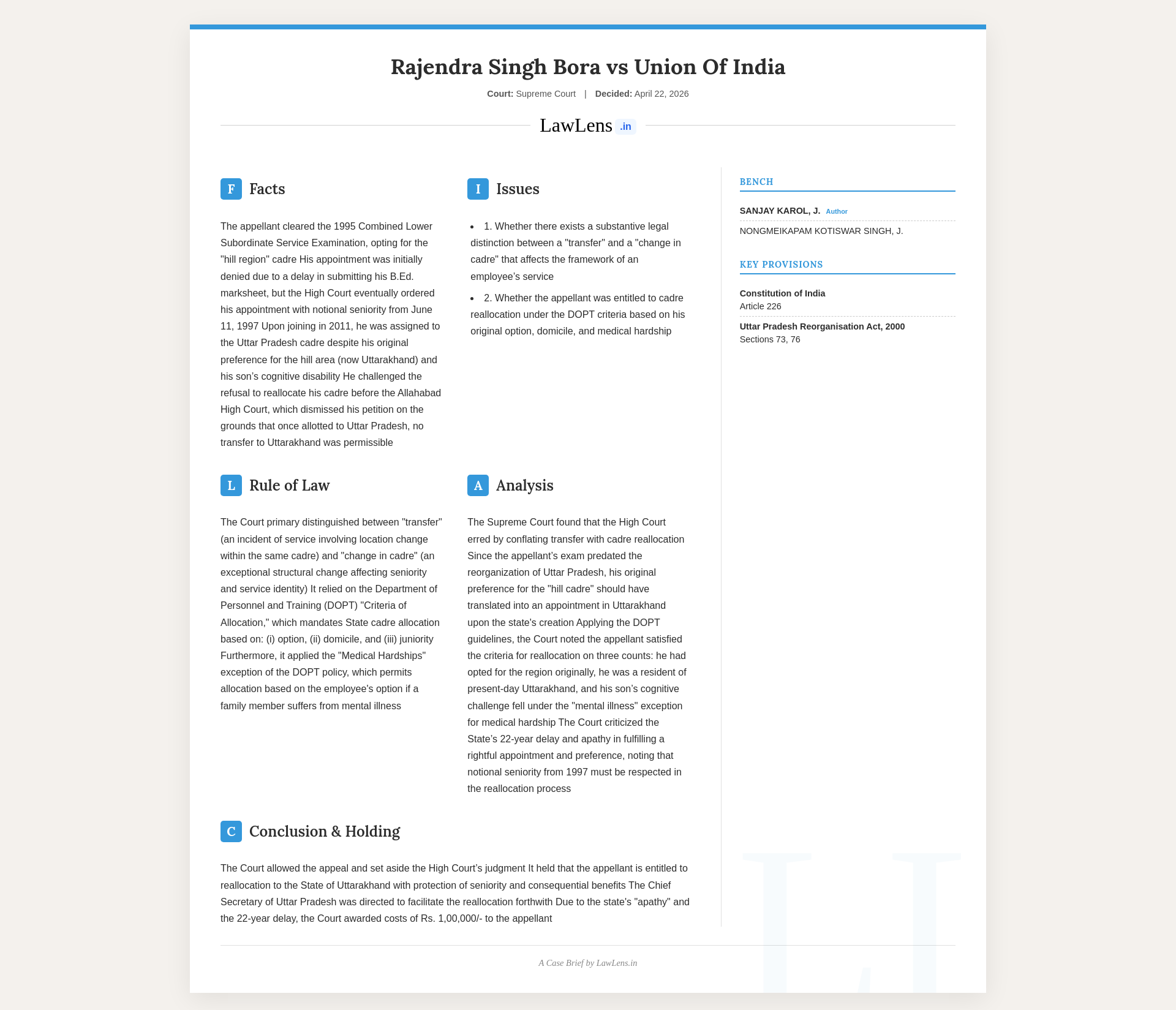
Rajendra Singh Bora v. Union of India 2026 INSC 404 Service Law - Transfer - Change in Cadre
A transfer is a matter of administrative convenience within the same service, whereas a change in cadre entails a reconfiguration of the employee’s service identity itself.

Service Law - Distinction between a transfer and a change in cadre - The two operate in entirely different domains and carry different legal and administrative consequences. A transfer refers to a change in the place of posting of an employee within the same cadre or service. The individual continues to belong to the same service structure, governed by the same rules, with no impact on seniority or substantive status. It is an incident of service, routinely exercised by the administration for functional, administrative, or public interest considerations. In essence, only the location or assignment changes, not the identity of service to which the employee belongs. A change in cadre, by contrast, involves a shift from one cadre to another and, therefore, alters the very framework within which the employee’s service is regulated. It is not a mere relocation but a structural change that may affect seniority, promotional avenues, and applicable service conditions. Such a change is exceptional in nature and typically requires specific statutory authority or higher-level approval, given its far-reaching implications. The difference, therefore, is clear and substantive. A transfer is a matter of administrative convenience within the same service, whereas a change in cadre entails a reconfiguration of the employee’s service identity itself. (Para 7)
Case Info
Case Information
Case name: Rajendra Singh Bora v. Union of India & Ors.Neutral citation: 2026 INSC 404
Coram:
- Justice Sanjay Karol
- Justice Nongmeikapam Kotiswar Singh
Judgment date: 22 April 2026 (New Delhi)
Case laws and citations
The judgment text provided does not cite or quote any other reported case law by name or citation. It refers only to earlier stages of the same matter:
- Writ Petition No. 16613 of 1997 (allowed by the Allahabad High Court on 13.02.2004)
- Special Appeal No. 781 of 2004 (dismissed on 07.10.2009)
- Writ A No. 20783 of 2013 (impugned order dated 11.04.2018 of Allahabad High Court)
No external Supreme Court or High Court precedents are expressly mentioned in the extracted text.
Statutes / laws / rules referred
The judgment proceeds mainly on service law principles and on the cadre allocation policy framed by the Department of Personnel and Training (DoPT) in the context of State reorganisation. From the text given, there are no specific statutory provisions (section numbers or Act names) quoted; instead, the Court reproduces and relies on the DoPT cadre allocation guidelines, including their exceptions for: women employees, Class IV employees, handicapped persons, spouse policy, medical hardship (including mental illness of self or family), Bhopal Gas tragedy claimants, and SC/ST employees.
Three‑sentence brief summary
The Supreme Court holds that the High Court erred in treating the appellant’s claim as a mere transfer request rather than a question of proper cadre allocation arising out of his original option for the “hill cadre” prior to the creation of Uttarakhand. Applying the DoPT’s cadre allocation criteria of option, domicile and seniority, and noting that the appellant is domiciled in present‑day Uttarakhand and has a cognitively challenged son falling within the “mental illness” medical‑hardship exception, the Court directs that he be reallocated to the State of Uttarakhand with his seniority and benefits protected. Expressing strong anguish at the decades‑long delay in securing his rights, the Court awards costs of Rs. 1,00,000 against the State of Uttar Pradesh and asks the Chief Justice of the High Court to identify and expedite similarly long‑pending service matters.