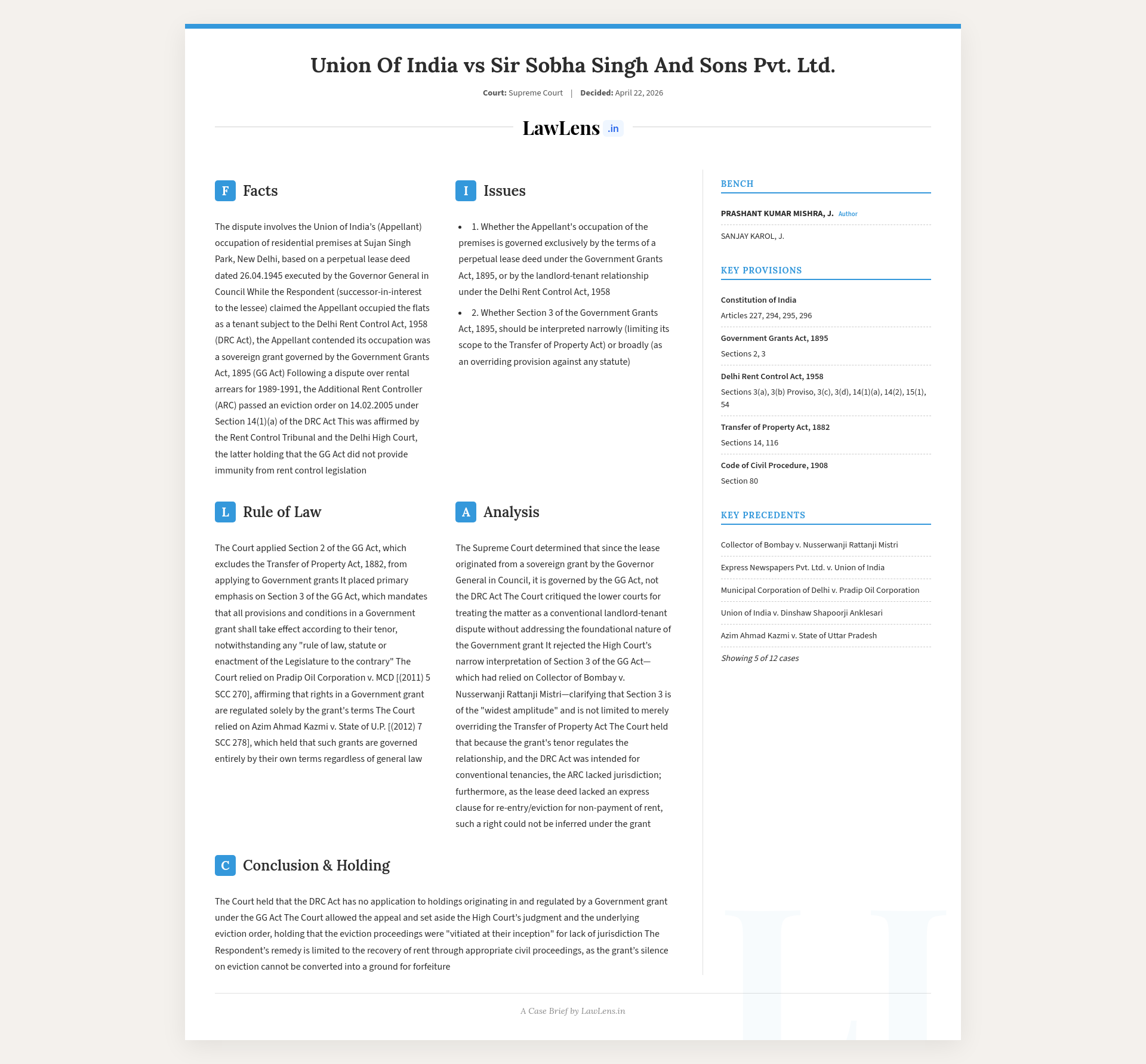
Union of India v. Sir Sobha Singh and Sons Pvt. Ltd., 2026 INSC 406 - Government Grants Act - Precedent
Observations which stray beyond the contours of the issue in question, however illuminating they may appear, do not partake of the character of binding precedent.

Precedent -A judgment is an authority only for what it actually decides. The binding element of a judgment lies in its ratio decidendi i.e., the principle of law which was necessary for the determination of the issue that directly arose for consideration and was consciously adjudicated upon. Observations which stray beyond the contours of the issue in question, however illuminating they may appear, do not partake of the character of binding precedent. (Para 41)
Government Grants Act, 1895 -Section 3 -The section does not admit a narrow construction that dilutes the supremacy accorded to the terms of the grant. At the same time, its application must be conditioned upon a faithful adherence to the actual stipulations contained in the grant; the Government cannot travel beyond the four corners of the instrument. Within those bounds, however, the tenor of the grant prevails, unfettered by inconsistent statutory or common law principles. . While Section 2 of the GG Act expressly excludes the application of the TP Act, Section 3 travels further and grants primacy to the conditions, limitations and stipulations contained in the Government grant itself, even if they run contrary to any general law. (Para 52- 54)
Jurisdiction - The existence or absence of a remedy cannot determine jurisdiction. (Para 55)
Case Info
Extracted Case Information
Case name and neutral citation:Union of India v. Sir Sobha Singh and Sons Pvt. Ltd., 2026 INSC 406 (Civil Appeal No. 4686 of 2026, arising out of SLP (Civil) No. 5629 of 2022)
Coram:Justice Sanjay Karol and Justice Prashant Kumar Mishra (judgment authored by Prashant Kumar Mishra, J.)
Judgment date:22 April 2026 (New Delhi)
Caselaws and citations referred:
- Collector of Bombay v. Nusserwanji Rattanji Mistri and Others, (1955) 1 SCC 184
- Express Newspapers Pvt. Ltd. and Others v. Union of India and Others, (1986) 1 SCC 133
- Municipal Corporation of Delhi v. Pradip Oil Corporation and Another, 2001 SCC OnLine Del 1026 (Full Bench, Delhi High Court)
- Pradeep Oil Corporation v. Municipal Corporation of Delhi and Another, (2011) 5 SCC 270
- Union of India and Another v. Dinshaw Shapoorji Anklesari and Others, (2014) 14 SCC 204
- Azim Ahmad Kazmi and Others v. State of Uttar Pradesh and Another, (2012) 7 SCC 278
- Hajee S.V.M. Mohamed Jamaludeen Bros. and Co. v. Government of T.N., (1997) 3 SCC 466
- State of U.P. v. Zahoor Ahmad, (1973) 2 SCC 547 : AIR 1973 SC 2520
- Chief Executive Officer v. Surendra Kumar Vakil, (1999) 3 SCC 555
- Union of India v. Kamla Verma, (2010) 13 SCC 511 : (2010) 4 SCC (Civ) 802
- Tata Steel Limited v. State of Jharkhand and Others, (2015) 15 SCC 55
- Jagannath Baksh Singh v. United Provinces, 1946 SCC OnLine PC 14 : (1945–46) 73 IA 123
Statutes / laws referred:
- Government Grants Act, 1895 (especially Sections 2 and 3)
- Transfer of Property Act, 1882
- Delhi Rent Control Act, 1958 (particularly Section 3, Section 14(1)(a), Section 14(2), Section 15(1), Section 54)
- Public Premises (Eviction of Unauthorised Occupants) Act, 1971
- Code of Civil Procedure, 1908 (Section 80)
- Constitution of India (Article 227; Articles 294–296 mentioned in context via Tata Steel)
Three‑sentence Brief Summary
The Supreme Court held that the Union of India’s occupation of residential premises at Sujan Singh Park flowed from a Government grant and a perpetual lease, so the relationship was governed exclusively by the tenor of that grant under Section 3 of the Government Grants Act, 1895, and not by the Delhi Rent Control Act, 1958. Consequently, the eviction proceedings under Section 14(1)(a) DRC Act were without jurisdiction and stood vitiated, and the High Court’s judgment affirming those proceedings was set aside, allowing the appeal. The Court clarified that while the respondent cannot seek eviction under the DRC Act, it remains free to pursue appropriate civil remedies for recovery of rent or other reliefs strictly in accordance with the terms of the grant and general civil law.