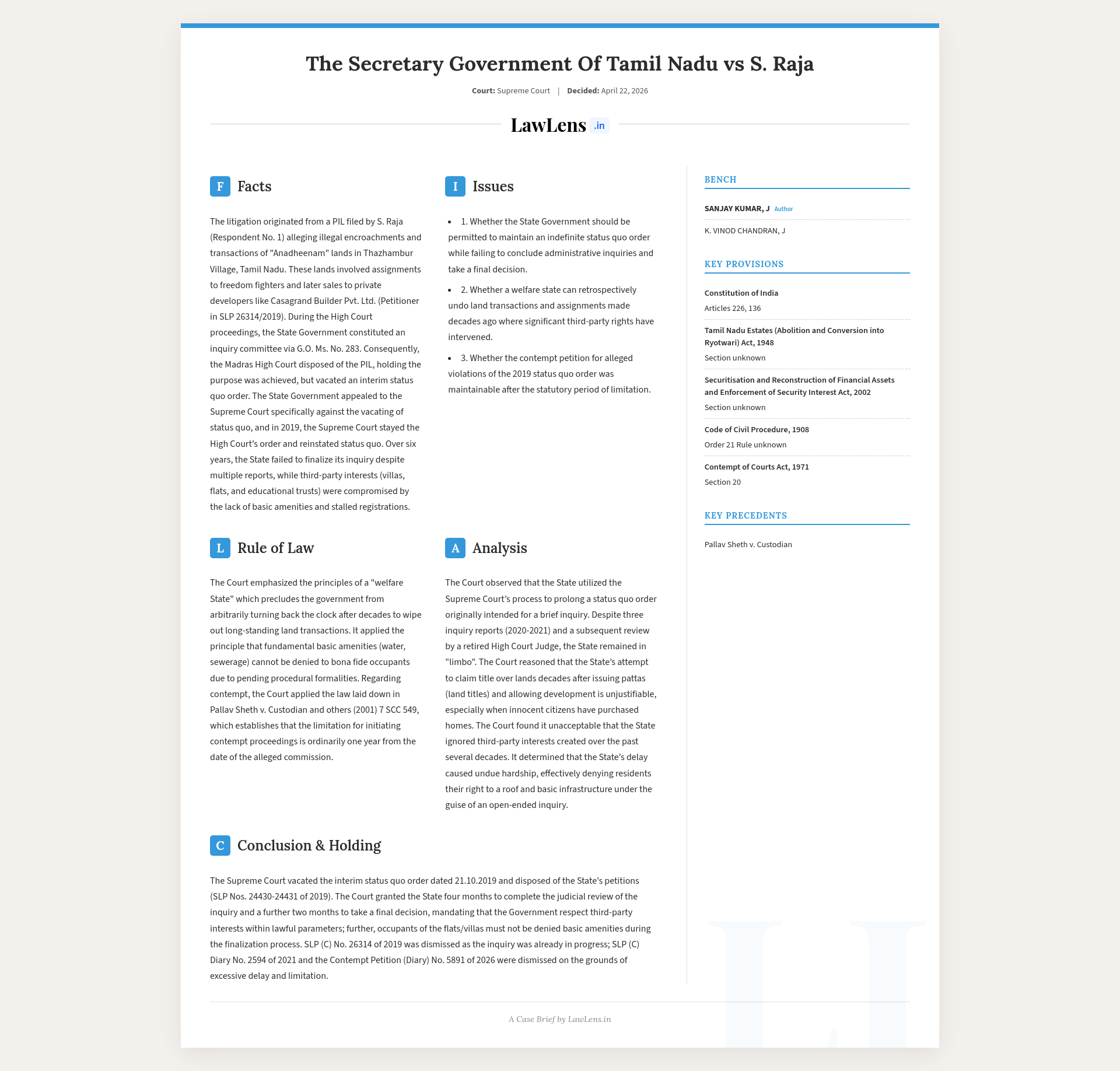
Secretary, Government of Tamil Nadu v. S. Raja 2026 INSC 407 - Contempt of Court - Limitation
The limitation for initiation of contempt proceedings would ordinarily be one year from the date of commission of the contempt.

Contempt of Court - The limitation for initiation of contempt proceedings would ordinarily be one year from the date of commission of the contempt. (Para 28)
Case Info
Here’s the structured information from the judgment on your current page:
Basic Case Details
Case name: The Secretary, Government of Tamil Nadu & Ors Etc. v. S. Raja & Ors Etc. (with connected SLPs)
Neutral citation: 2026 INSC 407
Coram:Justice Sanjay KumarJustice K. Vinod Chandran
Judgment date: April 22, 2026 (New Delhi)
Case‑law and citations referred
The judgment cites only one reported decision:
- Pallav Sheth v. Custodian and others, (2001) 7 SCC 549 – relied on for the principle that limitation for initiation of contempt proceedings is ordinarily one year from the date of commission of the contempt.
Statutes / laws referred
From the text provided, the judgment expressly refers to:
- The Tamil Nadu Estates (Abolition and Conversion into Ryotwari) Act, 1948 – in the context of estate abolition, vesting of lands in the Government, and subsequent grant of pattas.
- The Securitisation and Reconstruction of Financial Assets and Enforcement of Security Interest Act, 2002 (SARFAESI Act, 2002) – as the basis for the Army Welfare Housing Organisation’s purchase of land through SARFAESI proceedings.
(Various Government Orders and administrative instruments are also discussed, but they are not “statutes”:G.O. Ms. No. 283 dated 09.08.2019;G.O. (Ms) No. 126 dated 03.02.2026;G.O. Ms. No. 164 dated 23.03.2000;and earlier pattas and revenue orders.)
Three‑sentence brief summary
The Supreme Court dealt with special leave petitions arising from a Madras High Court order concerning alleged illegal land transactions in Thazhambur Village, where long‑standing pattas and large‑scale third‑party housing developments had come up over several decades. The Court noted that the State of Tamil Nadu had repeatedly failed to complete its enquiry within the timelines it itself set, had used the Supreme Court’s 2019 status quo order to indefinitely freeze the situation, and could not now “turn back the clock” to wipe out decades‑old transactions to the detriment of innocent purchasers. It therefore vacated the status quo, disposed of the State’s SLPs, dismissed Casagrand’s SLP and a delayed SLP by another party, and also dismissed a belated contempt petition as time‑barred in light of the one‑year limitation principle recognized in Pallav Sheth.