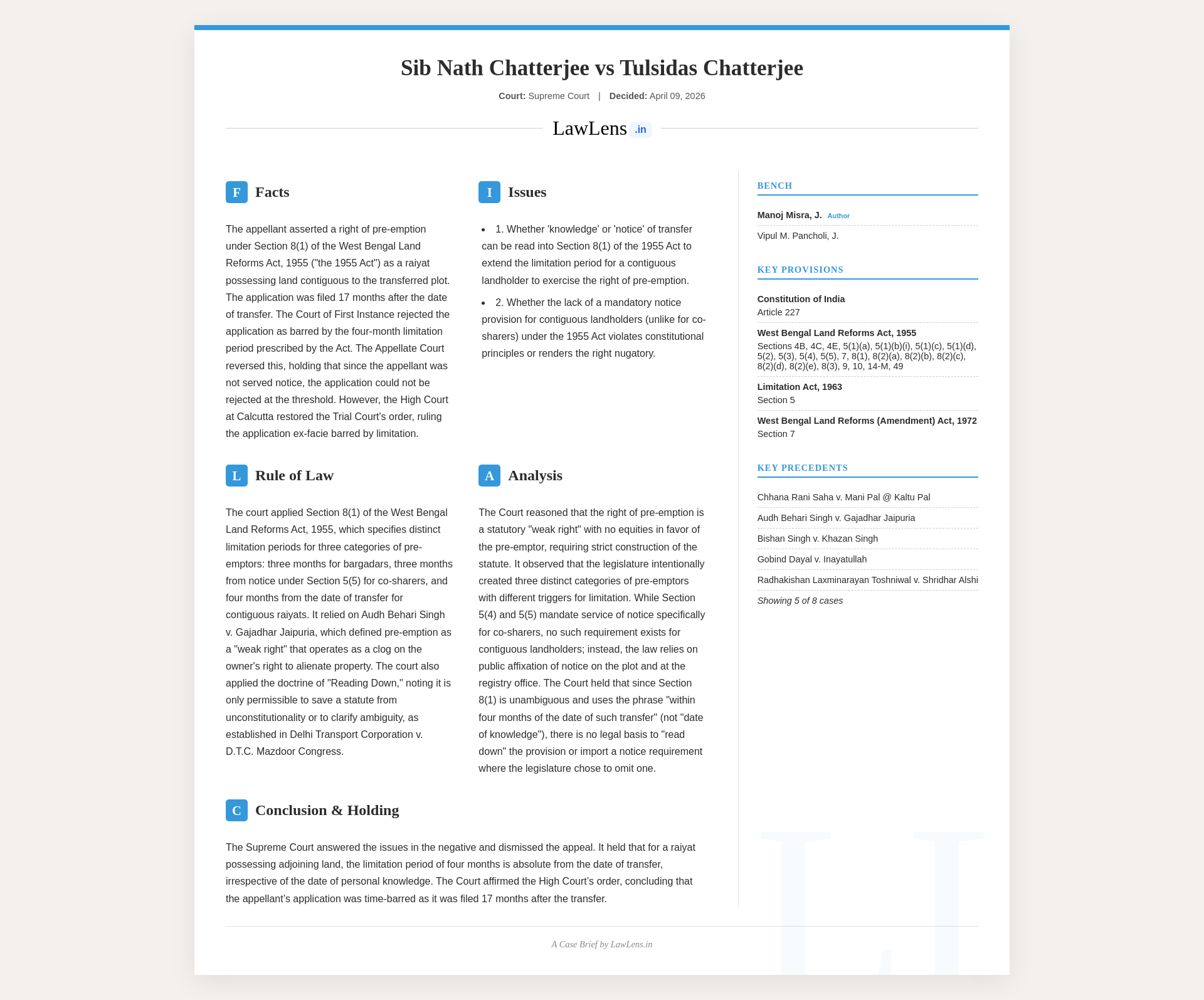
Sib Nath Chatterjee v. Tulsidas Chatterjee 2026 INSC 409 -West Bengal Land Reforms Act - Doctrine Of Reading Down
Harshness of a provision is no reason to read down the same, if its plain meaning is unambiguous and valid.

Doctrine of reading down - The doctrine of reading down or of recasting the statute can be applied in limited situations. It is essentially used, firstly, for saving a statute from being struck down on account of its unconstitutionality. It is an extension of the principle that when two interpretations are possible – one rendering it constitutional and the other making it unconstitutional, the former should be preferred. The second situation is where the provisions of the statute are vague and ambiguous and it is possible to gather the intentions of the legislature from the object of the statute, the context in which the provision occurs and the purpose for which it is made. However, when the provision is cast in a definite and unambiguous language and its intention is clear, it is not permissible either to mend or bend it even if such recasting is in accord with good reasons and conscience. In such circumstances, it is not permissible for the court to remake the statute. In short, the object of reading down is to keep the operation of the statute within the purpose of the Act and constitutionally valid. Harshness of a provision is no reason to read down the same, if its plain meaning is unambiguous and valid. (Para 32)
West Bengal Land Reforms Act, 1955 - Section 8 -The Section not only confers the right of pre-emption on three different categories of persons but also provides for separate periods of limitation within which each category could exercise its right. Importantly, the right of pre-emption gets triggered only when transfer is not to a cosharer. Understandably, a co-sharer stands on a different footing as he has a direct interest in the subject matter of transfer. Therefore, the legislature specifically provided for service of notice on him. The other two categories of pre-emptors cannot equate themselves with a co-sharer. In such view of the matter, if the legislature, in its wisdom, did not require service of notice on them as in the case of a co-sharer, there is no discrimination. Moreover, the right of preemption is neither a fundamental right nor a constitutional right, rather it is a weak right which, has been conferred by a statute and, therefore, must strictly be exercised in terms thereof. Thus, reading down sub-section (1) of section 8 is not required either to save it from being declared unconstitutional or to make it clear. (Para 34)
Case Info
Case Information
Case name and neutral citation:Sib Nath Chatterjee v. Tulsidas Chatterjee & Ors., 2026 INSC 409
Coram: Justice Manoj Misra and Justice Vipul M. PancholiJudgment date: 9 April 2026 (Reportable order signed at New Delhi on 09.04.2026)
Case laws and citations referred
- Audh Behari Singh v. Gajadhar Jaipuria & Ors., 3 (1954) 1 SCC 836; 1954 SCC OnLine SC 186
- Bishan Singh & Ors. v. Khazan Singh & Anr., AIR 1958 SC 838; 1959 SCR 878; 1958 SCC OnLine SC 88
- Gobind Dayal v. Inayatullah, (1885) ILR 7 All 775
- Radhakishan Laxminarayan Toshniwal v. Shridhar Alshi & Ors., AIR 1960 SC 1368; (1961) 1 SCR 248; 1960 SCC OnLine SC 308
- Mohd. Noor & Ors. v. Mohd. Ibrahim & Ors., (1994) 5 SCC 562
- Chhana Rani Saha v. Mani Pal @ Kaltu Pal, Civil Appeal No. 5905 of 2009, decided on 15.11.2017
- Delhi Transport Corporation v. D.T.C. Mazdoor Congress & Ors., 1991 Supp (1) SCC 600 (paras 255, 326)
- Central Bank of India v. Shanmugavelu, (2024) 6 SCC 641 (para 102)
Statutes / provisions referred
- West Bengal Land Reforms Act, 1955
- Section 5 (especially sub‑sections (1), (4), (5))
- Section 8 (right of purchase by co‑sharer or contiguous tenant)
- Section 7 (as referred to in Section 8(3))
- Sections 4B, 4C, 4E, 49 (as cross‑referenced in Section 5)
- Chapter IIB (in the Explanation to Section 8)
- Limitation Act, 1963 – Section 5 (its inapplicability to original proceedings noted)
- Constitution of India – Article 227 (High Court’s revisional/supervisory jurisdiction)
Three‑sentence brief summary
The Supreme Court held that a raiyat possessing land adjoining the plot under transfer (third‑category pre‑emptor under Section 8(1) of the West Bengal Land Reforms Act, 1955) must file a pre‑emption application within four months from the date of transfer, not from the date of knowledge, and that “notice” or “knowledge” cannot be read into the statute to extend limitation. Emphasising that the right of pre‑emption is a weak, statutory right that must be strictly exercised within the four corners of the Act, the Court refused to apply doctrines of reading down to add a notice requirement for non‑co‑sharer pre‑emptors, distinguishing the legislative treatment of co‑sharers under Sections 5 and 8. Consequently, since the appellant, a contiguous raiyat, filed his application after 17 months, it was barred by limitation, and the appeal was dismissed, affirming the High Court’s restoration of the Trial Court’s rejection.