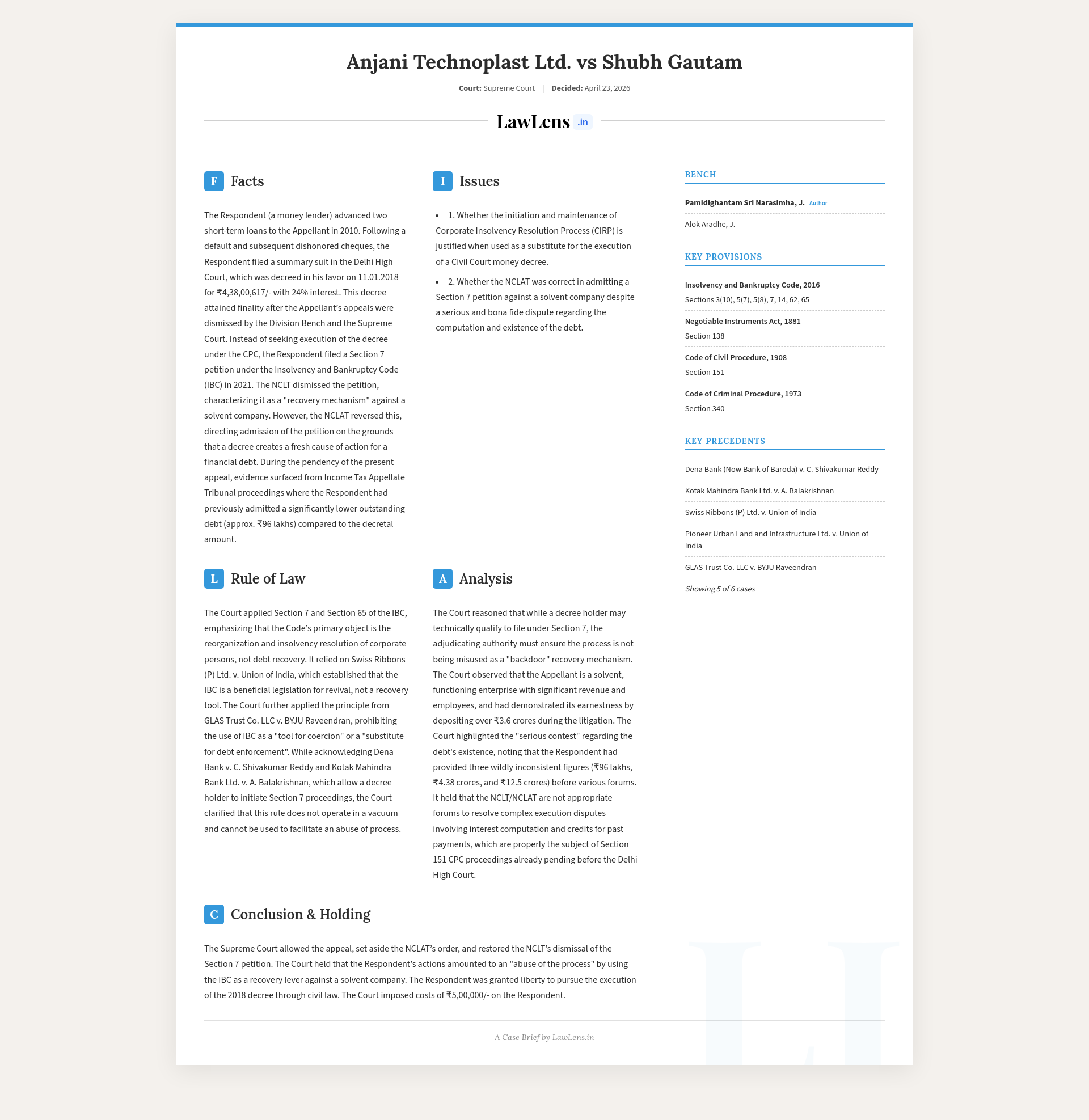
Anjani Technoplast Ltd. v. Shubh Gautam 2026 INSC 410 - IBC - Money Recovery
Improper use of the IBC using insolvency as a substitute for debt enforcement and as a means of coercing the corporate debtor into payment.

Insolvency and Bankruptcy Code, 2016 - Improper use of the IBC using insolvency as a substitute for debt enforcement and as a means of coercing the corporate debtor into payment- IBC is not to be misused as a tool for recovery or as a lever to coerce payment- The insolvency jurisdiction under the IBC was not designed to resolve disputes about the quantum of a decretal amount- The insolvency process is a remedy with far-reaching consequences and must be reserved for cases of genuine insolvency or financial distress, not for the enforcement of money decrees. A creditor who approaches the NCLT not with any genuine concern for the resolution of the corporate debtor but purely to secure payment of his individual dues is acting contrary to the purpose and spirit of the Code (Para 18-33)
Insolvency and Bankruptcy Code, 2016 - Section 7 - A party that takes contradictory positions before different forums on the same set of facts cannot be permitted to press an insolvency proceeding as though the quantum were an established and undisputed fact. (Para 29)
Insolvency and Bankruptcy Code, 2016 - Section 7 - In Dena Bank (Now Bank of Baroda) v. C. Shivakumar Reddy, (2021) 10 SCC 330, it was held that a decree for money in favour of a financial creditor would give rise to a fresh cause of action for initiating proceedings under Section 7 of the IBC - SC observed: We do not doubt that proposition as a general statement of law. However, that principle does not operate in a vacuum. It does not mean that every decree holder who also happens to be a financial creditor is entitled, as a matter of right, to invoke the insolvency process in preference to execution. The question of whether, in each case, the invocation of the IBC amounts to misuse of the process or to the use of the Code as a recovery mechanism remains a question to be examined on the facts. (Para 31)
Case Info
Basic Case Details
Case name: Anjani Technoplast Ltd. v. Shubh GautamNeutral citation: 2026 INSC 410Coram:Justice Pamidighantam Sri NarasimhaJustice Alok AradheJudgment date: April 23, 2026Court: Supreme Court of India, Civil Appellate Jurisdiction, Civil Appeal No. 8247 of 2022
Case Law and Citations Referred
- Swiss Ribbons (P) Ltd. v. Union of India, (2019) 4 SCC 17
- Pioneer Urban Land and Infrastructure Ltd. v. Union of India, (2019) 8 SCC 416
- Dena Bank (Now Bank of Baroda) v. C. Shivakumar Reddy, (2021) 10 SCC 330
- Kotak Mahindra Bank Ltd. v. A. Balakrishnan, (2022) 9 SCC 186
- GLAS Trust Co. LLC v. BYJU Raveendran, (2025) 3 SCC 625
- Tottempudi Salalith v. State Bank of India, (2024) 1 SCC 24
Statutes / Laws Referred
- Insolvency and Bankruptcy Code, 2016
- Section 3(10) – definition of “creditor”
- Section 5(7) – “financial creditor”
- Section 5(8) – “financial debt”
- Section 7 – initiation of CIRP by financial creditor
- Section 14 – moratorium (referred conceptually)
- Section 62 – appeal to Supreme Court
- Section 65 – fraudulent or malicious initiation of insolvency proceedings
- Code of Civil Procedure, 1908
- Execution of money decree (generally)
- Section 151 CPC – inherent powers (I.A. No. 17634 of 2022 before Delhi High Court)
- Negotiable Instruments Act, 1881
- Section 138 – dishonour of cheque
- Income-tax laws (by reference to proceedings)
- TDS and interest income; appeal before CIT(A) and ITAT (ITA No. 555/KOL/2020)
- Criminal Procedure Code, 1973
- Section 340 CrPC – mentioned as pending proceedings before Delhi High Court
- Recovery framework references (conceptually)
- Recovery of Debts and Bankruptcy Act, 1993 (“1993 Act”)
- SARFAESI Act, 2002(cited in the context of Tottempudi Salalith, to contrast recovery vs. IBC)
Three‑Sentence Brief Summary
The Supreme Court held that the respondent–decree holder was misusing the Insolvency and Bankruptcy Code by filing a Section 7 application as an alternative execution and coercive recovery mechanism against a solvent, running company, instead of pursuing civil execution of his money decree. Relying on precedents like Swiss Ribbons, Pioneer Urban, GLAS Trust, and Tottempudi Salalith, the Court reiterated that IBC is a resolution framework for genuine insolvency, not a debt recovery tool, especially where the very existence and quantum of the “debt” under the decree is seriously contested and already before the Delhi High Court. Consequently, it set aside the NCLAT’s order directing admission of the Section 7 petition, restored the NCLT’s dismissal of the insolvency proceedings, left the decree and execution/computation issues to the High Court, and awarded costs of Rs. 5,00,000/- to the appellant.