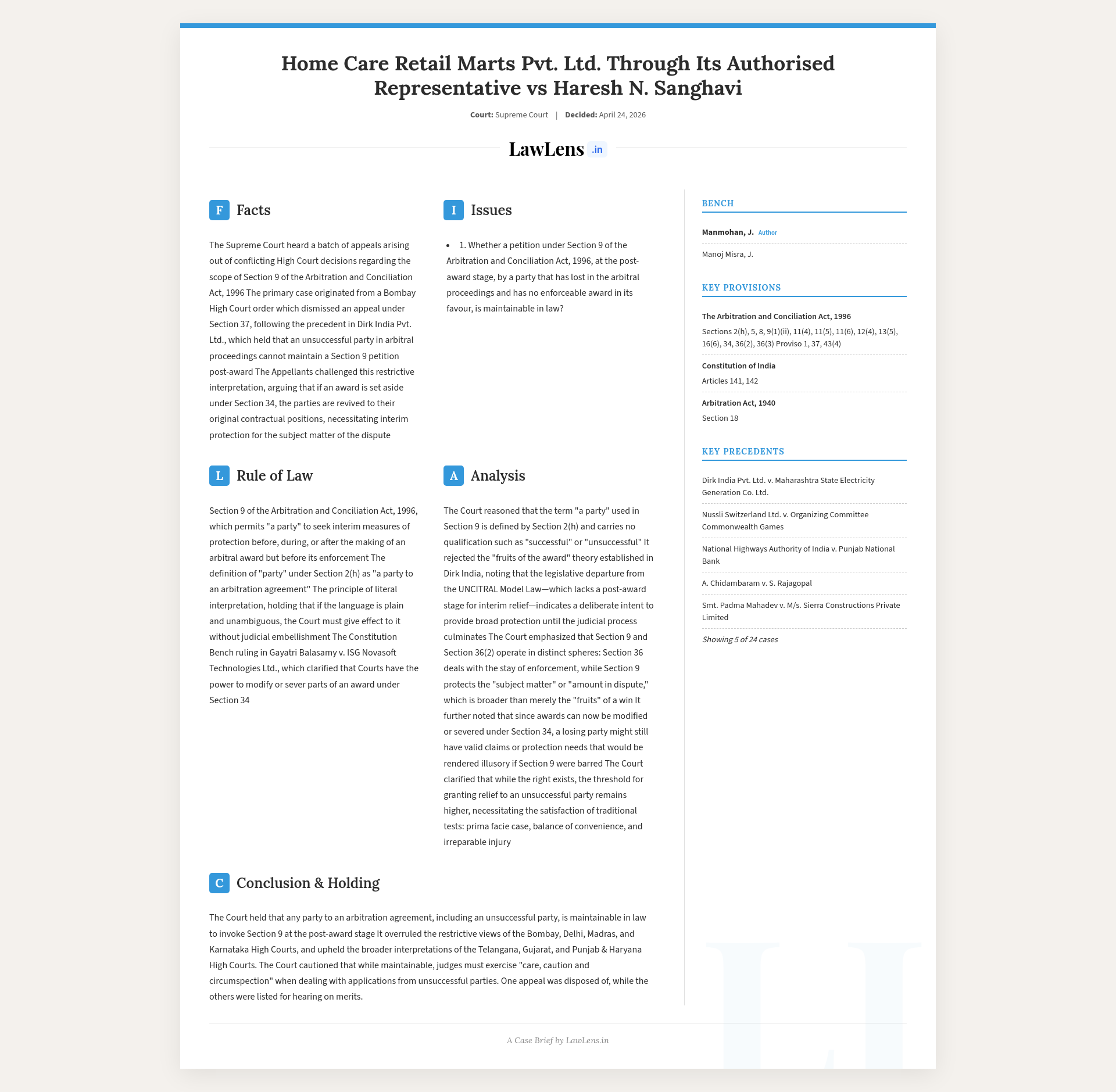
Home Care Retails Marts Pvt. Ltd. v. Haresh N. Sanghavi 2026 INSC 415 - S.9 Arbitration Act- Unsuccessful Party
whether a petition under Section 9 of the Arbitration and Conciliation Act, 1996 ) at the post-award stage, by a party that has lost in the arbitral proceedings and has no enforceable award in its favour, is maintainable in law?

Arbitration and Conciliation Act 1996 - Section 9 - Any party to an arbitration agreement, including an unsuccessful party in arbitration, may invoke Section 9 of the Act at the post-award stage. However, the Courts would be well advised to exercise care, caution and circumspection while dealing with a Section 9 application filed by an unsuccessful party in arbitration. (Para 62) The threshold for grant of interim relief will be higher in the case of an unsuccessful party in arbitration seeking such relief. In rare and compelling cases, permitting the unsuccessful party to invoke Section 9 of the Act would prevent irreparable prejudice and preserve the efficacy of the challenge proceedings. However, the rights of such a party cannot be curtailed merely on the apprehension of possible misuse of a statutory provision. (Para 60)
Arbitration and Conciliation Act 1996 - Section 2(h), 9 - Section 2(h) nor Section 9 of the Act draws any distinction between a successful and an unsuccessful party in arbitration proceedings. The meaning of the expression ‘a party’ cannot be contextually modulated or varied depending upon the outcome of the arbitral proceedings. (Para 29-33)
Arbitration and Conciliation Act 1996 - Section 9- The grant of interim relief under Section 9 to be guided by well-established principles, namely, the existence of a prima facie case, balance of convenience, and likelihood of irreparable harm or injury
Arbitration and Conciliation Act 1996 - Section 34,37- An unsuccessful party cannot secure protection of its claim under Section 34 or Section 36. (Para 43)
Constitution of India- Article 141- Precedent - The observations of Courts must be read in the context in which they appear and not as provisions of a Statute -A decision which does not proceed on consideration of an issue cannot be deemed to be law declared to have a binding effect as contemplated by Article 141 of the Constitution. (Para 53-54)
Interpretation of Statutes - Courts interpret the law, they do not alter or amend it - The principle of contextual or purposive interpretation cannot be invoked where the statutory language is unambiguous and admits of only one meaning. It is trite law that where the expressions employed in a statute are clear, categorical, and leave no room for doubt, the Court must refrain from resorting to contextual or purposive construction7 . If Courts were to resort to contextual or purposive interpretation so as to arrive at a meaning contrary to the plain language of the statute, it would not only do violence to the statute but at a jurisprudential level would constitute a breach of the doctrine of separation of powers. The test of whether the plain meaning of words leads to repugnancy, injustice, or absurdity is of a very high threshold and may be applied only in the rarest of rare cases, and that too for compelling reasons. 58. Consequently, rule of purposive construction is resorted to only when the provision read literally leads to manifest injustice or absurdity. (Para 55-58)
Case Info
Key case details
Case name and neutral citationHome Care Retails Marts Pvt. Ltd. v. Haresh N. Sanghavi, 2026 INSC 415
Coram: Justice Manoj Misra and Justice ManmohanJudgment date: 24 April 2026 (New Delhi)
Caselaws and citations referred
Within the extracted text, the judgment refers to (among others):
- Dirk India Pvt. Ltd. v. Maharashtra State Electricity Generation Co. Ltd., 2013 SCC OnLine Bom 481
- Nussli Switzerland Ltd. v. Organizing Committee Commonwealth Games 2010, 2014 SCC OnLine Del 4834
- National Highways Authority of India v. Punjab National Bank and Anr., 2023 SCC OnLine Del 4810
- A. Chidambaram v. S. Rajagopal and Ors., OA No. 843 of 2024 (Madras High Court)
- Smt. Padma Mahadev & Ors. v. M/s. Sierra Constructions Pvt. Ltd., COMAP No. 2 of 2021 (Karnataka High Court, 22 March 2021)
- M/s Saptarishi Hotels Pvt. Ltd & Anr. v. National Institute of Tourism & Hospitality Management (NITHM), 2019 SCC OnLine TS 1765
- GAIL (India) Ltd. v. Latin Rasayani Pvt. Ltd., 2014 SCC OnLine Guj 14836
- M/s DLF Home Developers Ltd. v. M/s Orris Infrastructure Pvt. Ltd. & Ors., FAO-CARB-51-2024 (O&M), 21 February 2025
- Firm Ashok Traders and Anr. v. Gurumukh Das Saluja and Ors., (2004) 3 SCC 155
- Gayatri Balasamy v. ISG Novasoft Technologies Ltd., 2025 SCC OnLine SC 986
- Wind World (India) Ltd. v. Enercon GmbH and Ors., 2017 SCC OnLine Bom 1147
- Hindustan Construction Co. Ltd. and Anr. v. Union of India and Ors., (2020) 17 SCC 324
- National Aluminium Co. Ltd. v. Pressteel & Fabrications (P) Ltd., (2004) 1 SCC 540
- Kakade Construction Co. Ltd. v. Vistra ITCL (India) Ltd., 2019 SCC OnLine Bom 1521
- State of West Bengal v. Union of India, AIR 1963 SC 1241
- Escorts Ltd. v. CCE, Delhi-II, (2004) 8 SCC 335
- MCD v. Gurnam Kaur, (1989) 1 SCC 101
- State of U.P. v. Synthetics & Chemicals Ltd., (1991) 4 SCC 139
- Jugal Kishore Saraf v. Raw Cotton Co. Ltd., (1955) 1 SCR 136 (referred to as (1955) 1 SCC 248 in the text-extract)
- DLF Qutab Enclave Complex Educational Charitable Trust v. State of Haryana and Ors., (2003) 5 SCC 622
- Essar House Pvt. Ltd. v. Arcellor Mittal Nippon Steel India Ltd., (2022) 20 SCC 178
(Plus multiple English authorities and treatises: R. v. Oakes [1959] 2 QB 350; Cox v. Hakes (1890) 15 App Cas 506; Abel v. Lee (1871) LR 6 CP 365; and passages from Craies on Statute Law.)
Statutes / provisions referred
The judgment refers primarily to the Arbitration and Conciliation Act, 1996, including:
- Section 2(h) – definition of “party”
- Section 5 – extent of judicial intervention
- Section 8 – reference to arbitration
- Section 9 – interim measures by court
- Sections 11(4), 11(5), 11(6) – appointment of arbitrators
- Sections 12(4), 13(5) – challenge procedure
- Section 16(6) – jurisdictional objections
- Section 18 – (of the 1940 Arbitration Act, by way of contrast)
- Section 34 – setting aside/modification of arbitral award
- Section 36(2) and 36(3) – stay of enforcement and conditions
- Section 43(4) – exclusion of time for limitation in fresh proceedings
It also refers to the Limitation Act, 1963 and, constitutionally, to Article 142 of the Constitution of India. The judgment situates Section 9 against Article 9 of the UNCITRAL Model Law.
Three‑sentence summary
The Supreme Court resolves a conflict among High Courts by holding that any party to an arbitration agreement, including an unsuccessful party in arbitration, may maintain a Section 9 petition for interim measures at the post‑award stage, up to enforcement under Section 36. It reasons that the statutory expression “a party” in Section 9 is clear and cannot be judicially cut down to “successful party”, that Sections 34, 36 and 9 operate in distinct spheres, and that denying Section 9 relief to a losing party would leave it remediless even where the award is stayed or vulnerable. At the same time, the Court stresses that while such Section 9 relief is legally maintainable, the threshold for grant to an unsuccessful party is higher and courts must exercise care, caution and circumspection in such cases.