S. Anand v. State of Tamil Nadu 2026 INSC 418 - Purchaser Of Property - FIR Quashed
Code of Criminal Procedure 1973 - Section 482- Purchaser Of Property - FIR Quashed

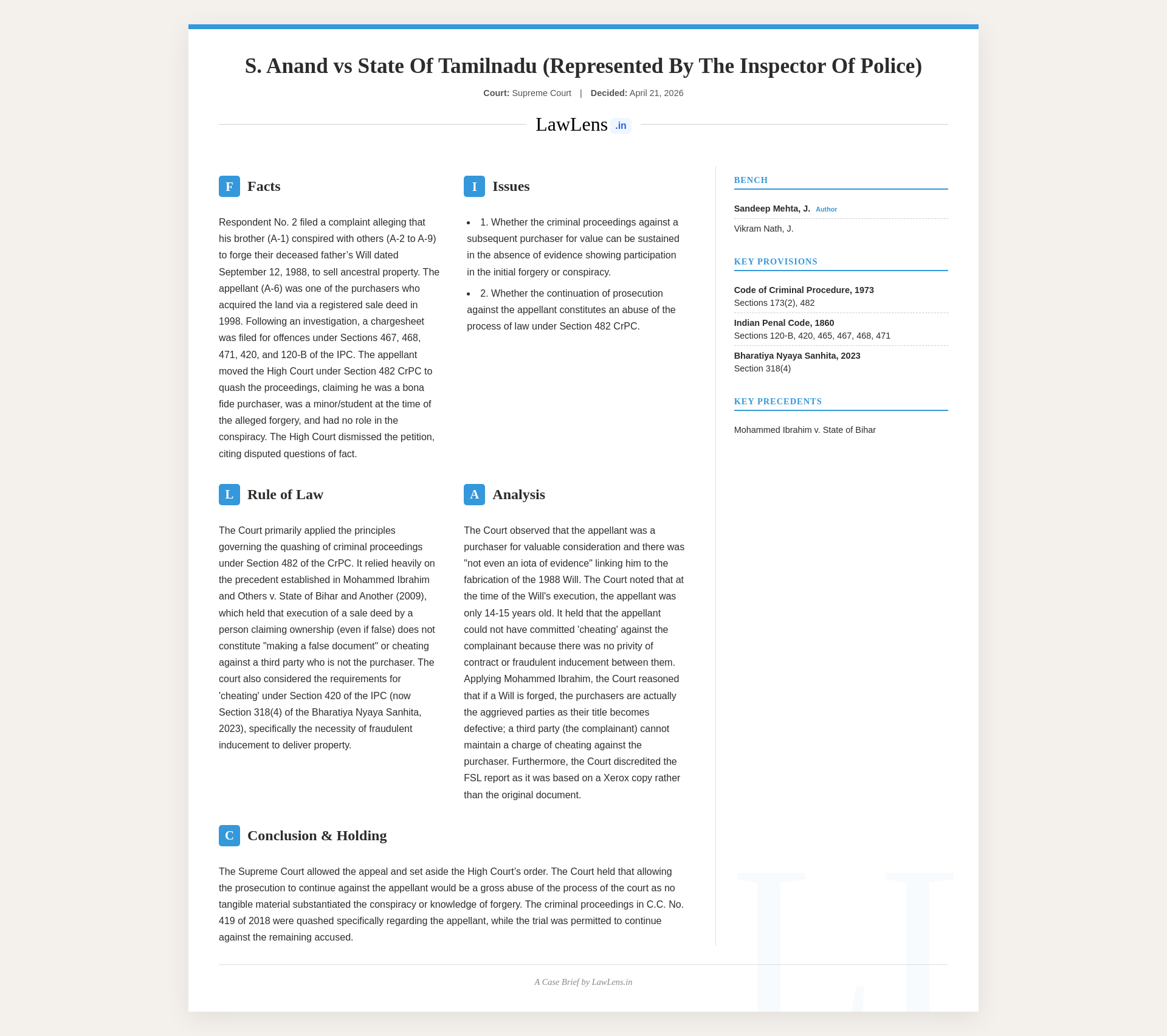
Code of Criminal Procedure 1973 - Section 482- Madras High Court refused to quash criminal proceedings against the appellant, a purchaser of land alleged to have been conveyed on the basis of a forged Will. The Supreme Court held that there was no material showing the appellant’s participation in the alleged forgery or conspiracy, that he was only a purchaser for valuable consideration with no privity of contract or fraudulent inducement vis‑à‑vis the complainant, and that even the handwriting expert’s report was based only on a xerox copy of the Will. Concluding that continuing prosecution against the appellant would be an abuse of process, the Court quashed the proceedings as against him alone while permitting the trial to continue against the other accused.
Case Info
Key Case Details
Case name and neutral citation:S. Anand v. State of Tamil Nadu (Represented by the Inspector of Police) & Anr., 2026 INSC 418
Coram:Justice Vikram Nath and Justice Sandeep Mehta
Judgment date:21 April 2026, Supreme Court of India
Statutes / laws referred:
- Code of Criminal Procedure, 1973:
- Section 482 (inherent powers of High Court)
- Section 173(2) (police report)
- Indian Penal Code, 1860:
- Section 120-B (criminal conspiracy)
- Section 420 (cheating) – explicitly linked to corresponding Section 318(4) of the Bharatiya Nyaya Sanhita, 2023
- Sections 465, 467, 468, 471 (forgery-related offences)
Caselaws and citations referred:
- Mohammed Ibrahim and Others v. State of Bihar and Another, (2009) 8 SCC 751
Brief Summary (Three Sentences)
This appeal arose from the refusal of the Madras High Court to quash criminal proceedings against the appellant, a purchaser of land alleged to have been conveyed on the basis of a forged Will. The Supreme Court held that there was no material showing the appellant’s participation in the alleged forgery or conspiracy, that he was only a purchaser for valuable consideration with no privity of contract or fraudulent inducement vis‑à‑vis the complainant, and that even the handwriting expert’s report was based only on a xerox copy of the Will. Concluding that continuing prosecution against the appellant would be an abuse of process, the Court quashed the proceedings as against him alone while permitting the trial to continue against the other accused.