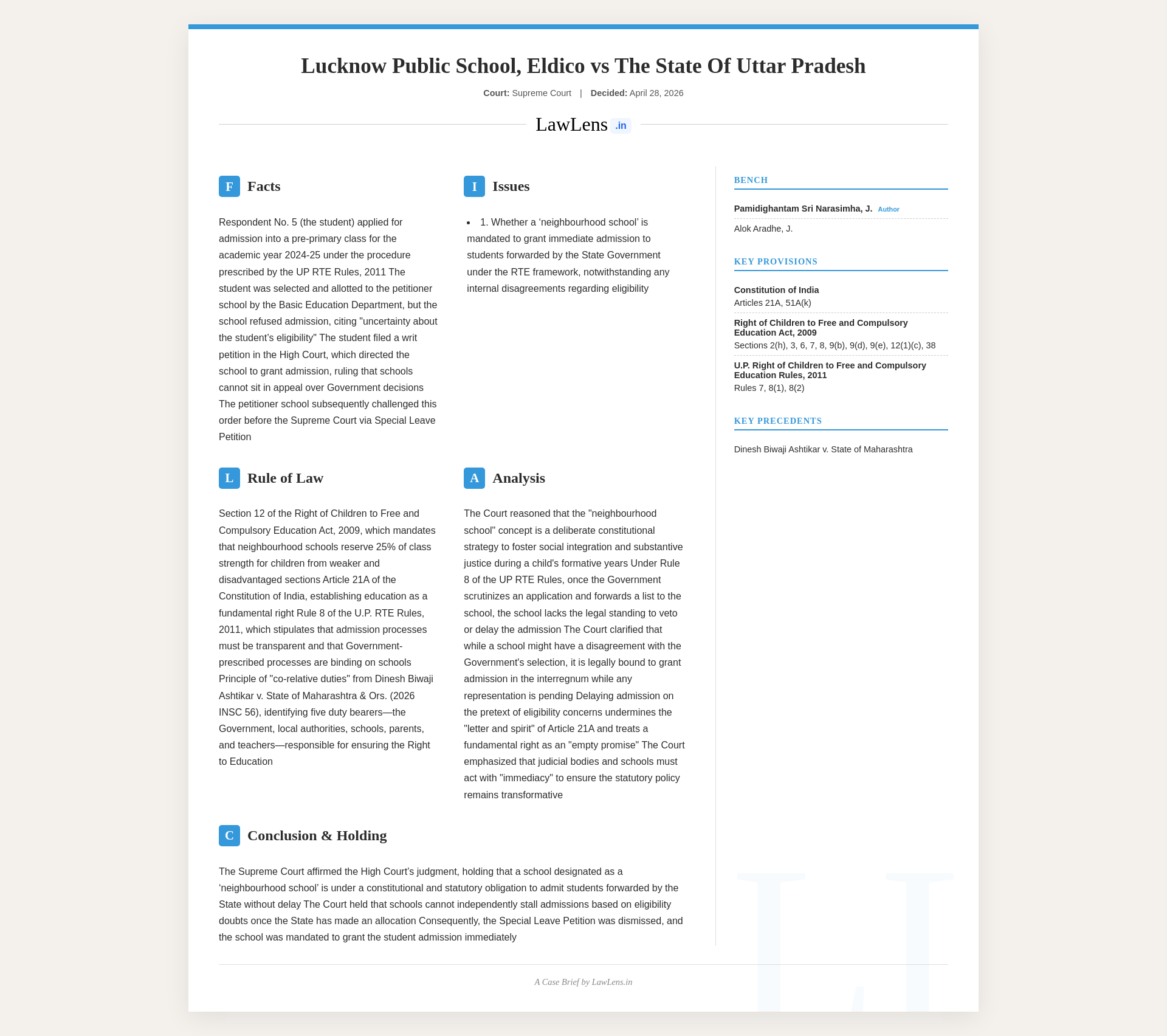
Lucknow Public School, Eldico v. State of Uttar Pradesh 2026 INSC 422 - Right To Education Act
The mandate under Section 12 RTE Act must be enforced with conviction and commitment.

Right of Children to Free and Compulsory Education Act, 2009 (RTE Act, 2009) - Section 12 - The mandate under Section 12 of the Act must be enforced with conviction and commitment. Admission of at least twenty-five percent of class strength in unaided schools with children of weaker and disadvantaged groups must be ensured -Schools may have some disagreement with the selection by the Government, can make representation to the concerned authority, but they ought not wait for the outcome of such a representation and are mandated to grant admission to the student whose name finds mention in list forwarded to the school in the interregnum. (Para 12-14)
Case Info
Case Information Extracted
Case name and neutral citation:Lucknow Public School, Eldico and Anr. v. State of Uttar Pradesh & Ors., 2026 INSC 422
Coram (Judges):Justice Pamidighantam Sri NarasimhaJustice Alok Aradhe
Judgment date:28 April 2026 (New Delhi)
Case laws and citations referred
- Dinesh Biwaji Ashtikar v. State of Maharashtra & Ors., 2026 INSC 56– Quoted extensively for the concept of five “duty bearers” in implementing the right to elementary education (appropriate government, local authority, neighbourhood schools, parents/guardians, and primary school teachers), and for the constitutional and statutory framework of the RTE regime.
Statutes / laws referred
- Constitution of India– Article 21A (fundamental right to free and compulsory education)– Article 51A(k) (fundamental duty of parents/guardians to provide opportunities for education to children between six and fourteen years)
- Right of Children to Free and Compulsory Education Act, 2009 (RTE Act, 2009)– Section 3 (right to free and compulsory elementary education)– Section 6 (duty to establish neighbourhood schools)– Section 7 (sharing of financial responsibilities between Centre and State)– Section 8 (duties of appropriate government)– Section 9 (duties of local authority, including ensuring neighbourhood schools, maintaining records, and monitoring admission and completion)– Section 12 and in particular Section 12(1)(c) (obligation of neighbourhood/unaided schools to admit at least 25% of strength in entry‑level class from weaker sections and disadvantaged groups, free of cost)– Section 38 (power to make rules)
- U.P. Right of Children to Free and Compulsory Education Rules, 2011 (UP RTE Rules, 2011)– Rule 7 (non‑segregation, non‑discrimination of children admitted under Section 12(1)(c))– Rule 8 (transparent admission process, maintenance and publication of details, written reasons for non‑admission, binding nature of State‑prescribed admission process)
Three‑sentence brief summary
The Supreme Court held that once the State Government allots a child to a neighbourhood unaided school under Section 12(1)(c) of the RTE Act and the UP RTE Rules, the school has no option but to grant admission immediately and cannot sit in appeal over the State’s decision. Emphasising the transformative and integrative role of the 25% reservation for children from weaker and disadvantaged sections, the Court reiterated that neighbourhood schools, along with the government, local authorities, parents and teachers, are duty‑bearers in the national mission of realising the right to education under Article 21A. Affirming the High Court’s order, the Court directed that schools may make representations if they disagree with the selection, but must in the meantime admit the child without delay to actualise this constitutional promise.