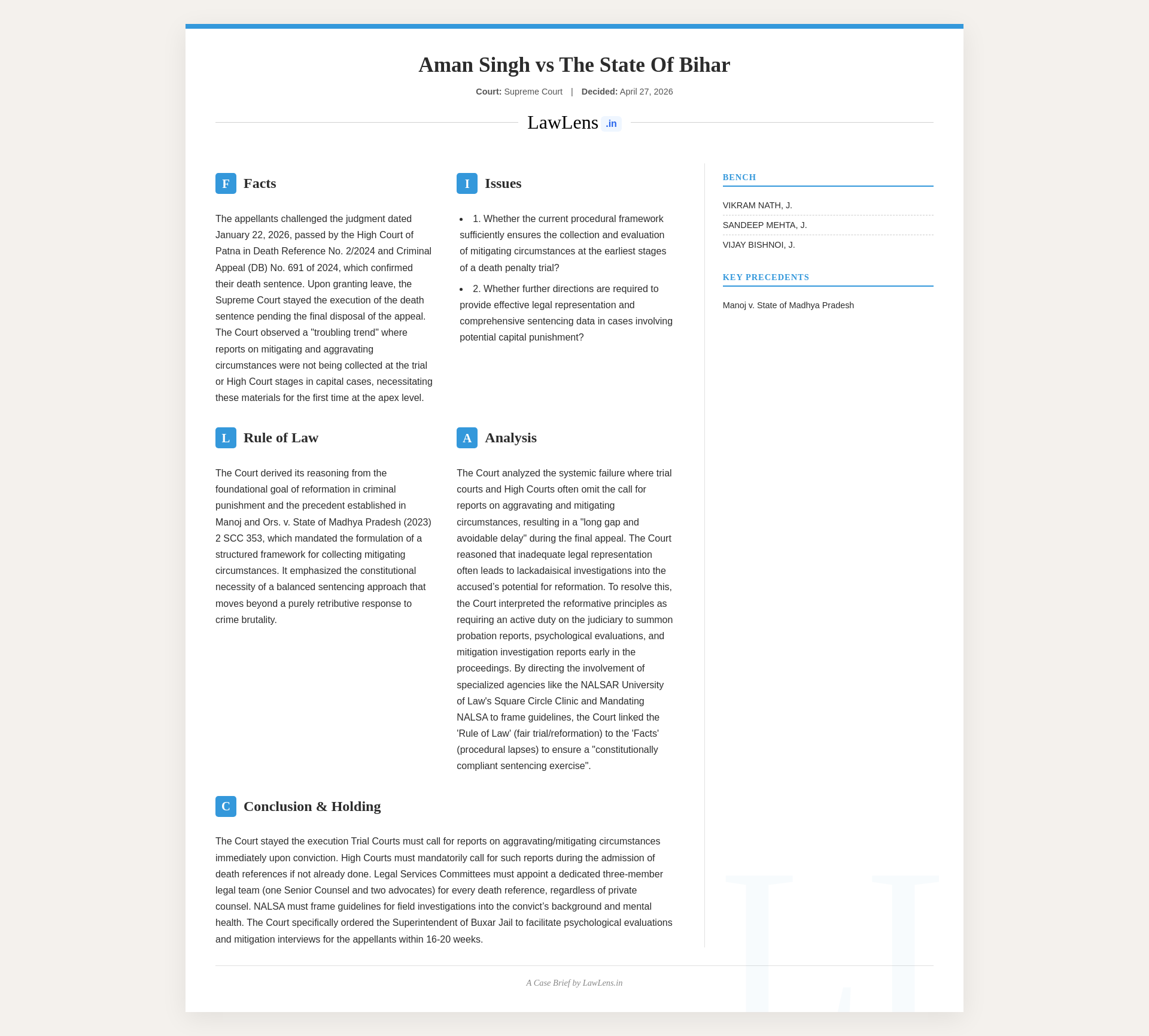
Aman Singh vs. State of Bihar 2026 INSC 424 - Death Sentence Matters - Calling Of Report -Aggravating & Mitigating Circumstances
The report pertaining to aggravating and mitigating circumstances shall, as a matter of course, be called for by the trial Court itself once the accused is convicted, prior to the determination of sentence

Criminal Trial - Death Sentence Matters - A. The report pertaining to aggravating and mitigating circumstances shall, as a matter of course, be called for by the trial Court itself once the accused is convicted, prior to the determination of sentence. B. In the event such a report has not been called for or placed on record before the trial Court, the High Court shall mandatorily call for the same at the stage of admission of the death reference C. The concerned authorities shall ensure that such reports are comprehensive, duly verified, and furnished within a stipulated timeframe so as to avoid any delay in the adjudicatory process, and to aid and enable the Courts to undertake a meaningful, informed, and constitutionally compliant sentencing exercise. Upon receipt of such report, the Court concerned shall afford adequate opportunity to the parties to peruse the same and to advance oral submissions thereon. In cases where the reports procured by the trial Court are found to be ineffective or lacking in proper details, the High Court would be at liberty to call for a fresh report. D. In every death sentence confirmation reference brought before the High Courts and this Court, the Legal Services Committee concerned shall assign a dedicated legal team comprising one Senior Counsel and at least two advocates having a minimum of 7 years practice, to represent the convicted person. Such representation shall be provided irrespective of whether the convict has engaged private counsel, so as to ensure full and effective assistance to the Court in matters involving death penalty, which necessitate a careful balancing of the interests of justice, societal concerns, and the possibility of reformation and rehabilitation. The appointed legal team shall be furnished with the complete case records and afforded adequate time to prepare, conduct research, and present a comprehensive assessment of mitigating circumstances. The legal aid team so appointed shall work in cohesion with the representing private counsel, if any. E. Each High Court, under the aegis of the High Court Legal Services Committee, shall constitute and maintain a dedicated panel of advocates for handling death reference matters. F. The National Legal Services Authority shall frame and circulate appropriate guidelines identifying the relevant fields of enquiry for gathering mitigating circumstances and may engage trained teams, including legal and social science professionals, to undertake fieldwork involving interaction with the convict, their family, and relevant authorities, for the purpose of collecting detailed information regarding background, antecedents, socio-economic conditions, mental health status, and other relevant factors. Such information shall be made available to the appointed legal team, which shall, in turn, place before the Court a holistic and well-documented account of the convict’s potential for reformation along with all pertinent mitigating and aggravating circumstances to assist in a just and informed determination of sentence.
Case Info
Basic Case Details
Case name: Aman Singh & Anr. vs. State of BiharNeutral citation: 2026 INSC 424
Coram (Judges):Justice Vikram Nath, Justice Sandeep Mehta, Justice Vijay Bishnoi
Judgment/order date: 27 April 2026
Case laws and citations referred
- Manoj and Ors. v. State of Madhya Pradesh, (2023) 2 SCC 353Referred to for the principles on sentencing in death penalty cases, especially the need to systematically collect and assess mitigating circumstances, and to focus on reformation and rehabilitation through a structured framework.
Statutes / laws referred (by subject)
The order does not cite specific statutory sections by number, but it operates within and refers to:
- The framework of criminal appellate jurisdiction of the Supreme Court of India (Constitution of India & Code of Criminal Procedure, 1973) in death reference matters.
- The death penalty sentencing framework, including the requirement to consider aggravating and mitigating circumstances and the potential for reformation (constitutional principles under Articles 14, 20, 21, and CrPC provisions on sentencing and reference of death sentences to High Courts).
- The legal aid framework under the Legal Services Authorities Act and the role of:
- National Legal Services Authority (NALSA)
- High Court Legal Services Committees
- State/UT Legal Services Authorities
These are invoked when directing constitution of dedicated legal teams, panels of lawyers, and formulation of guidelines for mitigation investigations in death penalty cases.
Brief three‑sentence summary
The Supreme Court stays the execution of the death sentence awarded to Aman Singh and another, calls for the complete trial and High Court records, and directs detailed reports on their conduct, work, and psychological evaluation in jail, along with a mitigation investigation report. Noticing a recurring failure of trial courts and High Courts to timely obtain and consider reports on aggravating and mitigating circumstances in potential death sentence cases, and the inadequacy of defence representation, the Court lays down mandatory directions for future cases. It directs that sentencing courts and High Courts must always call for comprehensive mitigation reports, that NALSA and Legal Services Committees create specialised guidelines, panels, and legal teams for death references, so that courts receive a full, constitutionally compliant picture before deciding on the death penalty.