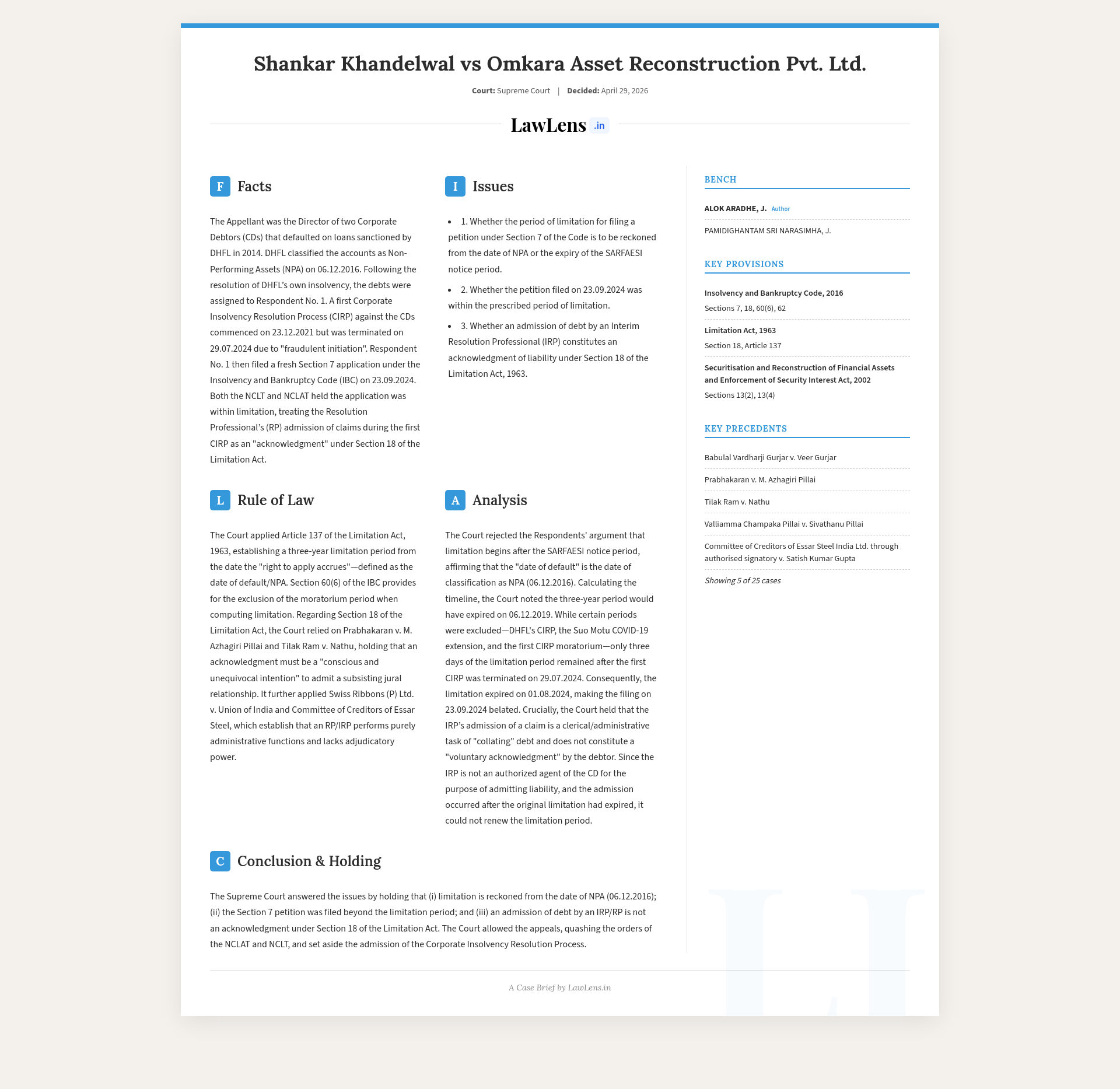
Shankar Khandelwal v. Omkara Asset Reconstruction Pvt. Ltd. & Anr., 2026 INSC 429 - IBC - Limitation Act - RP
IRP’s admission of secured financial creditors debt in first CIRP was not an acknowledgement under Section 18 Limitation Act

Insolvency and Bankruptcy Code, 2016 - Section 18 ; Limitation Act, 1963 - Section 18- Resolution Professional (RP) - RP has no adjudicatory powers and his role involves collation of claims. RP performs its administrative duties under Section 18 of the Code. The admission of a claim by RP is merely an administrative/clerical task performed as part of its statutory duties under Section 18 of the Code and, therefore, admission of claim by RP only means induction/entry of a claim. An admission of a claim by RP is akin to mere recital/reference of debt, which does not amount to an acknowledgment under Section 18 of the 1963 Act . Therefore, IRP’s admission of secured financial creditors debt in first CIRP was not an acknowledgement under Section 18 of 1963 Act. (Para 16)
Insolvency and Bankruptcy Code, 2016 – Section 7 ; Limitation Act, 1963 - Article 137 - The limitation for filing an application under Section 7 of the Code is three years and is governed by Article 137 of 1963 Act. The accrual of such right has been consistently interpreted by this Court to arise on the date of the default, that is, when the corporate debtor first fails to discharge its repayment obligations. The limitation begins to run from the date of classification of the account as NPA, being the date of default, and not from any subsequent proceeding initiated for recovery. (Para 13)
Limitation Act, 1963 - Section 18- For a writing to constitute a valid acknowledgment, it must be made by the party against whom the right is claimed, or by a person duly authorized on its behalf; it must be made before the expiration of the prescribed period of limitation; and, most importantly, it must evince a conscious and unequivocal intention to admit a subsisting jural relationship and an existing liability. A mere reference to a past transaction or a bald recital of a debt, without an intention to admit liability, would not suffice. An acknowledgment under Section 18 can only extend/renew a limitation period which has not already expired. Therefore, a limitation period can be extended only by an acknowledgment which is made within the period of limitation. (Para 16- 17)
Case Info
Basic Case Information
Case name and neutral citation:Shankar Khandelwal v. Omkara Asset Reconstruction Pvt. Ltd. & Anr., 2026 INSC 429
Coram:Justice Pamidighantam Sri Narasimha and Justice Alok Aradhe
Judgment date:29 April 2026
Statutes/laws referred:Insolvency and Bankruptcy Code, 2016 – especially Section 7 and Section 60(6)Limitation Act, 1963 – especially Article 137 and Section 18Securitisation and Reconstruction of Financial Assets and Enforcement of Security Interest Act, 2002 – especially Sections 13(2) and 13(4)Suo motu orders of the Supreme Court in Cognizance for Extension of Limitation due to COVID‑19
Case law cited (with citations)
From the judgment text:
- Babulal Vardharji Gurjar v. Veer Gurjar (2020) 15 SCC 1
- Prabhakaran & Ors. v. M. Azhagiri Pillai (Dead) by LRs & Ors. (2006) 4 SCC 484
- Tilak Ram & Ors. v. Nathu & Ors. 1966 SCC OnLine SC 99
- Valliamma Champaka Pillai v. Sivathanu Pillai & Ors. (1979) 4 SCC 429
- Committee of Creditors of Essar Steel India Ltd. v. Satish Kumar Gupta & Ors. (2020) 8 SCC 531
- Ajay Kumar Radheyshyam Goenka v. Tourism Finance Corporation of India Ltd. (2023) 10 SCC 545
- China Development Bank v. Doha Bank Q.P.S.C. & Ors. (2025) 7 SCC 729
- Kotak Mahindra Bank Ltd. v. Kew Precision Parts Pvt. Ltd. & Ors. (2022) 9 SCC 364
- Laxmi Pat Surana v. Union Bank of India & Anr. (2021) 8 SCC 481
- Reliance Asset Reconstruction Co. Ltd. v. Hotel Poonja International Pvt. Ltd. (2021) 7 SCC 352
- Hindalco Industries Ltd. v. Hirakud Industrial Works Ltd. & Ors. 2023 SCC OnLine NCLAT 1554
- Expert Realty Professionals Pvt. Ltd. v. Logix Infrastructure Pvt. Ltd. & Ors. 2025 SCC OnLine NCLAT 1455
- Cognizance For Extension of Limitation, In Re (2022) 3 SCC 117
- New Delhi Municipal Council v. Minosha India Limited (2022) 8 SCC 384
- Shantanu Jagdish Prakash v. SBI & Anr. 2025 SCC OnLine NCLAT 117
- Mavjibhai Nagarbhai Patel v. SBI & Anr. 2024 SCC OnLine NCLAT 2014
- R. Kandasamy (D) & Ors. v. T.R.K. Sarawathy & Anr. (2025) 3 SCC 513
- S. Shivraj Reddy (D) thr. LRs & Anr. v. S. Raghuraj Reddy & Ors. 2024 SCC OnLine SC 963
- National Textile Corporation Ltd. v. Naresh Kumar Badrikumar Jagad & Ors. (2011) 12 SCC 695
- Marg Ltd. v. Srei Equipment Finance Ltd. SCC OnLine Cal 7940
- BK Educational Services (P) Ltd. v. Paras Gupta & Associates (2019) 11 SCC 633
- Gaurav Hargovindbhai Dave v. Asset Reconstruction Company (India) Ltd. & Anr. (2019) 10 SCC 572
- Tech Sharp Engineers Pvt. Ltd. v. Sanghvi Movers Ltd. (2023) 2 SCC 53
- Swiss Ribbons Pvt. Ltd. & Anr. v. Union of India & Ors. (2019) 4 SCC 17
- M/s Airen and Associates v. M/s Sanmar Engineering Services Ltd. 2025 SCC OnLine SC 1562
Three‑sentence brief summary
The Supreme Court held that the limitation period for filing the Section 7 IBC application began on 06.12.2016, when the corporate debtors’ loan accounts were classified as NPA, and that even after excluding time under Section 60(6) IBC, the COVID‑19 extension orders, and the moratorium periods, the creditor’s application filed on 23.09.2024 was beyond limitation. The Court further held that admission of a creditor’s claim by an IRP/RP during CIRP is merely an administrative act of collation of claims and does not amount to an “acknowledgment of liability” under Section 18 of the Limitation Act, nor can it revive a time‑barred debt. Consequently, the NCLT and NCLAT orders admitting the Section 7 petition were set aside and the appeals of the erstwhile director were allowed.