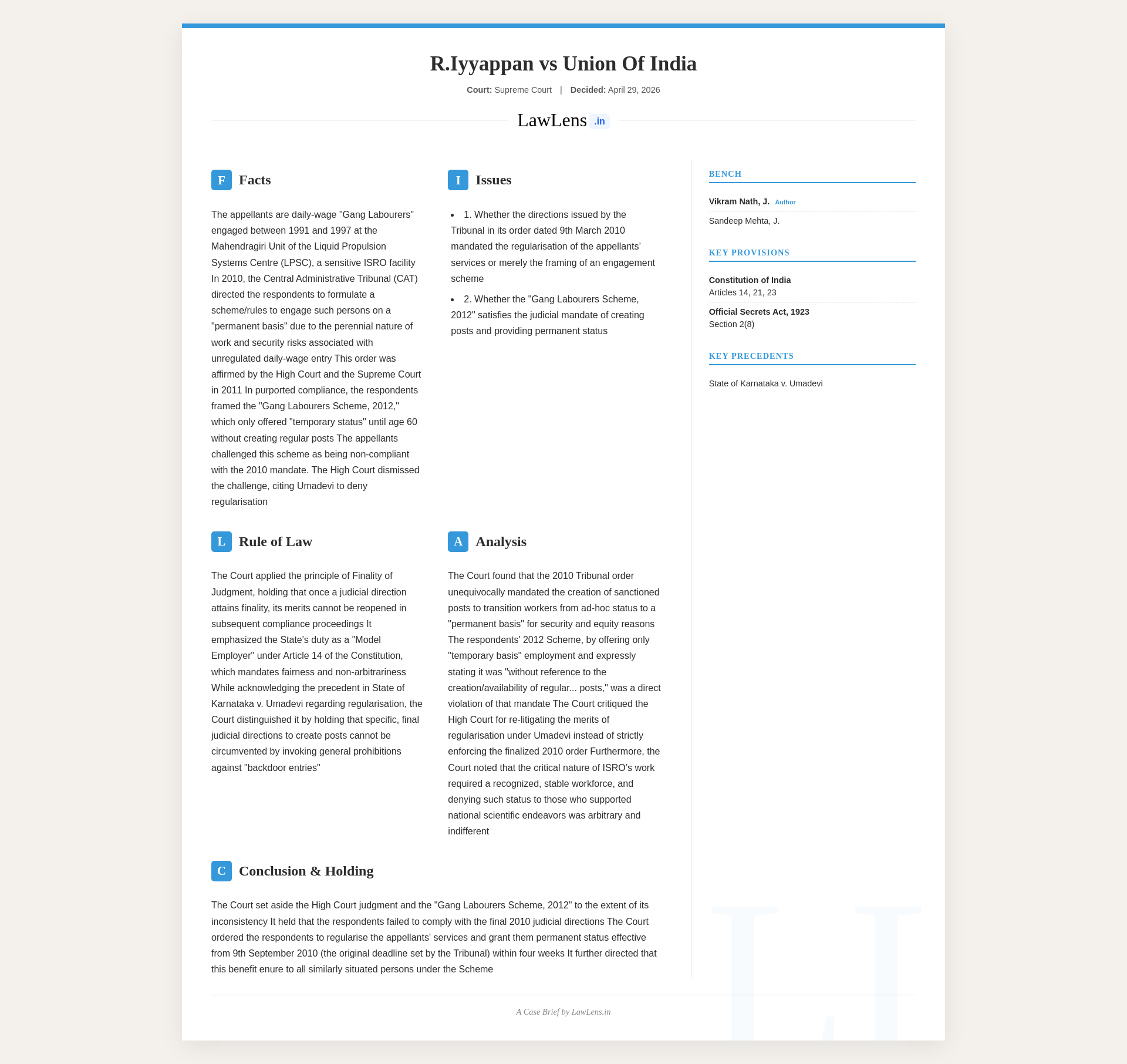
R. Iyyappan v. Union of India 2026 INSC 431 - State - Model Employer

Constitution of India - Article 14- The obligation of the State to act as a model employer is not a mere exhortation but flows directly from the guarantee of equality enshrined in Article 14 of the Constitution. Article 14 strikes at arbitrariness and mandates fairness, non-discrimination, and reasoned decision-making in all State actions. [Context: The appellants were long‑serving daily‑wage “gang labourers” at ISRO’s Liquid Propulsion Systems Centre, Mahendragiri, who claimed a right to regularisation based on an earlier Central Administrative Tribunal order directing the framing of a scheme and creation of posts for permanent engagement. The Supreme Court held that the subsequent “Gang Labourers (Employment for Sporadic Types of Work) Scheme, 2012” failed to comply with the Tribunal’s mandate because it kept workers only on a temporary footing and did not create permanent posts, and that the High Court erred by reopening the merits already finalised in the first round. The Court therefore set aside the inconsistent parts of the Scheme, directed that the appellants be regularised with permanent status from 9 September 2010, and extended the benefit of the judgment to all similarly situated workers under the Scheme.]
Case Info
Basic Case Details
Case name: R. Iyyappan & Ors. v. Union of India & Ors.
Neutral citation: 2026 INSC 431
Coram:Justice Vikram NathJustice Sandeep Mehta
Judgment date: 29 April 2026 (signed at New Delhi; press release dated 12 April is separate)
Case Law and Citations Referred
The judgment expressly refers to:
- State of Karnataka v. Umadevi, (2006) 4 SCC 1 – cited by the High Court (and discussed by the Supreme Court) on the principle that there is no fundamental right to regularisation and that backdoor entries cannot be ordered to be regularised.
No other specific Supreme Court case names or SCC citations are mentioned in the extracted text.
Statutes / Constitutional Provisions Referred
The Court refers to:
- Article 14 of the Constitution of India – State’s obligation to act as a model employer, and prohibition of arbitrariness in service matters.
- Article 21 of the Constitution of India – referred to indirectly in summarising the High Court’s reasoning that no right to employment flows from Article 21.
- Article 23 of the Constitution of India – invoked by the appellants, arguing that continued daily‑wage engagement without regularisation is exploitative and violative of the prohibition on forced labour.
- Official Secrets Act – cited to describe Mahendragiri campus of LPSC as a “prohibited area” and to highlight security concerns.
Three‑Sentence Brief Summary
The appellants were long‑serving daily‑wage “gang labourers” at ISRO’s Liquid Propulsion Systems Centre, Mahendragiri, who claimed a right to regularisation based on an earlier Central Administrative Tribunal order directing the framing of a scheme and creation of posts for permanent engagement. The Supreme Court held that the subsequent “Gang Labourers (Employment for Sporadic Types of Work) Scheme, 2012” failed to comply with the Tribunal’s mandate because it kept workers only on a temporary footing and did not create permanent posts, and that the High Court erred by reopening the merits already finalised in the first round. The Court therefore set aside the inconsistent parts of the Scheme, directed that the appellants be regularised with permanent status from 9 September 2010, and extended the benefit of the judgment to all similarly situated workers under the Scheme.