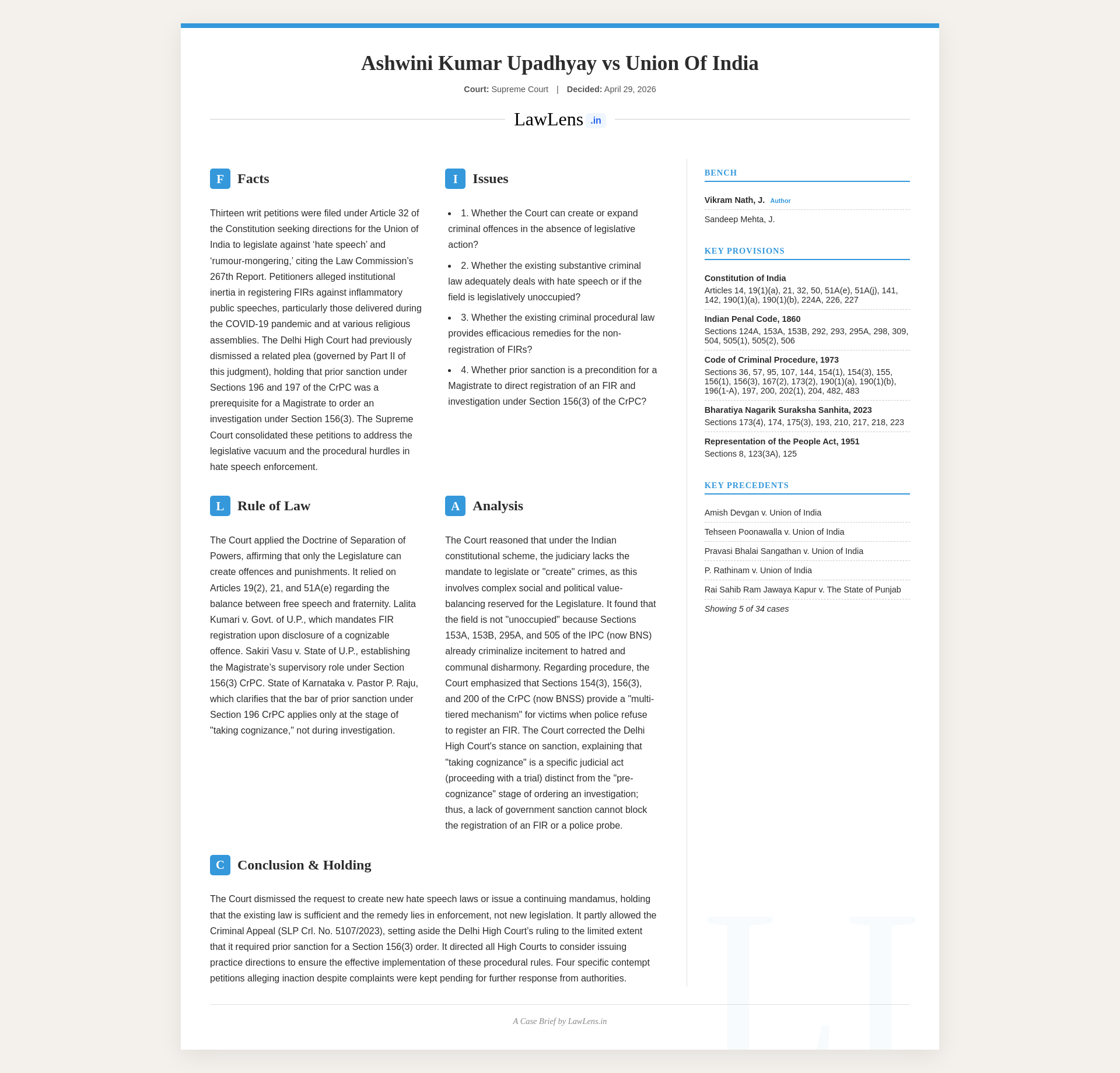
Ashwini Kumar Upadhyay v. Union of India 2026 INSC 432 - Hate Speech - Fraternity

Constitution of India - Article 32- Supreme Court, in exercise of its constitutional jurisdiction, cannot create or expand criminal offences or prescribe punishments in the absence of legislative sanction. Any such exercise would transgress the settled doctrine of separation of powers and encroach upon the legislative domain. The field of substantive criminal law governing hate speech is not unoccupied. The existing statutory framework contains adequate provisions to address acts that promote enmity, hatred, or disturb public order. The grievance projected pertains not to any legislative vacuum, but to issues of enforcement -The procedural framework under the CrPC (now Bharatiya Nagarik Suraksha Sanhita, 2023) provides a comprehensive and multi-tiered mechanism to address grievances arising from non-registration of FIRs. The remedies available under Sections 154(3), 156(3) and 200 of the CrPC, coupled with the supervisory jurisdiction of the Magistrate, constitute an efficacious statutory scheme. (Para 98). [Context: The Supreme Court dismisses a batch of Article 32 writ petitions seeking new, court‑crafted criminal offences and continuing mandamus to curb hate speech, holding that creation or expansion of crimes and punishments is exclusively a legislative function and that existing criminal/statutory provisions already cover hate‑speech‑type conduct. It observed: issues relating to ‘hate speech’ and ‘rumour mongering’ bear directly upon the preservation of fraternity, dignity, and constitutional order. It would be open to the Union of India and competent legislative authorities to consider, in their wisdom, whether any further legislative or policy measures are warranted in light of evolving societal challenges or to bring about suitable amendments as suggested by the Law Commission’s 267th Report dated 23rd March, 2017 ]
Code of Criminal Procedure 1973 - Section 156(3),190, 196,197 - Bharatiya Nagarik Suraksha Sanhita 2023 - Section 175(3), 210, 217,218-The requirement of sanction is, therefore, a condition precedent only for taking cognizance and not for the registration of an FIR or for the conduct of investigation (Para 127) The requirement of prior sanction under Sections 196 and 197 of CrPC (corresponding Sections 217 and 218 of BNSS) operates at the stage of taking cognizance and does not extend to the pre-cognizance stage of registration of FIR or investigation under Section 156(3) of CrPC (corresponding Section 175(3) of BNSS). An order directing investigation under Section 156(3) of CrPC does not amount to taking cognizance within the meaning of Section 190 of CrPC (corresponding Section 210 of BNSS). (Para 164 (IX))
Constitution of India - Article 32- Court must exercise due circumspection while invoking its constitutional powers and employing judicially evolved mechanisms. Such tools cannot be deployed in anticipation of a possible failure or omission in the discharge of statutory duties, much less in relation to contingencies that have not yet arisen. Where the statute itself provides a complete and efficacious remedial framework, it would be inappropriate for this Court to transgress the limits imposed by the doctrine of separation of powers by assuming functions that are primarily vested in the Executive. It is only upon a demonstrated failure in the discharge of statutory obligations that constitutional Courts may justifiably step in, in exercise of their power of judicial review. A writ of mandamus is ordinarily issued in situations where the law provides no specific remedy and where justice, despite being sought, has not been rendered. (Para 72-73) While the Constitution recognises the doctrine of separation of powers, it does not adopt it in its rigid or absolute form. Nonetheless, the functional demarcation between the three organs of the State remains fundamental. One organ cannot usurp the essential functions assigned to another. Just as the Legislature cannot assume the function of interpreting laws, which lies within the domain of the Judiciary, the Judiciary likewise cannot assume the role of the Legislature by enacting laws. (Para 25) while exercising its writ jurisdiction, this Court may interpret and develop the law and may also indicate the necessity for legislative reform where the circumstances so warrant. However, the Court cannot issue a writ of mandamus directing the Legislature or the Government to enact a particular law or to introduce a Bill before the Legislature within a stipulated time frame. While the Court may draw attention to the need for legislative action, it cannot compel the Legislature to undertake the law-making function. (Para 36)
Code of Criminal Procedure 1973 - Section 155 ; Bharatiya Nagarik Suraksha Sanhita 2023 - Section 174 - Mandatory Language - The officer in charge of a police station to record the substance of information relating to a noncognizable offence in the prescribed register. Though investigation in such cases requires prior authorization of the Magistrate, the recording of information itself is not left to discretion. (Para 49)
Code of Criminal Procedure 1973 - Section 156(3) - Bharatiya Nagarik Suraksha Sanhita 2023 - Section 175 -The power to order investigation under Section 156(3) implicitly includes the power to direct registration of a case. once a Magistrate directs investigation under Section 156(3) of CrPC, the police is duty-bound to first register an FIR and thereafter proceed with the investigation into the complaint, which, upon such direction, attains the character of a duly registered case disclosing a cognizable offence. (Para 54) The supervisory jurisdiction of the Magistrate under Section 156(3) of CrPC (Section 175 of BNSS) is of a wide amplitude, encompassing judicial oversight over the investigative process at various stages. Such jurisdiction is not confined merely to the precognizance stage, but extends, in appropriate cases, even after the submission of the police report under Section 173 of CrPC (Section 193 of BNSS) (Para 57)
Constitution of India - Preamble - Preamble is an integral part of the Constitution of India. Preamble embodies the foundational values of the Constitution, i.e. justice, liberty, equality and fraternity, which together constitute the guiding faith and normative framework of the constitutional order, imbued with a sense of permanence. (Para 87) Fraternity - Citizenship - The modern construct of “citizenship” cannot be reduced to a basis for exclusion or division. It is, therefore, inconceivable that citizens be classified or discriminated against on grounds such as caste, colour, creed, gender, or any other marker rooted in an “us versus them” mindset. Such an approach would be wholly inconsistent with the constitutional vision of unity, dignity, and equality. The Constitution of India, thus, does not envisage classification as a means to foster division or discrimination among its citizens. On the contrary, it seeks to promote the welfare of the nation through collective coexistence, grounded in mutual respect, harmony, and a shared sense of fraternity. (Para 87-90) “Vasudhaiva kutumbakam” - The idea that the entire world is one family. Rooted in the Yajur Veda, the expression signifies a worldview that transcends narrow identities and affirms universal kinship. In constitutional terms, it resonates with the principle of fraternity, which calls upon every citizen to recognise the shared humanity and equal dignity of all others.
Case Info
Extracted Information from the Judgment
Case name and neutral citation Ashwini Kumar Upadhyay v. Union of India & Ors. & connected mattersNeutral citation is not expressly mentioned in the text provided; only cause-title and case numbers (W.P.(C) No. 943 of 2021 etc., SLP (C) No. 6913 of 2021, SLP (Crl.) No. 5107 of 2023, various WPs/Diaries/Contempt Petitions) appear. On this text alone, no specific neutral-citation number can be extracted.
CoramBench of: Justice Vikram Nath and Justice Sandeep Mehta(Lead opinion authored by Vikram Nath, J.)
Judgment date29 April 2026 (as shown at the end: “NEW DELHI APRIL 29, 2026” and the press‑release heading)
Case law and citations referred
- P. Rathinam v. Union of India, (1994) 3 SCC 394
- Rai Sahib Ram Jawaya Kapur v. State of Punjab, AIR 1955 SC 549
- Kesavananda Bharati v. State of Kerala, (1973) 4 SCC 225
- Supreme Court Advocates-on-Record Assn. v. Union of India, (2016) 5 SCC 1
- Asif Hameed v. State of J&K, 1989 Supp (2) SCC 364
- Supreme Court Women Lawyers Assn. v. Union of India, (2016) 3 SCC 680
- Vishaka v. State of Rajasthan, (1997) 6 SCC 241 : 1997 SCC (Cri) 932
- Dr. Ashwini Kumar v. Union of India, (2020) 13 SCC 585
- Union of India v. K. Pushpavanam, (2023) 20 SCC 736
- Pravasi Bhalai Sangathan v. Union of India, AIR 2014 SC 1591
- Tehseen S. Poonawalla v. Union of India, (2018) 9 SCC 501
- Lalita Kumari v. Government of U.P., (2014) 2 SCC 1
- Madhu Bala v. Suresh Kumar, (1997) 8 SCC 476
- Sakiri Vasu v. State of U.P., (2008) 2 SCC 409
- Union of India v. S.B. Vohra, (2004) 2 SCC 150
- Lok Prahari v. Union of India, (2021) 15 SCC 80
- Tirupati Balaji Developers (P) Ltd. v. State of Bihar, (2004) 5 SCC 1
- National Federation of Indian Women v. Union of India, W.P. (C) No. 719 of 2023
- K.S. Puttaswamy v. Union of India, (2017) 10 SCC 1
- Citizenship Act, 1955, s. 6‑A, In Re, (2024) 16 SCC 105
- Kaushal Kishor v. State of U.P., (2023) 4 SCC 1
- Bhim Singh v. Union of India, (2010) 5 SCC 538
- Kalpana Mehta v. Union of India, (2018) 7 SCC 1
- P. Ramachandra Rao v. State of Karnataka, (2002) 4 SCC 578 : 2002 SCC (Cri) 830
- State of Karnataka v. Pastor P. Raju, (2006) 6 SCC 728
- R.R. Chari v. State of U.P., 1951 SCC OnLine SC 22
- Supt. & Remembrancer of Legal Affairs v. Abani Kumar Banerjee, 1950 SCC OnLine Cal 49
- Anil Kumar v. M.K. Aiyappa, (2013) 10 SCC 705
- L. Narayana Swamy v. State of Karnataka, (2016) 9 SCC 598
- Manju Surana v. Sunil Arora, (2018) 5 SCC 557
(Plus references to foreign case Airedale NHS Trust v. Bland, 1993 AC 789, etc., in quotations.)
Statutes / laws referred
- Constitution of India – Articles 14, 19(1)(a), 21, 32, 50, 224‑A, 226, 227; Preamble; Part IVA – Article 51A(e), (j); basic‑structure / judicial review.
- Indian Penal Code, 1860 (IPC) – ss. 124A, 153A, 153B, 295A, 298, 504, 505(1),(2), 506, 309 etc.
- Bharatiya Nyaya Sanhita, 2023 (BNS) – corresponding provisions replacing IPC (promoting enmity, national integration, religious offences).
- Code of Criminal Procedure, 1973 (CrPC) – ss. 36, 95, 107, 144, 154(1), 154(3), 155, 156(1),(3), 167, 173(2), 190, 196, 197, 200, 202, 204; Chapters XII, XIV, XV, XXXVI.
- Bharatiya Nagarik Suraksha Sanhita, 2023 (BNSS) – ss. 173, 173(4), 174, 175, 193, 210, 217, 218, 223 etc. (as replacements of CrPC provisions).
- Representation of the People Act, 1951 – ss. 8, 123(3A), 125.
- Protection of Civil Rights Act, 1955 – s. 7.
- Religious Institutions (Prevention of Misuse) Act, 1988 – s. 3(g).
- Cable Television Networks (Regulation) Act, 1995 – ss. 5, 6 and Rules 6, 7 of the Cable Television Network Rules, 1994.
- Cinematograph Act, 1952 – ss. 4, 5B, 7.
- Unlawful Activities (Prevention) Act, 1967 – referred in prayers re action against hate‑speech organisations.
Also: Law Commission of India, 267th Report (2017) on “Hate Speech” (proposed ss. 153C, 505A IPC).
Three‑sentence brief summary
The Supreme Court dismisses a batch of Article 32 writ petitions seeking new, court‑crafted criminal offences and continuing mandamus to curb hate speech, holding that creation or expansion of crimes and punishments is exclusively a legislative function and that existing criminal/statutory provisions already cover hate‑speech‑type conduct. It finds the real problem to be uneven enforcement, not a legislative vacuum, and reiterates the mandatory nature of FIR registration and the layered remedies under CrPC/BNSS (including recourse to the Magistrate under s. 156(3), etc.), clarifying that prior sanction under ss. 196/197 CrPC is needed only at the cognizance stage, not for directing registration of an FIR. The Court partly allows one criminal appeal to correct the High Court’s view on prior sanction, closes several contempt petitions where FIRs were in fact registered or no complaint was made, keeps a few contempt matters pending for responses, and ends with a strong restatement of fraternity and “vasudhaiva kutumbakam” as constitutional values threatened by hate speech.