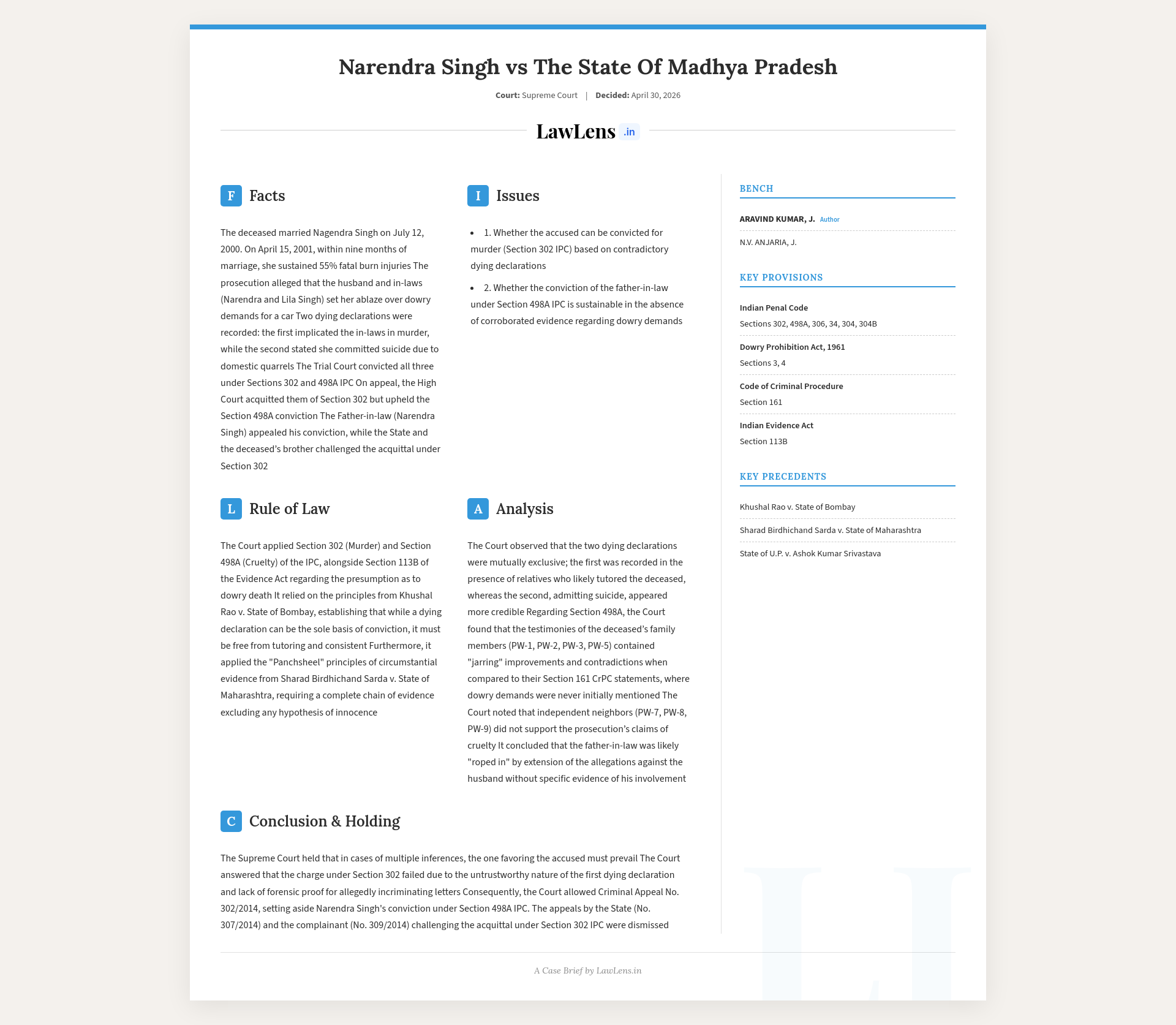
Narendra Singh v. State of Madhya Pradesh 2026 INSC 433 - S.498A IPC - Family Members
Section 498A IPC is to ensure the safety of women in their marital homes and not to take grudges against all the members of the family even in the absence of any role attributable to them

Indian Penal Code 1860 - Section 498A - This is to ensure the safety of women in their marital homes and not to take grudges against all the members of the family even in the absence of any role attributable to them. (Para 27)
Criminal Trial - While conviction can be solely based on a dying declaration, the court still has to weigh the same in the light of the surrounding circumstances and with reference to the principles governing the evidence tendered by the prosecution. Circumstances cannot take the place of proof and in a criminal trial, the guilt has to be proved beyond reasonable doubt. (Para 25) In a criminal trial, in case there are two inferences possible, then the one favouring the accused must be followed. (Para 27)
Case Info
Case Information
Case name: Narendra Singh v. State of Madhya Pradesh & Connected Appeals (Criminal Appeal Nos. 302, 307, 309 of 2014)Neutral citation: Not mentioned in the text you’ve provided (SC has not yet appended a neutral citation in this extract).
Coram:
- Justice Aravind Kumar (author of the judgment)
- Justice N.V. Anjaria
Judgment date: 30 April 2026 (New Delhi; April 30th, 2026.)
Statutes / Laws Referred
Indian Penal Code, 1860:
- Section 302 (Murder)
- Section 304B (Dowry death)
- Section 306 (Abetment of suicide – appears in FIR)
- Section 498A (Cruelty by husband or relatives)
- Section 34 (Common intention)
Dowry Prohibition Act, 1961:
- Sections 3 and 4
Indian Evidence Act, 1872:
- Section 113B (Presumption as to dowry death)
Code of Criminal Procedure, 1973:
- Section 161 CrPC (Statements to police)
Case Law & Citations Cited
- Khushal Rao v. State of Bombay, 1957 SCC OnLine SC 20– Principles on evidentiary value and evaluation of dying declarations.
- Sharad Birdhichand Sarda v. State of Maharashtra, (1984) 4 SCC 116– “Panchsheel” principles governing conviction based on circumstantial evidence.
- State of U.P. v. Ashok Kumar Srivastava, (1992) 2 SCC 86– Caution in appreciating circumstantial evidence and rule that where two views are possible, the one favouring the accused should be adopted.
Brief Summary (Three Sentences)
A young married woman suffered fatal burn injuries within nine months of marriage, leading to prosecution of her husband and in‑laws for murder, dowry death and cruelty, primarily on the basis of two conflicting dying declarations and testimony from her family about dowry demands. The Supreme Court found serious contradictions and afterthoughts in the relatives’ evidence, lack of independent corroboration, hostility of neighbours, and tutoring indicated in the first dying declaration, while the second declaration supporting suicide was found more credible. Holding that the prosecution had failed to prove either murder or cruelty beyond reasonable doubt, the Court set aside Narendra Singh’s conviction under section 498A IPC and dismissed the appeals seeking to restore the section 302 conviction.