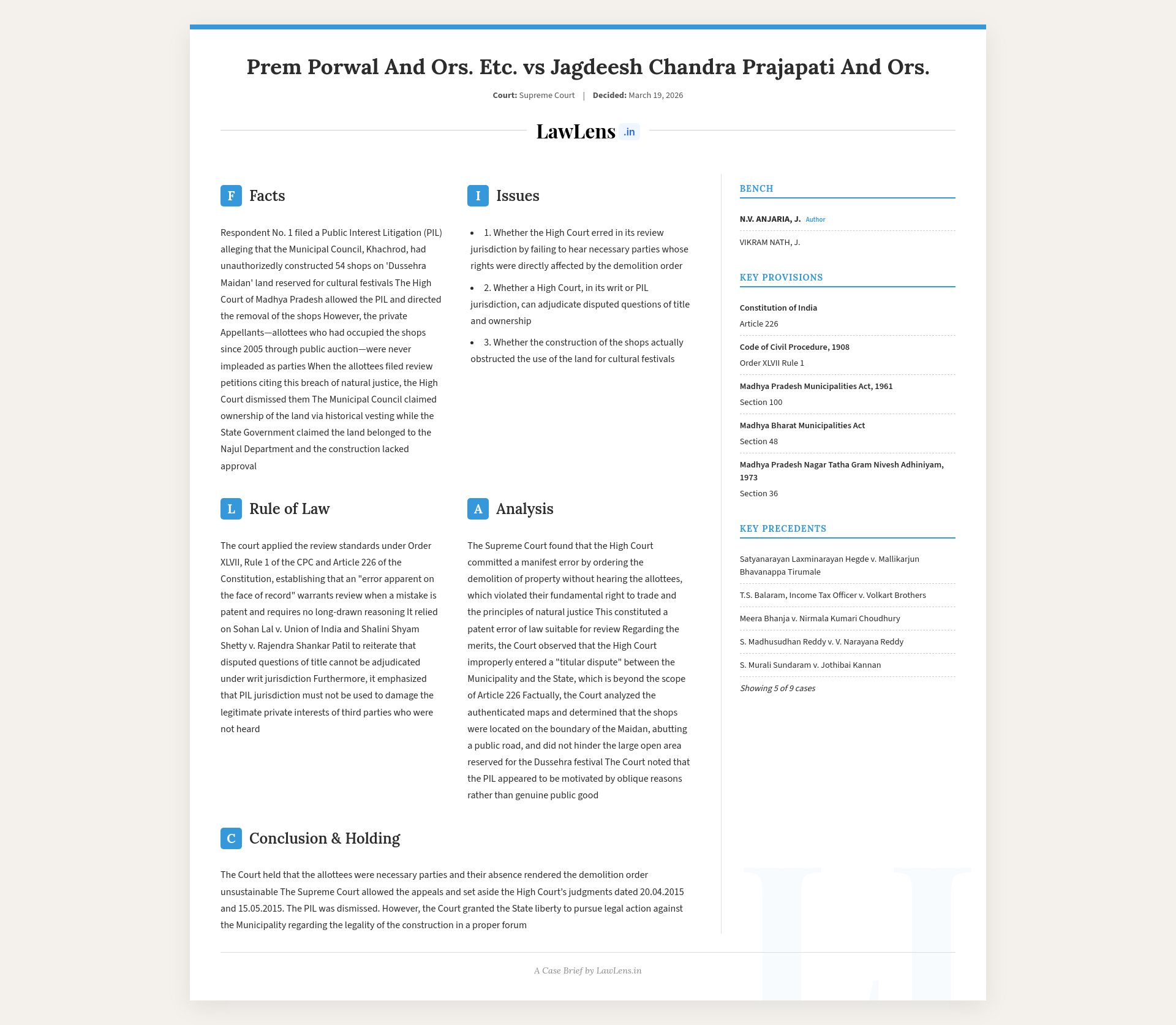
Prem Porwal vs. Jagdeesh Chandra Prajapati 2026 INSC 435 - PIL Jurisdiction - Titular Issues - Review Scope
Travelling into the area to adjudicate the titular issues would be a wrongful exercise of public interest jurisdiction

Constitution of India - Article 226 - The public interest jurisdiction of the Constitutional Courts stems from plenary jurisdiction under Article 226 of the Constitution, and a public interest petition, for its substance, procedure and purpose, is a petition under Article 226 of the Constitution. Travelling into the area to adjudicate the titular issues would be a wrongful exercise of public interest jurisdiction(Para 6.3) Any public interest litigation in its outcome aims at promoting a larger public interest. The public interest petition is a medium to achieve and preserve public good. An order passed or directions issued in a public interest petition should not operate to derecognise or to damage legitimate private interest or the lawful rights enjoyed by the citizens or those third persons who may not be party to the proceedings. An order in the public interest petition should not become antithetic to the very idea and object underlying the public interest jurisdiction. (Para 8) It is advisable that the court always remains cautious and disciplined in dealing with and in disposing of the public interest petitions. (Para 9)
Code of Civil Procedure, 1908 - Order XLVII Rule 1 - A judgment and order which is passed in absence of the necessary parties, without joining them and directions are issued by which they stand directly affected in terms of their rights, making them suffer the prejudice and the civil consequences, has to be treated as tainted with the vice of ‘an error apparent on the face of record’ (Para 5.8)
Code of Civil Procedure, 1908 - Order XLVII Rule 1 - - An error apparent on the face of record is thus a ground for invoking the review jurisdiction, and in a given case where such apparent error exists, reviewing of the judgment or order becomes imperative. An error apparent on the face of record is one when in comprehending such error, elaborate reasoning is not required. It is one which does not involve debatable issues. An error which is self-evident and which can be detected without resorting to a long-drawn process of reasoning, is classified as ‘an error apparent on the face of record’ When ‘an error apparent on the face of record’ is noticed or found to exist, the court should not hesitate to exercise the review powers to set right the injustice and restore the justice to the aggrieved party. (Para 5.2-5.5)
Constitution of India - Article 226 - The disputed questions relating to title cannot be satisfactorily gone into or adjudicated in a writ petition. (Para 6.2)
Case Info
Basic Case Details
Case name: Prem Porwal and Others etc. vs. Jagdeesh Chandra Prajapati and OthersNeutral citation: 2026 INSC 435Coram: Vikram Nath, J. and N.V. Anjaria, J.Judgment date: 19 March 2026 (New Delhi)
Case Law Cited
- Satyanarayan Laxminarayan Hegde and Others vs. Mallikarjun Bhavanappa Tirumale, 1959 SCC OnLine 10
- T.S. Balaram, Income Tax Officer, Company Circle IV, Bombay vs. M/s. Volkart Brothers, Bombay, (1971) 2 SCC 526
- Meera Bhanja vs. Nirmala Kumari Choudhury, (1995) 1 SCC 170
- S. Madhusudhan Reddy vs. V. Narayana Reddy and Others, (2022) 17 SCC 255
- S. Murali Sundaram vs. Jothibai Kannan and Others, (2023) 13 SCC 515
- Arun Dev Upadhyaya vs. Integrated Sales Service Limited and Another, (2023) 8 SCC 11
- Sohan Lal vs. Union of India, (1957) 1 SCC 439
- State of Rajasthan vs. Bhawani Singh, 1993 Supp (1) SCC 306
- Shalini Shyam Shetty vs. Rajendra Shankar Patil, (2010) 8 SCC 329
Statutes / Laws Referred
- Code of Civil Procedure, 1908 – Order XLVII Rule 1 (review)
- Constitution of India – Article 226 (writ and PIL jurisdiction)
- Income Tax Act, 1961 – Section 154 (rectification; for analogy on “mistake/error apparent”)
- Madhya Pradesh Municipalities Act, 1961 – Section 100 (vesting of property in municipality)
- Madhya Bharat Municipalities Act – Section 48
- Madhya Pradesh Nagar Tatha Gram Nivesh Adhiniyam, 1973 – Section 36
- Gwalior State Municipalities Act (provisions on vesting of land in municipality)
- Revenue Department Circular No. 3, Samvat 1998 – “Domestic Boundary Document” (open land in municipal area vesting in municipality)
- Gwalior Government Gazette dated 14.09.1929 – transfer/vesting of land in municipality
Brief Summary (Three Sentences)
The Supreme Court set aside the Madhya Pradesh High Court’s directions in a PIL ordering demolition of 54 shops at Khachrod alleged to have been illegally constructed on the Dussehra Maidan, and also set aside the dismissal of review petitions filed by the shop allottees. It held that non‑impleadment of the allottees, whose shops were ordered to be demolished, was an error apparent on the face of the record justifying review, and further that disputed questions of title between the State and the Municipal Council over the land could not be adjudicated in writ/PIL jurisdiction under Article 226. On the facts, the Court noted that the shops stood on a strip of land abutting the road and separated from the main open Maidan by other buildings, found no real obstruction to Dussehra activities, dismissed the PIL, but left it open to the State to take action under law against the municipality if any illegal construction is ultimately established.