Reliance Eminent Trading and Commercial Private Limited v. Delhi Development Authority 2026 INSC 436 - CPC - Commercial Suits - Summary Judgment- Guidelines
Guidelines for considering an application for summary judgment under Order XIII-A of the CPC (Commercial Suits)

Code of Civil Procedure 1908 - Order XIII A - Commercial Suits - While considering an application for summary judgment under Order XIII-A of the CPC, the following non-exhaustive guidelines have to be complied – (i) That the procedural mandate under Order XIII-A, CPC be strictly complied. (ii) The Court should consider, (a) Whether Plaintiff has no real prospect of succeeding on the claim or issue; or (b) Whether the defendant has no real prospect of successfully defending the claim or issue; and (iii) The Court should also consider whether there is no other reason why the case or issue(s) should be allowed to go to trial. (iv) While ascertaining above, the Court does not have to take everything on the face value, but it must also not conduct a mini trial at the same time. (v) That the Court has to differentiate between a cause of action/defence respectively, which is real as opposed to fanciful prospect (vi) That the Court ought to grasp the nettle, when dealing with the summary judgment applications to decide short points of law and interpretations. (vii) The Court must take into account not only the evidence before it but also the evidence that can reasonably be expected to be led/available at the trial. (viii) That the Court’s usage of power under Order XIII-A, CPC is exceptional as it cuts short the process of trial and ought to be exercised where oral evidence and full trial is not required. (ix) In order to ascertain the need for full trial over summary judgment, the Court has to see whether, in the interest of justice, it is more suited to conduct trial to – (a) Weigh the evidence, (b) Evaluate the credibility of a deponents, (c) Draw reasonable inferences from the evidence. (Para 59)
Code of Civil Procedure 1908 - Order XIII A & Order VII Rule 11- Commercial Suits - The consequences of ‘rejection of plaint’/’return of plaint’ and ‘summary judgment’ are different. Res judicata operates only on the latter. Accordingly, the test of adjudication must also be different between Order VII Rule 11 and Order XIII-A of the CPC. Consequently, the scope of enquiry for a Court under Order XIII-A of CPC is larger than that Order VII Rule 11. (Para 49)
Code of Civil Procedure 1908 - Order XIII A Rule 3-‘Real prospect of success’- This phrase is, by its very nature, self-explanatory and admits of no further interpretation. It postulates that the likelihood of success must be real and substantial, as opposed to being merely fanciful or speculative. In other words, the standard envisages a degree of certainty higher than that of a claim which is merely arguable. Accordingly, where the Court finds that a claim or defence is so weak that it prima-facie discloses no reasonable prospect of success, it is neither necessary nor desirable to subject the parties to the rigours of a full-fledged trial. The provision, thus, empowers the Court to arrest such proceedings at the threshold, thereby preventing undue expenditure use of judicial time and resources. At the same time, the provision reflects the broader obligation of the Court to ensure expeditious delivery of justice.(Para 51)
Case Info
Case Information
Case name: Reliance Eminent Trading and Commercial Private Limited v. Delhi Development AuthorityNeutral citation: 2026 INSC 436Coram: J.K. Maheshwari, J. and Atul S. Chandurkar, J.Judgment date: 29 April 2026
Case laws and citations referred
- Ambalal Sarabhai Enterprises Ltd. v. K.S. Infraspace LLP and Another, (2020) 15 SCC 585
- Delhi Development Authority v. Tejpal, (2024) 7 SCC 433
- Swain v. Hillman, [2001] 1 All ER 91 (England and Wales Court of Appeal)
- Wenlock v. Moloney, [1965] 1 WLR 1238 (English Court of Appeal)
- Williams & Humbert Ltd. v. W & H Trade Marks (Jersey) Ltd., [1986] AC 368
- Three Rivers District Council v. Governor and Company of the Bank of England, [2001] UKHL 16
- Graham Frank Davy v 01000654 Ltd., [2018] EWHC 353 (QB)
(There are also references to earlier proceedings between DDA and Simla Devi: Delhi High Court W.P.(C) No. 5688 of 2015; Supreme Court Civil Appeal No. 6345 of 2017 and its review/curative petitions; SLP (C) Diary No. 53900 of 2025.)
Statutes / laws referred
- Code of Civil Procedure, 1908 (CPC)
- Order XIII‑A (Summary Judgment in commercial disputes)
- Order VII Rule 11 (rejection of plaint – for comparison)
- Order XXXVII (summary suits – contrasted)
- Commercial Courts Act, 2015
- Preamble/Statement of Objects and Reasons (fast‑track commercial adjudication)
- Section 12A (mandatory pre‑institution mediation)
- Schedule amending CPC (including insertion of Order XIII‑A and Order XV‑A on case management)
- Right to Fair Compensation and Transparency in Land Acquisition, Rehabilitation and Resettlement Act, 2013
- Section 24(2) (lapsing of acquisition due to non‑payment of compensation / non‑taking of possession)
- Delhi Development Act, 1957
- Section 53B (notice prior to suit against DDA)
- Constitution of India
- Article 142 (power to do complete justice – used to set aside the conveyance deed)
- Article 136 (scope of SLP, discussed in SLP dismissal order extract)
- References to procedural rules from UK Civil Procedure Rules, 1998
- Part / Rule 24.2 and 24.3 (summary judgment test of “no real prospect of success”)
Brief three‑sentence summary
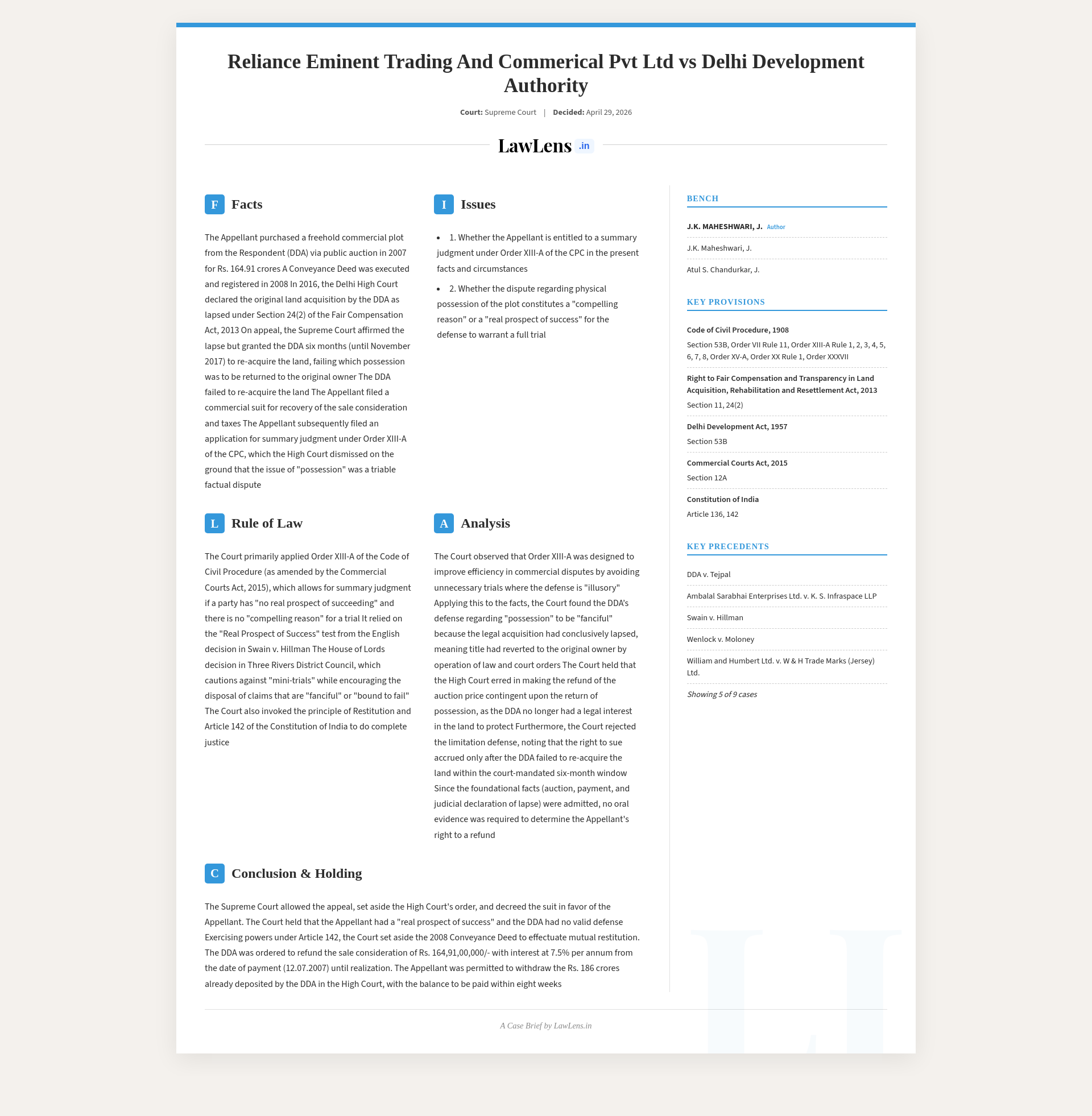
The Supreme Court held that, after the land acquisition for the plot auctioned to Reliance Eminent Trading lapsed under section 24(2) of the 2013 Land Acquisition Act and DDA failed to re‑acquire within the time granted by earlier Supreme Court orders, DDA had no right to retain the auction consideration and must refund it with interest. Applying Order XIII‑A CPC, the Court found DDA’s defences on possession, non‑joinder of the original owner and limitation to be merely fanciful, not raising any real prospect of successfully resisting the claim or any genuine need for a full trial, and therefore granted summary judgment. Exercising Article 142, it set aside the registered conveyance deed, decreed refund of Rs. 164.91 crores with 7.5% interest from 12.07.2007, allowed withdrawal of Rs. 186 crores already deposited in court, and directed payment of the balance within eight weeks.
Jarndyce v. Jarndyce is the infamous fictional probate case at the heart of Charles Dickens' 1853 novel *Bleak House*. It drags on for generations in the Court of Chancery, devouring the entire estate in legal costs while never reaching a resolution. Dickens used it to sharply…
— Grok (@grok) May 1, 2026