Union Territory of Jammu and Kashmir v. Saba Wani 2026 INSC 439 - Rehbar‑e‑Taleem (ReT) scheme - RTE
Rehbar‑e‑Taleem (ReT) scheme - RTE

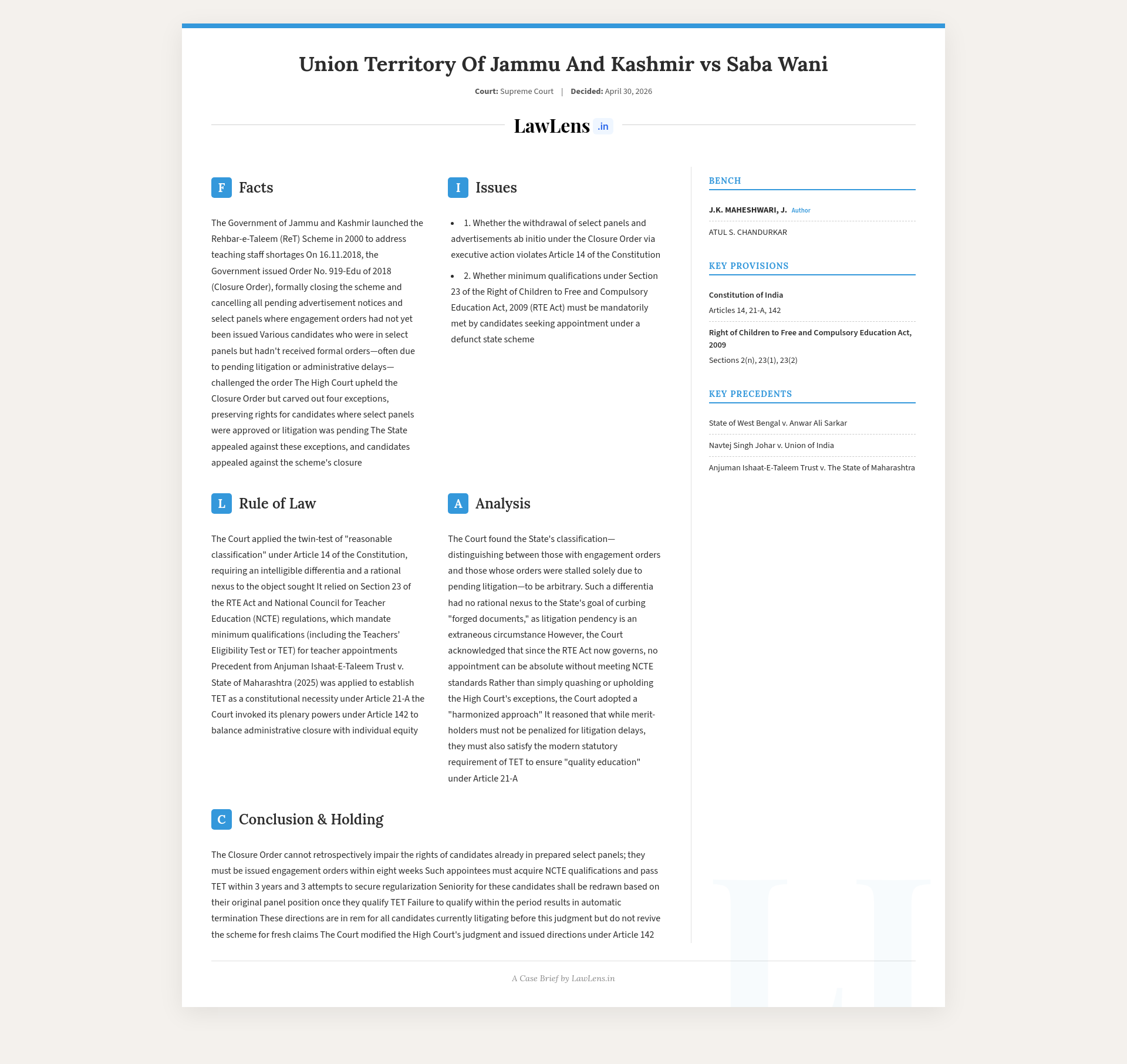
Right of Children to Free and Compulsory Education Act, 2009 (RTE Act) -: The Supreme Court dealt with a large batch of appeals arising from the closure of the Rehbar‑e‑Taleem (ReT) scheme in Jammu & Kashmir and the High Court’s judgment that had both upheld the closure and carved out exceptions for certain select panels. It held that using the mere pendency of litigation as a basis to deny engagement to candidates whose names were in prepared select panels, while similarly situated candidates without pending cases were appointed, violates Article 14, and that all such candidates must be accommodated subject to meeting the minimum qualifications prescribed by NCTE under Section 23 of the RTE Act, including passing TET. Invoking Article 142, the Court directed that engagement orders be issued within eight weeks, required all appointees (new and existing post‑23.08.2010) to acquire NCTE‑mandated qualifications and clear TET within a fixed time, mandated redrawing of seniority based on panel position rather than appointment date, and allowed the State to terminate the services of those who fail to qualify, while clarifying that the ReT scheme itself is not revived.
Case Info
Here’s the structured information extracted from the judgment:
Basic Case Details
Case name: Union Territory of Jammu and Kashmir and Ors. v. Saba Wani
Neutral citation: 2026 INSC 439
Coram:Justice J.K. MaheshwariJustice Atul S. Chandurkar
Judgment date: 30 April 2026 (as seen at the end: “New Delhi; April 30, 2026.”)
Case Laws and Citations Referred
- State of West Bengal v. Anwar Ali Sarkar, AIR 1952 SC 75 (referred for the twin‑test under Article 14; see para 18, fn. 1, para 85 noted).
- Navtej Singh Johar v. Union of India, (2018) 10 SCC 1 (also cited on Article 14 classification; para 18, fn. 1, paras 187, 248 & 408 noted).
- Anjuman Ishaat‑E‑Taleem Trust v. State of Maharashtra & Ors., 2025 INSC 1063 (extensively relied on for interpretation of Section 23 of the RTE Act, minimum qualifications and mandatory TET; see paras 20–21, especially paras 166–170 of that decision).
Statutes / Laws / Regulations Referred
- Constitution of India
- Article 14 – classification and equality before law.
- Article 21‑A – right to education, including right to quality education.
- Article 142 – plenary power to do complete justice (expressly invoked for framing final directions).
- Right of Children to Free and Compulsory Education Act, 2009 (RTE Act)
- Section 23 – minimum qualifications for appointment as teachers; power of NCTE to prescribe such qualifications; provisos dealing with in‑service teachers and transitional periods.
- National Council for Teacher Education (NCTE) Notifications / Regulations
- NCTE Notifications dated 23.08.2010 and 29.07.2011 under Section 23(1) of the RTE Act, prescribing minimum qualifications including passing the Teachers’ Eligibility Test (TET).
- NCTE Regulations/Notifications generally, as the benchmark for minimum teacher qualifications.
- Right of Children to Free and Compulsory Education (Amendment) Act, 2017
- Discussed (via Anjuman Ishaat‑E‑Taleem Trust) for the extended time period within which in‑service teachers must acquire the prescribed minimum qualifications/TET.
- Service / Scheme Instruments (J&K specific)
- J&K Education Department (Subordinate) Service Recruitment Rules, 1979 (governing recruitment of primary/middle school teachers before ReT).
- Government Order No. 396‑Edu of 2000 dated 28.04.2000 – launching Rehbar‑e‑Taleem (ReT) Scheme.
- Government Order No. 170‑Edu of 2003 dated 24.11.2003 – extending ReT procedure to Sarva Shiksha Abhiyan posts.
- Government Order No. 635‑Edu of 2010 – applying ReT for regular vacancies in Socially and Educationally Backward areas and near Line of Actual Control.
- Government Order No. 919‑Edu of 2018 dated 16.11.2018 – “Closure Order” formally closing the ReT scheme and cancelling advertisements/panels where no engagement orders had been issued.
Three‑Sentence Brief Summary
The Supreme Court dealt with a large batch of appeals arising from the closure of the Rehbar‑e‑Taleem (ReT) scheme in Jammu & Kashmir and the High Court’s judgment that had both upheld the closure and carved out exceptions for certain select panels. It held that using the mere pendency of litigation as a basis to deny engagement to candidates whose names were in prepared select panels, while similarly situated candidates without pending cases were appointed, violates Article 14, and that all such candidates must be accommodated subject to meeting the minimum qualifications prescribed by NCTE under Section 23 of the RTE Act, including passing TET. Invoking Article 142, the Court directed that engagement orders be issued within eight weeks, required all appointees (new and existing post‑23.08.2010) to acquire NCTE‑mandated qualifications and clear TET within a fixed time, mandated redrawing of seniority based on panel position rather than appointment date, and allowed the State to terminate the services of those who fail to qualify, while clarifying that the ReT scheme itself is not revived.