Vadiyala Prabhakar Rao vs Government of Andhra Pradesh 2026 INSC 450 Revenue Records - Title Proof

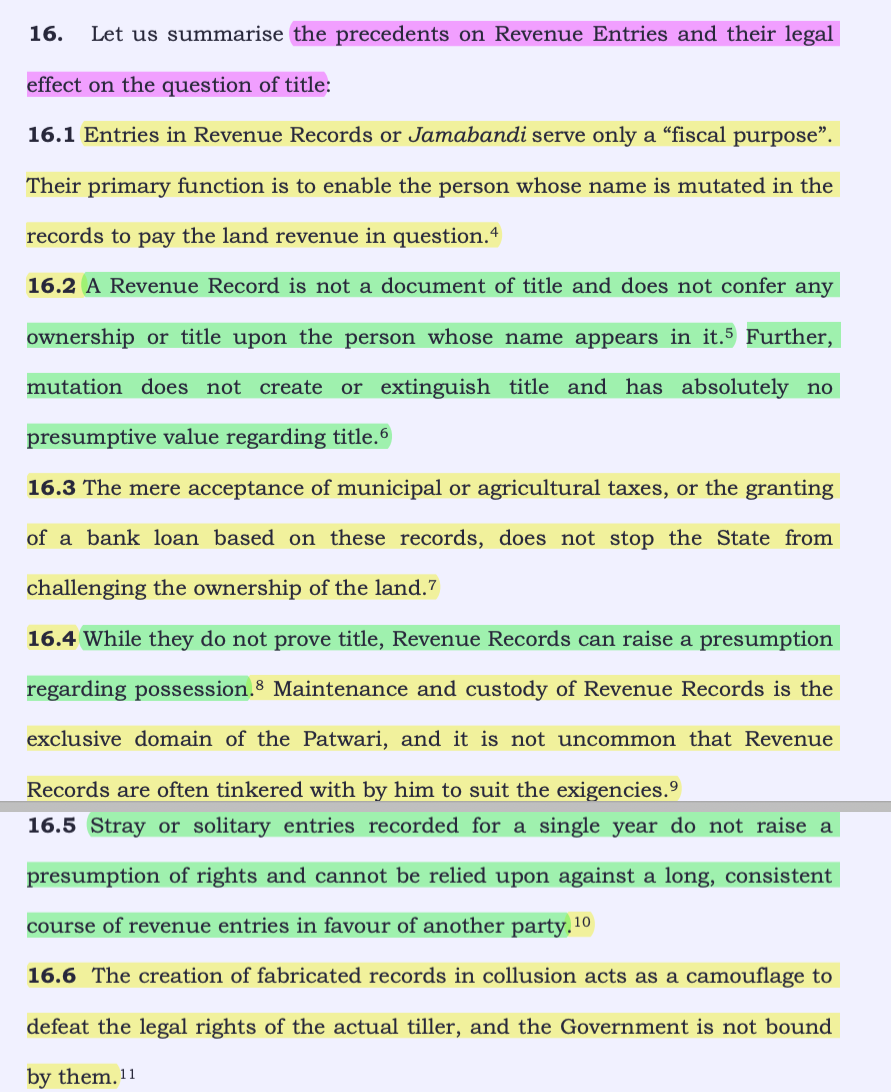
Revenue Records - Revenue Entries and their legal effect on the question of title- Entries in Revenue Records or Jamabandi serve only a “fiscal purpose”. Their primary function is to enable the person whose name is mutated in the records to pay the land revenue in question- A Revenue Record is not a document of title and does not confer any ownership or title upon the person whose name appears in it. Further, mutation does not create or extinguish title and has absolutely no presumptive value regarding title- The mere acceptance of municipal or agricultural taxes, or the granting of a bank loan based on these records, does not stop the State from challenging the ownership of the land. -While they do not prove title, Revenue Records can raise a presumption regarding possession-Maintenance and custody of Revenue Records is the exclusive domain of the Patwari, and it is not uncommon that Revenue Records are often tinkered with by him to suit the exigencies. Stray or solitary entries recorded for a single year do not raise a presumption of rights and cannot be relied upon against a long, consistent course of revenue entries in favour of another party-The creation of fabricated records in collusion acts as a camouflage to defeat the legal rights of the actual tiller, and the Government is not bound by them. (Para 16-17)
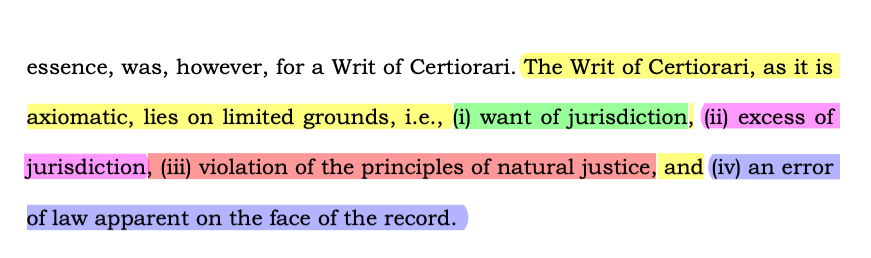
Constitution of India - Article 226 -The proceedings under Article 226 of the Constitution of India are not the appropriate forum for resolving serious disputes concerning questions of fact and title to property. Investigating these claims is the proper function of a civil court in a regularly constituted suit, rather than of a court exercising the prerogative to issue writs. (Para 17) The Writ of Certiorari lies on limited grounds, i.e., (i) want of jurisdiction, (ii) excess of jurisdiction, (iii) violation of the principles of natural justice, and (iv) an error of law apparent on the face of the record. (Para 20)
Case Info
Case name and neutral citation:Vadiyala Prabhakar Rao & Ors. v. The Government of Andhra Pradesh & Ors., 2026 INSC 450
Coram:Justice Pankaj Mithal and Justice S.V.N. Bhatti
Judgment date:May 6, 2026
Statutes / Laws Referred
Hyderabad forest and revenue/land laws (including their Fasli year references) are central:
- Hyderabad Forest Act, 1326 Fasli (corresponding roughly to 1916 AD)
- Hyderabad Forest Act, 1355 Fasli (corresponding roughly to 1945 AD)
- Andhra Pradesh Forest Act (referred in the MRO’s report about non‑declaration under section 15)
- Land Acquisition Act, 1871
- Andhra Pradesh Land Revenue Enhancement Act
- Provisions on land ceiling / Land Reforms Tribunal proceedings (1970s onwards)
- Constitutional law: Article 226 of the Constitution of India (scope of writs of certiorari and mandamus; not quoted but directly applied)
Case Law Cited (with SCC citations)
(Only those explicitly named and cited in the judgment text you provided are listed.)
On revenue records, mutation and title:
- Suraj Bhan v. Financial Commissioner, (2007) 6 SCC 186
- Jitendra Singh v. State of MP, 2021 SCC OnLine SC 802
- Bhimabai Mahadeo Kambekar v. Arthur Import & Export Co., (2019) 3 SCC 191
- Sawarni v. Inder Kaur, (1996) 6 SCC 223
- Gurunath Manohar Pavaskar v. Nagesh Siddappa Navalgund, (2007) 13 SCC 565
- State of A.P. v. Star Bone Mill & Fertiliser Co., (2013) 9 SCC 319
- Balwant Singh v. Daulat Singh (D) by LRs., (1997) 7 SCC 137
- Guru Amarjit Singh v. Rattan Chand, (1993) 4 SCC 349
- Bhimeshwara Swami Varu Temple v. Pedapudi Krishna Murthi, (1973) 2 SCC 261
- Salem Municipality (case name appears in reference to Bhimeshwara Swami Varu Temple; full citation not fully extracted from text)
- Baleshwar Tewari v. Sheo Jatan Tiwary, (1997) 5 SCC 112
- State of Punjab v. Sadhu Ram, (1997) 9 SCC 544
- Sohan Lal v. Union of India & Anr., (1957) 1 SCC 439
Brief 3‑Sentence Summary
The appellants claimed ownership over 600 acres in Survey No. 81 of Kalvalanagaram village, relying mainly on revenue records (Faisal Patti, Vasool Baqi, Pahanies, and land‑ceiling orders) and sought exclusion of this land from a proposed reserve forest notification. The Supreme Court held that revenue entries and ceiling orders do not by themselves establish title, especially in the absence of the foundational patta or other original title documents, and reiterated that serious disputes of title cannot be conclusively decided in writ jurisdiction under Article 226. Finding the High Court Division Bench was right in setting aside the Single Judge’s order that had effectively declared title and invalidated the forest proceedings, the Court dismissed the civil appeal and upheld the rejection of the appellants’ claim.