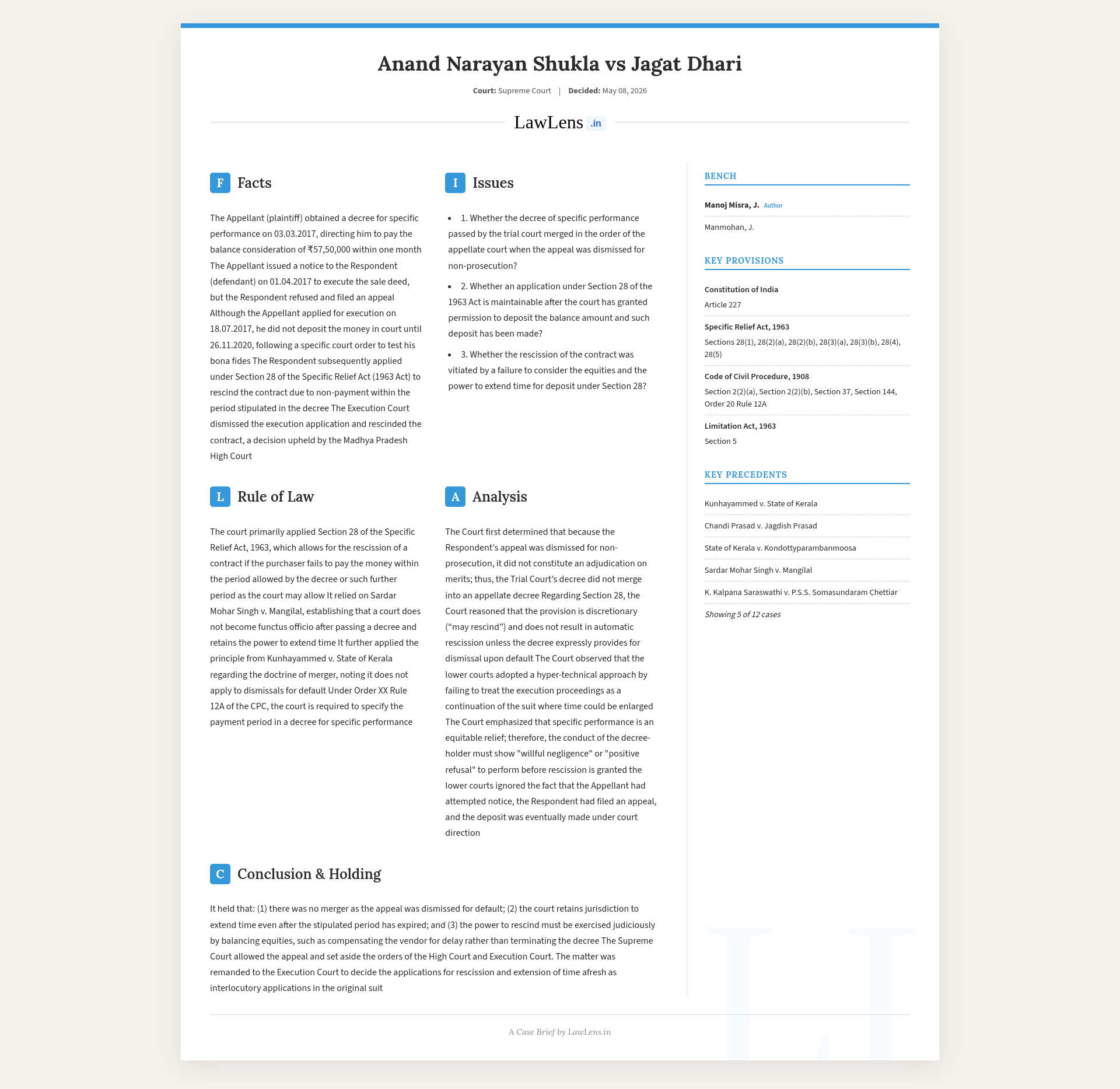
Anand Narayan Shukla vs. Jagat Dhari 2026 INSC 463 - S.28 Specific Relief Act - Rescission - Doctrine of Merger - Appeal Non- Prosecution

Specific Relief Act 1963 - Section 28 - (i) A decree for specific performance of a contract is in the nature of a preliminary decree and therefore, till the deed is executed pursuant to the decree, the Court that passed the decree is vested with the jurisdiction to either rescind the contract / the decree for non-payment/non-deposit within the stipulated period or extend the period for making such payment/ deposit. (ii) Neither there is an automatic rescission of the contract/ decree for non-payment/ non-deposit within the period stipulated by the decree, nor there is an automatic extension of time by making such deposit, if the stipulated period for payment/ deposit has expired. However, where the decree stipulates that on failure to pay / deposit within the specified period, the decree shall stand rescinded or the suit shall stand dismissed, the decree is rendered inexecutable on failure to pay/ deposit (iii) Prayer to extend the time for making deposit in compliance of the conditions stipulated in the decree may be made prior to, or even after, expiry of the period stipulated therefor (iv) There is no form prescribed for making the prayer to extend the time to make such payment or deposit. Therefore, the prayer seeking permission to deposit the defaulted amount may be treated as one for extension of time to deposit. Such prayer may be made even orally while the Court seeks to address an application for rescission of the contract/ decree or when the decree is put for execution, provided the execution court is the one which passed the decree. However, if the decree is passed by the appellate court, such prayer/ application may be made before the court of first instance having regard to the provisions of Section 37 of CPC. Further, what is important is that such an application must be treated as an application in the suit and numbered accordingly. (v) As specific performance of a contract is an equitable relief, while considering the prayer for rescission of the contract/ decree, or for extension of time to make deposit in compliance of the decree, the Court must be guided by principles of equity. Therefore, while considering the prayer for extension of time to make deposit, to balance the equities, the Court would have to consider the attending facts and circumstances of the case, the conduct of the parties and whether, by putting the decree holder to such additional terms and conditions, the judgment debtor could be adequately compensated for the delay. (vi) Though each day’s delay in deposit need not be explained as in an application under Section 5 of the Limitation Act, the test is whether from the conduct of the decree holder it could be logically inferred that he had no intention to complete his part of the contract. If it appears so, and there appears an element of willful negligence on the part of the decree holder in complying with the terms of the decree, the Court may invoke its power under Section 28 and rescind the contract. (vii) Under Order XX Rule 12 A of CPC, when a decree for specific performance of a contract for the sale, or lease of immovable property, orders that the purchase-money or other sum is to be paid by the purchaser or lessee, the Court must specify the period within which the payment shall be made. Therefore, where the suit for specific performance is dismissed by the trial court but decreed by the appellate court, or where the appeal against the decree for specific performance is dismissed on merits, the Court must fix the time within which such payment is to be made. If no time limit is fixed, the compliance thereof would have to be within a reasonable period. As to what would be the reasonable period would depend on facts of the case. (Para 33)
Code of Civil Procedure, 1908 – Section 2(2); Doctrine of merger - Dismissal of the appeal for non-prosecution would not merge the trial court decree in the order of the appellate court. For there to be a merger of the trial court decree in the appellate court decree, there must be an adjudication on merits, though it is immaterial whether the decree or order under appeal is set aside or modified or simply confirmed. (Para 22)
Doctrine of merger - The doctrine of merger is based on the principle of propriety in the hierarchy of the justice-delivery system. The said doctrine postulates that there cannot be more than one operative decree governing the same subject matter at a given point of time. Once the superior Court has disposed of the lis before it either way - whether the decree or order under appeal is set aside or modified or simply confirmed, it is the decree or order of the superior Court, tribunal or authority which is the final, binding and operative decree or order wherein merges the decree or order passed by the Court, tribunal or the authority below. The doctrine of merger does not make a distinction between an order of reversal, modification or an order of confirmation passed by the appellate authority/ court. However, the doctrine of merger would only apply in a case when a higher forum entertains an appeal or revision and passes an order on merit and not when the appeal or revision is dismissed on the ground of delay in filing the same. (Para 21)
Case Info
Case details
Case name: Anand Narayan Shukla v. Jagat DhariNeutral citation: 2026 INSC 463Coram: Hon’ble Mr. Justice Manoj Misra, Hon’ble Mr. Justice ManmohanJudgment date: 8 May 2026, Supreme Court of India (Civil Appellate Jurisdiction), Civil Appeal No. 7355 of 2026 (@ SLP (C) No. 14206 of 2025)
Caselaws and citations referred
- Kunhayammed and others v. State of Kerala and another, (2000) 6 SCC 359
- Chandi Prasad & Ors. v. Jagdish Prasad & Ors., (2004) 8 SCC 724
- State of Kerala & Anr. v. Kondottyparamban Moosa & Ors., (2008) 8 SCC 65
- Sardar Mohar Singh v. Mangilal, (1997) 9 SCC 217
- K. Kalpana Saraswathi v. P.S.S. Somasundaram Chettiar, (1980) 1 SCC 630
- Bhupinder Kumar v. Angrej Singh, (2009) 8 SCC 766
- Ramankutty Guptan v. Avara, (1994) 2 SCC 642
- V.S. Palanichamy Chettiar Firm v. C. Alagappan & Anr., (1999) 4 SCC 702
- Ishwar (Since Deceased) through LRs and Others v. Bhim Singh and Another, 2024 SCC OnLine SC 2338
- Ram Lal v. Jarnail Singh, 2025 SCC OnLine SC 584
- P.R. Yelumalai v. N.H. Ravi, (2015) 9 SCC 52
- Johri Singh v. Sukhpal Singh and others, (1989) 4 SCC 403
Statutes / provisions referred
- Specific Relief Act, 1963 – Section 28 (rescission / extension of time in decrees for specific performance)
- Code of Civil Procedure, 1908 – Section 2(2) (definition of “decree”)
- Code of Civil Procedure, 1908 – Section 37 (definition of “court which passed a decree”)
- Code of Civil Procedure, 1908 – Order XX Rule 12A (time for payment in specific performance decrees)
- Constitution of India – Article 227 (supervisory jurisdiction of High Court, mentioned as the revisional provision used)
Three‑sentence brief summary
The Supreme Court considered whether a decree for specific performance could be treated as automatically inoperative because the purchaser failed to deposit the balance sale consideration within one month, even though he later deposited the entire amount under orders of the executing court. It held that under Section 28 of the Specific Relief Act there is no automatic rescission; the trial court retains control over the decree, must exercise a discretionary, equity‑based power either to rescind the contract or extend time, and must properly consider the parties’ conduct and the possibility of compensating the vendor for delay. Finding that both the Execution Court and the High Court had taken a purely technical view without applying these principles, the Supreme Court set aside their orders and remitted the execution and connected Section 28 applications to the court of first instance for fresh decision in accordance with law.
AI Generated Summary
Anand Narayan Shukla vs. Jagat Dhari — C.A. No. 7355/2026
Supreme Court of India | 8 May 2026 | Bench: Manoj Misra & Manmohan JJ.
1. Plain-Language Summary
Anand Narayan Shukla (the buyer/appellant) had won a court decree in 2017 ordering Jagat Dhari (the seller/respondent) to transfer 3.75 acres of land in Satna, Madhya Pradesh, once Shukla paid the balance purchase price of ₹57.5 lakhs. Shukla failed to deposit that money within the one-month deadline set by the decree, and only paid it in November 2020 — over three years late — under a court order. The seller then applied to have the contract rescinded and the execution case dismissed due to the delay. Both the Execution Court and the Madhya Pradesh High Court sided with the seller and threw out the execution case. The Supreme Court has now overturned those decisions, holding that the lower courts applied an overly mechanical approach and failed to properly weigh all the circumstances, and has sent the matter back for a fresh, balanced reconsideration.
2. Key Legal Questions Decided
Issue A — Doctrine of Merger: Does the trial court's decree merge into the appellate court's order when the appeal is dismissed for non-prosecution (i.e., abandoned), rather than decided on merits?
The Court held no — merger only occurs when a higher court decides an appeal on its merits. A dismissal for non-prosecution is not a decision on merits, so the original trial court decree stands on its own.
Issue B — Maintainability of rescission application: Once the Execution Court had allowed the buyer to deposit the balance amount (even belatedly), could the seller still apply to rescind the contract under Section 28 of the Specific Relief Act, 1963?
The Court held yes — the court's permission to deposit was only to test the buyer's bona fides, not a formal extension of time. It did not extinguish the seller's right to seek rescission.
Issue C — Whether the lower courts exercised discretion correctly: Did the Execution Court and High Court err by rescinding the contract without properly considering all the facts and circumstances — including whether compensation to the seller could cure the delay?
The Court held yes, they erred — neither court engaged with the full factual picture or considered whether a justice-oriented remedy (such as awarding compensation to the seller for the delay) was appropriate.
3. Notable Reasoning and Principles
The judgment delivers a comprehensive restatement of the law on Section 28 of the Specific Relief Act, 1963. The key principles laid down are:
- No automatic rescission: There is no automatic rescission of a specific performance decree simply because the buyer missed the payment deadline. Rescission is a discretionary remedy, not a mechanical consequence. The exception is where the decree itself explicitly says it will stand rescinded on default — which was not the case here.
- Court retains jurisdiction: Even after passing a decree for specific performance, the court does not become functus officio (i.e., it does not lose its power). It retains jurisdiction to extend time or rescind the contract until the sale deed is actually executed.
- Equity must guide the court: Specific performance is an equitable relief. The court must consider the conduct of both parties, the reason for delay, and whether compensation to the judgment-debtor (seller) can adequately balance the equities — rather than taking a hyper-technical or pedantic approach.
- Willful negligence is the real test: The test for rescission is not merely that there was delay, but whether the buyer's conduct shows a positive refusal or willful negligence in completing their part of the contract.
- Appellate courts must fix fresh timelines: When an appeal against a specific performance decree is decided on merits, the appellate court is obliged under Order XX Rule 12A CPC to fix a fresh time period for the buyer to deposit the balance consideration.
Outcome: The Supreme Court allowed the appeal, set aside the orders of both the Execution Court and the High Court, and remitted the matter back to the Execution Court for fresh consideration in light of the above principles — giving both parties another opportunity to be heard properly.