Gajula Thirupathi vs Telangana State Level Police Recruitment Board and Others 2026 INSC 493 - Public Employment - Cheating Case - Pre-Marital Relationships

Public Employment – Police Recruitment – Criminal Case -Unless the charge is proved in a court of law there shall be a presumption of innocence. No doubt, where commission of the offence is proved but the accused is let off for some technical reason or is given the benefit of doubt, the employer may, based on the material available on record, conclude that person who had got the benefit of doubt or technical latch is not suitable for appointment. However, to form such an opinion there would have to be: (a) evidence/ material that the crime was committed and (b) some evidence/ material linking the person concerned to the crime. (Para 22) [Context: The Supreme Court directed reconsideration of the petitioner’s candidature for appointment as Stipendiary Cadet Trainee Police Constable. It held that mere registration and compounding of a cheating case arising out of a consensual premarital relationship between two adults, without any material showing coercion or a foisted compromise, could not by itself justify branding the candidate as of bad character or unsuitable for police service.]
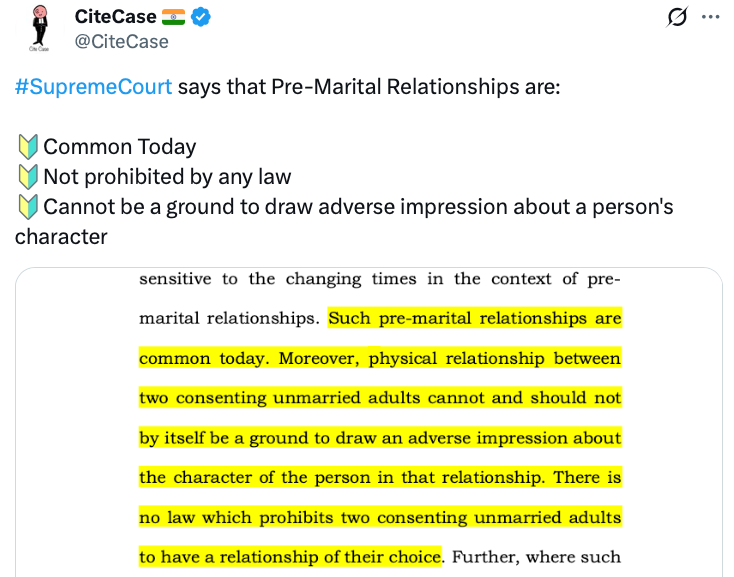
Pre-marital relationships - Pre-marital relationships are common today. Moreover, physical relationship between two consenting unmarried adults cannot and should not by itself be a ground to draw an adverse impression about the character of the person in that relationship. There is no law which prohibits two consenting unmarried adults to have a relationship of their choice. (Para 19)
Criminal Procedure- Quashing - Where a relationship spans a considerable period, say a few years and criminal proceedings are initiated by one party against the other on a complaint that the victim was lured into physical relationship by a false promise of marriage, in such a case there would be a presumption that such relationship is based on a valid consent. (Para 19)
Public Employment – Police Recruitment – Character & Antecedents Verification — Truthful disclosure and employer’s discretion — Where a candidate has made a full and complete disclosure of a past criminal case that ended in his favour, the employer is undoubtedly free to assess his suitability and decline appointment despite such acquittal-However, the State and its officers cannot act arbitrarily. Therefore, when such a decision is subjected to judicial review, to ensure that the same is not held arbitrary, in our view, it must be demonstrated that, (a) there exists material on record to indicate that an offence involving moral turpitude was indeed committed; and (b) there exists material against the candidate even though he may have succeeded in earning an acquittal or a discharge for reasons such as the benefit of: (i) a technical latch, (ii) a reasonable doubt, (iii) the witnesses turning hostile, either because they are won over or because they are threatened or lured into a compromise. If after consideration of those facts an informed decision is taken, the Courts should be slow to interfere with such a decision of the employer / recruiter because ultimately the employer is the best judge to assess whether a person is suitable for appointment in its organization.— (Paras 14, 15,)