Tarini Prasad Mohanty v. Sunflag Iron and Steel Company Limited 2026 INSC 566 - Writ Jurisdiction - Arbitration Act

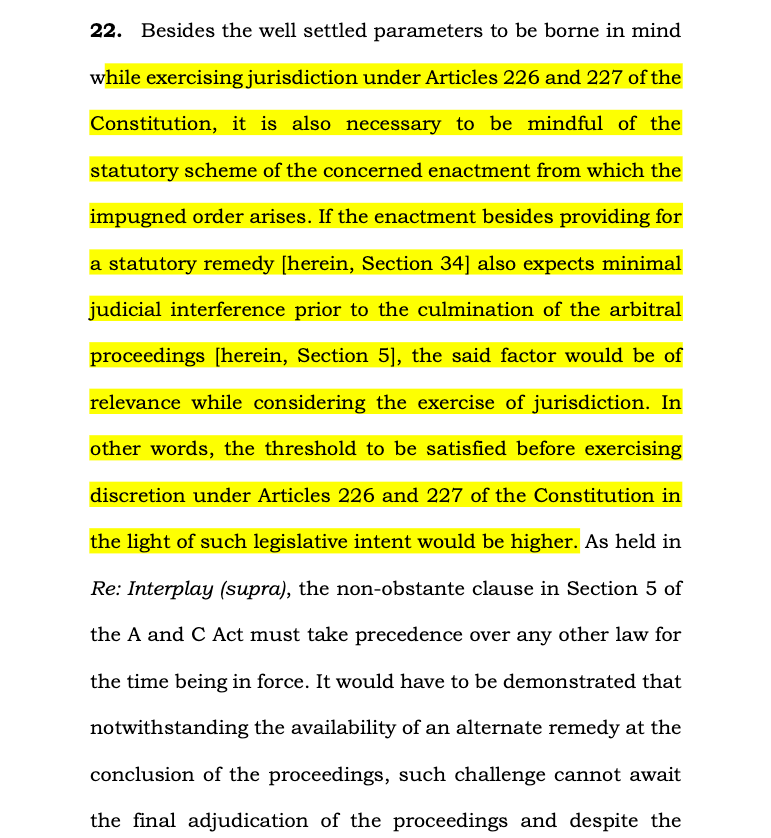
Constitution of India, 1950 – Articles 226 and 227 ; Arbitration and Conciliation Act, 1996 – Sections 5, 16 and 34 - If the enactment besides providing for a statutory remedy [herein, Section 34] also expects minimal judicial interference prior to the culmination of the arbitral proceedings [herein, Section 5], the said factor would be of relevance while considering the exercise of jurisdiction. It would have to be demonstrated that notwithstanding the availability of an alternate remedy at the conclusion of the proceedings, such challenge cannot await the final adjudication of the proceedings and despite the statutory expectation of minimal interference, intervention in exercise of writ jurisdiction at an interim stage is imperative [Context: The Supreme Court held that where a party’s objection under Section 16 is rejected by the arbitral tribunal, the party must ordinarily await the final award and challenge it under Section 34, and that the High Court should not, save in the rarest of exceptional cases, interfere mid‑arbitration in writ jurisdiction under Articles 226/227 ]
Constitution of India, 1950 – Articles 226 and 227 -The jurisdiction to decide cannot mean to decide in a particular manner. While exercising such power, one may err on merits. Such error may not be one beyond jurisdiction. (Para 23)
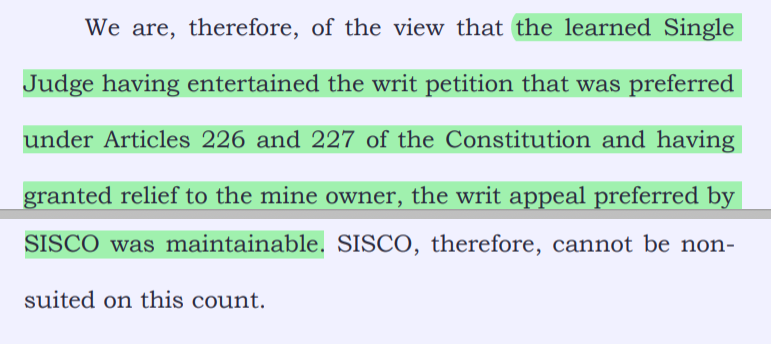
Constitution of India, 1950 – Articles 226 and 227 - When Single Judge entertained the writ petition that was preferred under Articles 226 and 227 of the Constitution and granted relief to the petition, the writ appeal is maintainable. (Para 14,15)
Constitution of India, 1950 – Articles 226 - Interpretation of contracts should not generally be undertaken while exercising writ jurisdiction (Para 23)
Arbitration and Conciliation Act, 1996 - Non- stamping or inadequate stamping of an arbitration agreement is merely a curable defect. (Para 21)