Madhya Pradesh Road Development Corporation Ltd v. Jabalpur Corridor Pvt Ltd 2026 INSC 590 – Ss.34,37 Arbitration Act

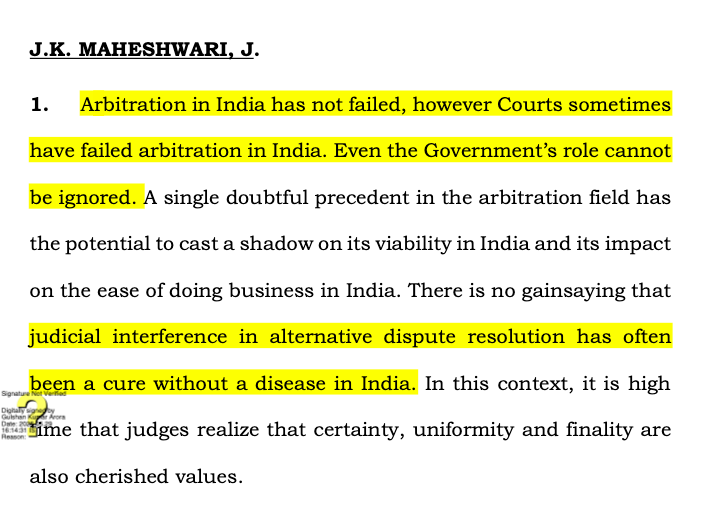
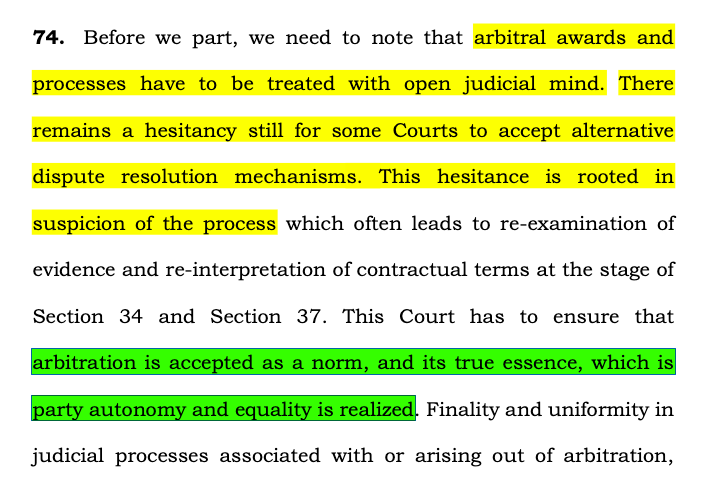
Arbitration - Arbitration in India has not failed, however Courts sometimes have failed arbitration in India. Even the Government’s role cannot be ignored. A single doubtful precedent in the arbitration field has the potential to cast a shadow on its viability in India and its impact on the ease of doing business in India. Judicial interference in alternative dispute resolution has often been a cure without a disease in India. In this context, it is high time that judges realize that certainty, uniformity and finality are also cherished values. (Para 1) Arbitral awards and processes have to be treated with open judicial mind. There remains a hesitancy still for some Courts to accept alternative dispute resolution mechanisms. This hesitance is rooted in suspicion of the process which often leads to re-examination of evidence and re-interpretation of contractual terms at the stage of Section 34 and Section 37. This Court has to ensure that arbitration is accepted as a norm, and its true essence, which is party autonomy and equality is realized. Finality and uniformity in judicial processes associated with or arising out of arbitration. (Para 74)
Arbitration and Conciliation Act, 1996 – Section 34 — Section 34 does not provide for an appeal against the award of the arbitral tribunal but only for an application to seek “setting aside” of the award, and the jurisdiction of the Court under Section 34 is narrowly circumscribed and confined to the specific grounds enumerated therein, without permitting the Court to assume the role of an appellate forum to correct errors of fact, reconsider costs, or engage in a review of the merits. (Paras 31–33, 40) Once the arbitral tribunal has applied its mind, appreciated the evidence on record, and interpreted the terms of the contract to take a certain view, such view would ordinarily be accepted and ought not to be interfered with unless palpably erroneous and falling within the limited grounds of Section 34; even if two views are possible, it is beyond the scope of Section 34 for the Court to reappraise the evidence to take a different view. (Paras 33–35)
Arbitration and Conciliation Act, 1996 – Section 34, 37 —The appellate Court under Section 37 does not sit as a court of appeal on the merits of the arbitral award; its role is confined to examining whether the Court under Section 34 has acted within the limits prescribed by law. Interference is permissible only where the Section 34 Court has exceeded its jurisdiction or failed to exercise it within the confines of Section 34, and not merely because another view of the facts or interpretation of the contract may appear preferable. Courts ordinarily must give requisite deference to finality of arbitral awards unless it is palpably clear that the award is perverse and unreasonable. The arbitral tribunal remains the final authority on appreciation of evidence, and concurrent findings under Sections 34 and 37 are entitled to great deference. (Para 40)
Arbitration and Conciliation Act, 1996 – Sections 34(2)(b)(i), 34(2)(b)(ii) and 16; Madhya Pradesh Madhyastham Adhikaran Adhiniyam, 1983 – Sections 7 and 20; Law of Finality and Issue Estoppel — Once a jurisdictional issue concerning applicability of the Adhiniyam versus the 1996 Act has been specifically raised (including under Sections 14 and 16), adjudicated through the hierarchy of courts, and culminated in dismissal of special leave and review petitions, that question attains finality inter se the parties and cannot be resurrected in collateral proceedings under the guise of public policy or subsequent legal developments, nor can an award be annulled solely on lack of jurisdiction where objections were not raised at the appropriate stage or were decided as per then prevailing law. (Paras 45–57, 62–66) — Where an objection to the jurisdiction of the arbitral tribunal (e.g. based on applicability of the Adhiniyam) is raised only after filing the statement of defence, contrary to Section 16(2), such conduct attracts statutory waiver under Section 4, and if the objection is thereafter decided as per the law prevailing prior to LG Chaudhary case, the resultant award cannot later be set aside merely on that ground. (Paras 59–66)