Gopi Chand v. State (NCT of Delhi) 2026 INSC 598 – Approver’s Testimony; Criminal Conspiracy; Defect in Charge; Sentencing in Life Imprisonment

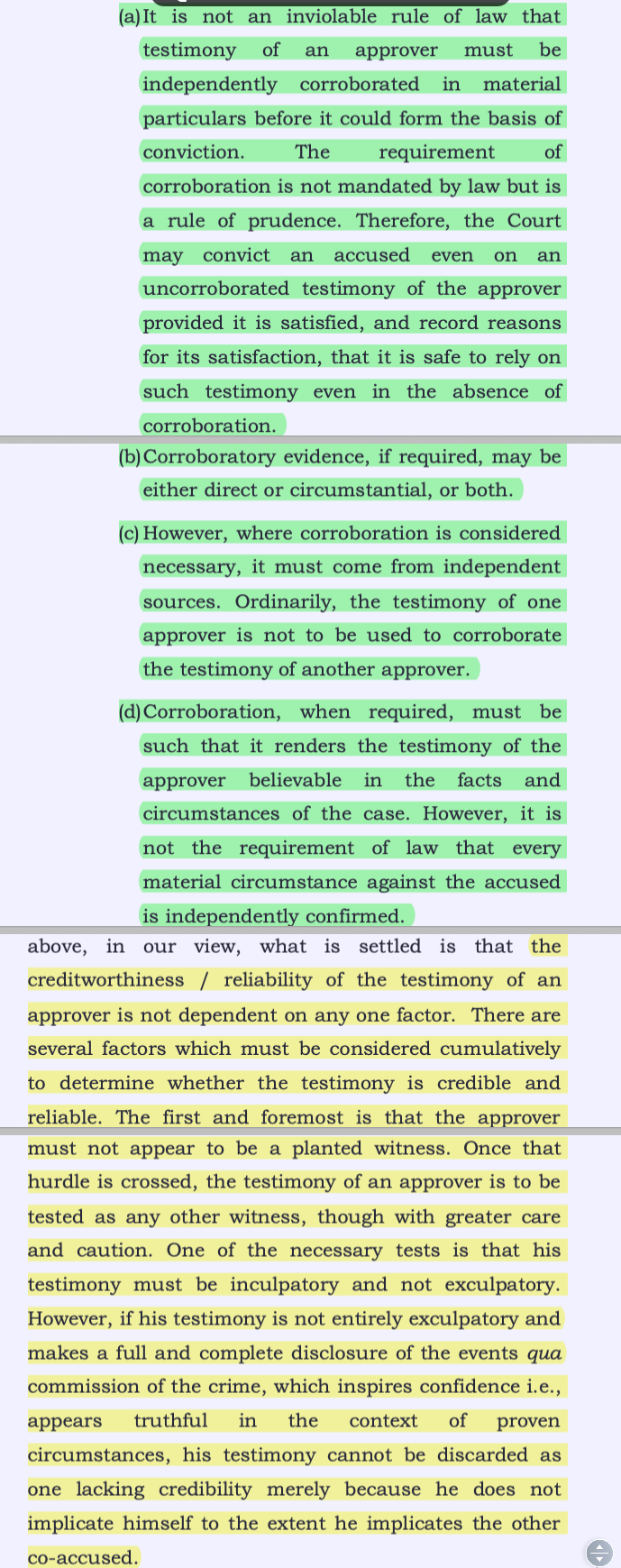
Indian Evidence Act, 1872 – Sections 133, 114 Illustration (b) — - Legal principles regarding the necessity of corroboration of an approver’s testimony : (a)It is not an inviolable rule of law that testimony of an approver must be independently corroborated in material particulars before it could form the basis of conviction. The requirement of corroboration is not mandated by law but is a rule of prudence. Therefore, the Court may convict an accused even on an uncorroborated testimony of the approver provided it is satisfied, and record reasons for its satisfaction, that it is safe to rely on such testimony even in the absence of corroboration. b)Corroboratory evidence, if required, may be either direct or circumstantial, or both. (c) However, where corroboration is considered necessary, it must come from independent sources. Ordinarily, the testimony of one approver is not to be used to corroborate the testimony of another approver. (d)Corroboration, when required, must be such that it renders the testimony of the approver believable in the facts and circumstances of the case. However, it is not the requirement of law that every material circumstance against the accused is independently confirmed. (Para 29) The creditworthiness / reliability of the testimony of an approver is not dependent on any one factor. There are several factors which must be considered cumulatively to determine whether the testimony is credible and reliable. The first and foremost is that the approver must not appear to be a planted witness. Once that hurdle is crossed, the testimony of an approver is to be tested as any other witness, though with greater care and caution. One of the necessary tests is that his testimony must be inculpatory and not exculpatory. However, if his testimony is not entirely exculpatory and makes a full and complete disclosure of the events qua commission of the crime, which inspires confidence i.e., appears truthful in the context of proven circumstances, his testimony cannot be discarded as one lacking credibility merely because he does not implicate himself to the extent he implicates the other co-accused. (Para 36)
Indian Penal Code, 1860 – Sections 120‑A, 120‑B (Criminal Conspiracy) — The essential ingredients of the offence of criminal conspiracy are: (1) an agreement between two or more persons; (2) the agreement must relate to doing or causing to be done either (a) an illegal act, or (b) an act which is not illegal but is done by illegal means; the meeting of minds for such purpose is sine qua non, existence of conspiracy can ordinarily be inferred from surrounding circumstances and conduct, and indulgence in the illegal act or legal act by illegal means may be inferred from knowledge itself. (Para 50) Indian Evidence Act, 1872 – Section 10 — one who enters into a conspiratorial relationship is liable for every reasonable foreseeable crime committed by every other member of the conspiracy in reference to their common intention, whether or not he knew of the crimes or aided in their commission. (Para 54)
Code of Criminal Procedure, 1973 – Section 464 read with Indian Penal Code, 1860 – Section 302 read with Section 120‑B — Where the charge‑framing order initially contained the name of an accused along with others for offences under Section 302 read with Section 120‑B IPC, later struck off, but the order reflects that he denied that charge and claimed trial, he was fully aware of the charge he was facing and, having regard to the issues tried and questions put to witnesses, no prejudice can be said to have been caused to him on ground of any defect in the charge. (Para 43)
Criminal Sentencing – Life Imprisonment – Conversion to Fixed‑Term Sentence — Modifying a sentence of life imprisonment to a fixed term sentence is permissible as long as the sentence imposed is more than 14 years of imprisonment. (Para 60)