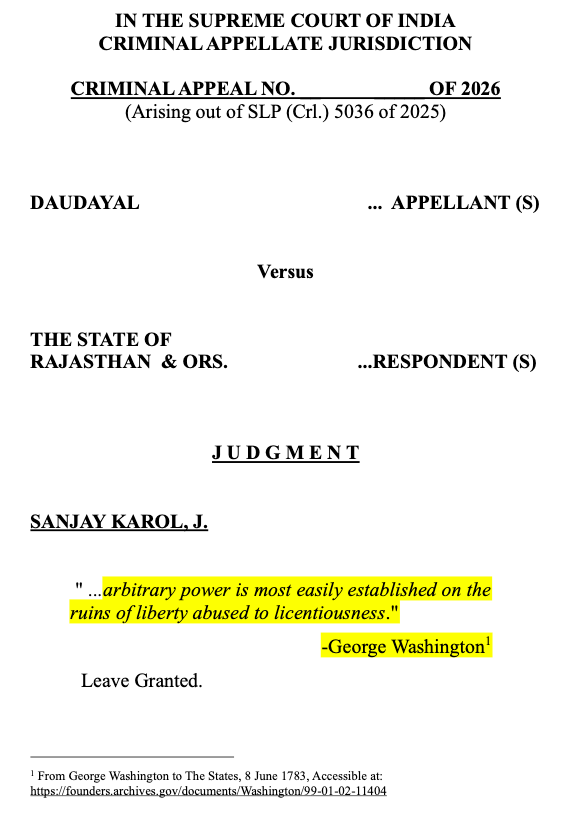
Daudayal v. State of Rajasthan 2026 INSC 599 - Parole - Non-Release - Illegal Detention

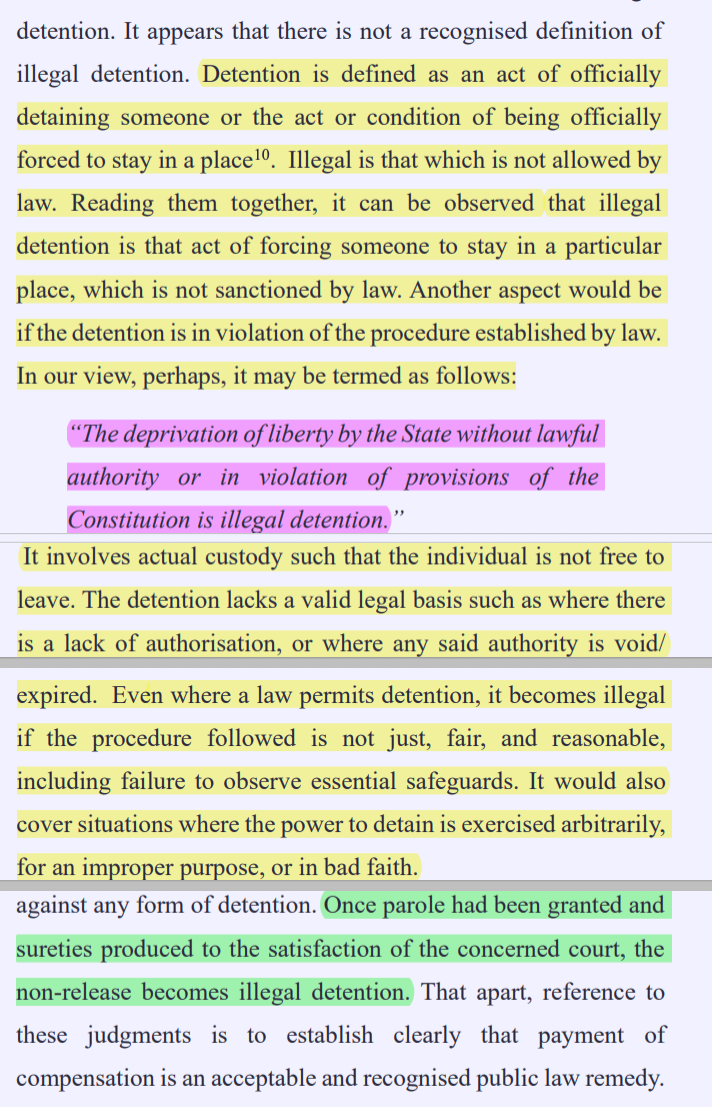
Constitution of India - Article 32 -Parole - Non-Release - Habeas corpus would be maintainable against any form of detention. Once parole had been granted and sureties produced to the satisfaction of the concerned court, the non-release becomes illegal detention.Payment of compensation is an acceptable and recognised public law remedy. (Para 11) [Context: In this case, SC held that the appellant’s continued custody for 24 days after an order of permanent parole and verification of sureties amounted to illegal detention and violated Article 21, notwithstanding that his original imprisonment was pursuant to a valid conviction. The Court rejected the State’s defence that the parole order was contrary to Rule 9 of the Rajasthan Parole Rules or that it was contemplating an appeal, reiterating the principle of “obey first, appeal later” and that liberty cannot be subordinated to bureaucratic delay. Treating monetary relief as a public law remedy for breach of fundamental rights, the Court awarded compensation of Rs. 11,00,000 to the appellant.]
Illegal detention-The deprivation of liberty by the State without lawful authority or in violation of provisions of the Constitution is illegal detention- The detention lacks a valid legal basis such as where there is a lack of authorisation, or where any said authority is void/expired. Even where a law permits detention, it becomes illegal if the procedure followed is not just, fair, and reasonable, including failure to observe essential safeguards. It would also cover situations where the power to detain is exercised arbitrarily, for an improper purpose, or in bad faith Detention is defined as an act of officially detaining someone or the act or condition of being officially forced to stay in a place. Illegal is that which is not allowed by law. Reading them together, it can be observed that illegal detention is that act of forcing someone to stay in a particular place, which is not sanctioned by law. Another aspect would be if the detention is in violation of the procedure established by law. (Para 7)
Practice and Procedure - Mere preferring of an appeal would not, by itself, operate as a stay of the order impugned therein. (Para 9)