State of Uttar Pradesh v. Raghvendra Nath Srivastava 2026 INSC 601 – Rent Control - Art. 227 Constitution

Constitution of India – Article 227 (Power of superintendence of High Courts) — Although interference of the High Court under Article 227 in rent matters is not completely barred and can be exercised in exceptional circumstances, the High Court is not meant to substitute its own decision for that of the court or tribunal subject to its supervision, and in the absence of material on record to support the rate of rent relied upon, an order of direct enhancement of rent under Article 227 is unsustainable. (Pages 9–11) [Context: High Court enhanced rent to Rs. 14 per sq. ft. based only on landlord’s counsel’s statement about adjoining premises, without supporting material or tenant’s recorded consent.]
Uttar Pradesh Urban Buildings (Regulation of Letting, Rent and Eviction) Act, 1972 – Section 21(8) proviso — The proviso is the only recourse available to the landlord and bonafide requirement as a ground stands completely extinguished; deletion of clauses (ii) and (iv) of the Explanation to Section 21(1) does not impact the operationality of the proviso, since acceptance of the contrary contention would virtually make the tenant into the landlord by leaving the landlord with no way to reclaim his own property either physically or financially. (Page 6–7) In the case of buildings let out to the State Government, a local authority, a public sector corporation or a recognised educational institution, an application for enhancement of rent made under the proviso to Section 21(8) is permissible and maintainable, and the landlord may seek enhancement of monthly rent to one‑twelfth of ten per cent of the market value of the building, with further enhancement only after five years from the last order. (Pages 6–7, 11)
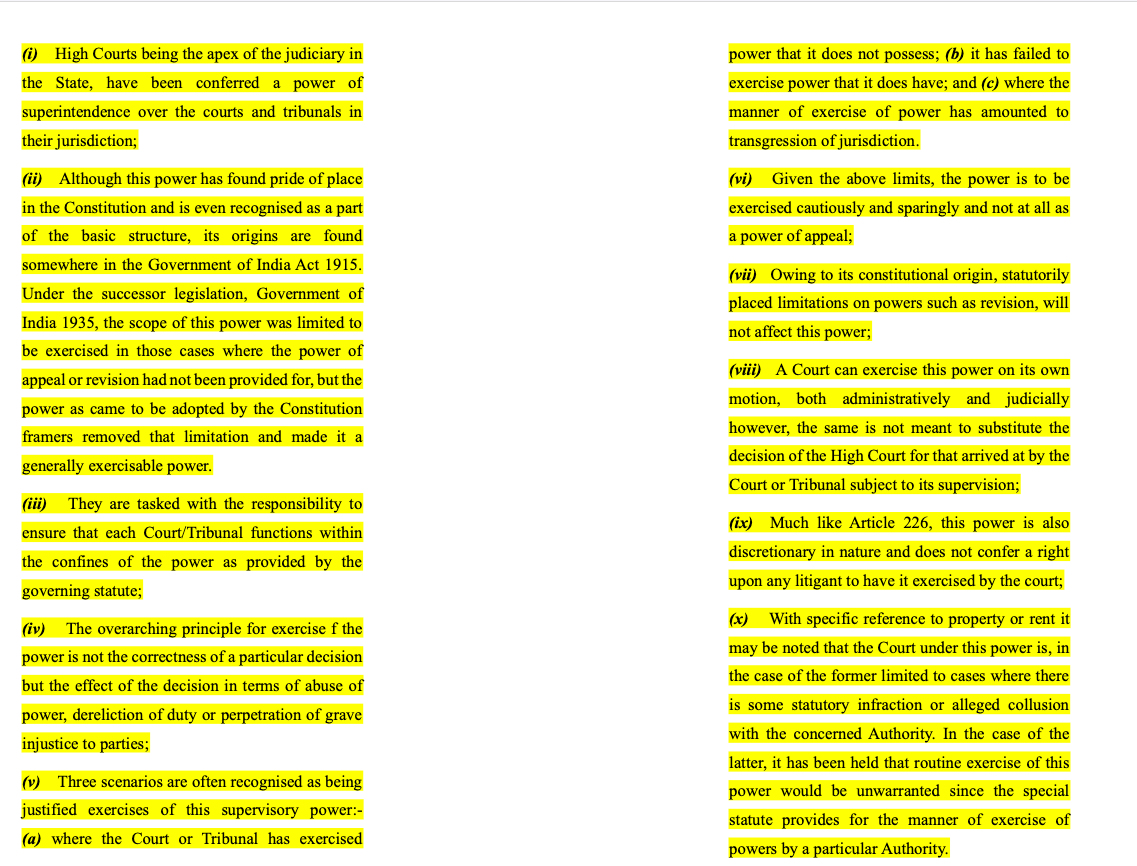
Constitution of India – Article 227 (Power of superintendence of High Courts) — High Courts, being the apex of the judiciary in the State, have been conferred a power of superintendence over the courts and tribunals in their jurisdiction, tasked with the responsibility to ensure that each court or tribunal functions within the confines of the power as provided by the governing statute; the overarching principle for exercise of this power is not the correctness of a particular decision but the effect of the decision in terms of abuse of power, dereliction of duty or perpetration of grave injustice to parties; three scenarios are recognised as justified exercises of this supervisory power, namely where the court or tribunal has exercised power that it does not possess, has failed to exercise power that it does have, or has in the manner of exercise of power transgressed its jurisdiction; this power, though of constitutional origin and unaffected by statutory limitations on revision, is to be exercised cautiously and sparingly and not as a power of appeal, is discretionary in nature, can be exercised suo motu, and in rent matters routine exercise is unwarranted since special statutes provide the manner of exercise of powers by particular authorities. (Pages 7–9) [Context: Challenge to High Court’s interference with Rent Control proceedings and direct fixation of higher rent under Article 227.]