Prajwala v. Union of India 2026 INSC 609 Immoral Traffic (Prevention) Act - Rehabilitation Of Victims Of Trafficking - Commercial Sexual Exploitation

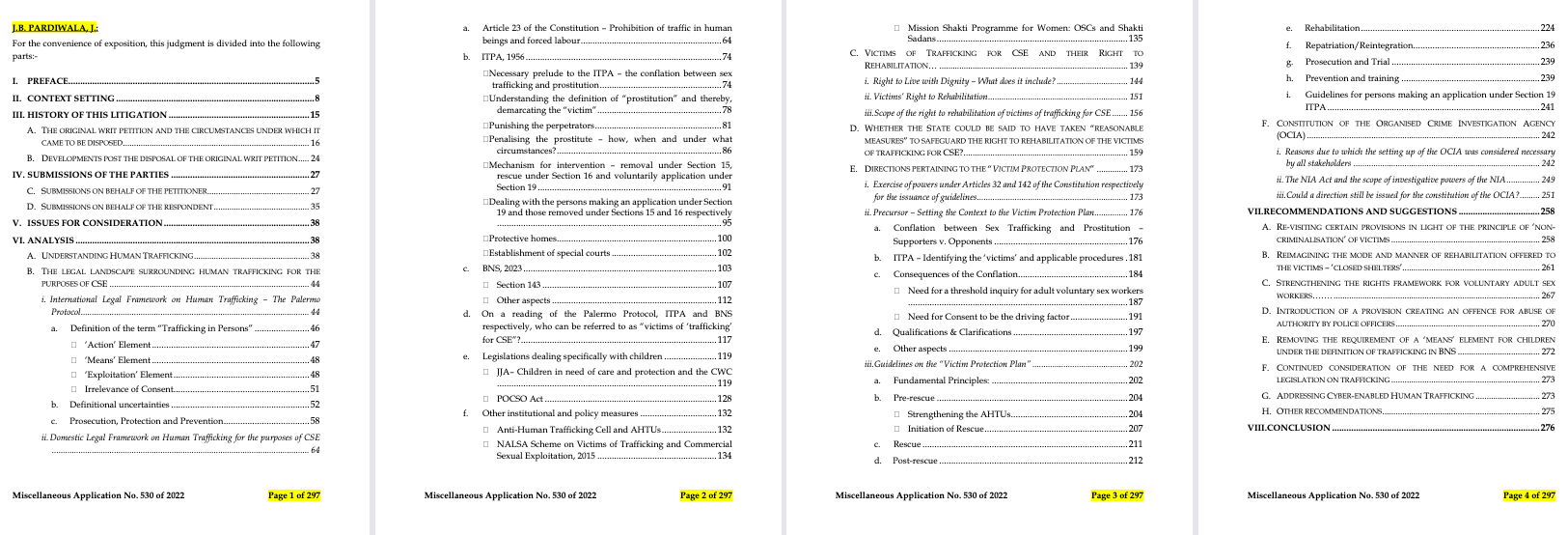
Constitution of India - Articles 21 and 23 ; Immoral Traffic (Prevention) Act - Victims of trafficking for commercial sexual exploitation have a fundamental right to rehabilitation, and finds that neither the existing legal framework nor its implementation amounts to “reasonable measures” to secure that right- Issued an extensive, binding “Victim Protection Plan” that restructures pre‑rescue, rescue, post‑rescue, rehabilitation, repatriation and trial processes, centres victim consent (especially for adult victims), distinguishes voluntary adult sex workers, and prescribes minimum standards for protective homes and AHTUs, to operate until Parliament enacts a comprehensive trafficking law- Made recommendations for legislative reforms to ITPA and BNS, stronger non‑criminalisation of victims, better protection of voluntary sex workers, and a focused response to cyber‑enabled trafficking and trafficking proceeds.
Bharatiya Nyaya Sanhita, 2023 - Section 143(1) - Palermo Protocol’s definition- To establish the offence of trafficking under Section 143: (i) the actus reus element has to be established via the ‘action’ and ‘means’ elements; and (ii) the mens rea element has to be established via the ‘purpose’ element i.e., the individual intended that the action (made possible through one of the means) would lead to exploitation. b. While the acts mentioned as constituting the ‘action’ element in both the protocol and Section 143(1) are one and the same, there are certain differences in the components forming part of the ‘means’ and ‘purpose’ elements. However, the most important difference between the two definitions is that, unlike the Palermo Protocol, under the BNS, all three elements must be established for the offence of trafficking to be constituted, even for children. c. Further, explanation 1 to the section states that “exploitation” shall include “any form of sexual exploitation”. The term ‘sexual exploitation’ is wide in its ambit and would include all forms of sexual exploitation, including but not limited to trafficking for prostitution, pedophilia, pornography, cybersex, and other disguised forms of sexual exploitation. (Para 432)
Bharatiya Nyaya Sanhita, 2023 - Section 143(1) ; Immoral Traffic (Prevention) Act - What constitutes ‘trafficking for the purposes of Commercial Sexual Exploitation (CSE).'? Under Section 143 BNS, for an act of sexual exploitation to amount to trafficking, all three elements of act, means, and purpose must be fulfilled. In other words, the act of bringing a person towards prostitution must have been done through one of the specified means, such as force, coercion, inducement, or deception, for it to constitute trafficking. The ITPA, on the other hand, operates on a fundamentally different logic. The ITPA requires no such ‘means’. Any act done by a third party (‘act’ element) in furtherance of prostitution (‘purposes’ element) is sufficient to attract liability under the Act. The result is that under the ITPA, all prostitution involving third parties is, in effect, treated as trafficking for CSE, regardless of whether any force, coercion, or inducement was employed. Thus, conduct that would not qualify as trafficking under Section 143 may nevertheless constitute an offence under the ITPA. (Para 434) F for all further purposes, when any reference is made to “victims of trafficking for CSE”, it would include those persons who have been identified as victims under the ITPA regime and those persons who have been victimised by persons alleged to have committed an offence under Section 143 of the BNS. (Para 219)
Constitution of India - Article 23 - Not only bonded labourers, but also victims of trafficking for CSE have a right to rehabilitation. (Para 281)
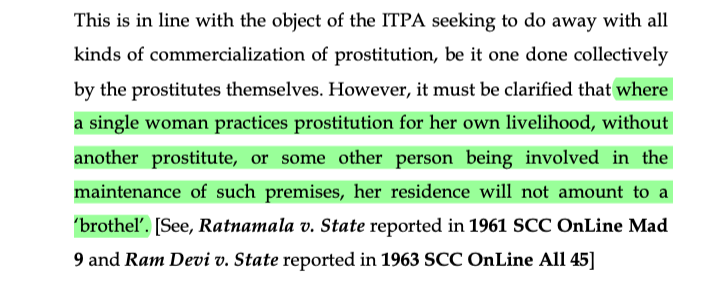
Immoral Traffic (Prevention) Act 1956- Section 3- Where a single woman practices prostitution for her own livelihood, without another prostitute, or some other person being involved in the maintenance of such premises, her residence will not amount to a ‘brothel’. (Para 154)
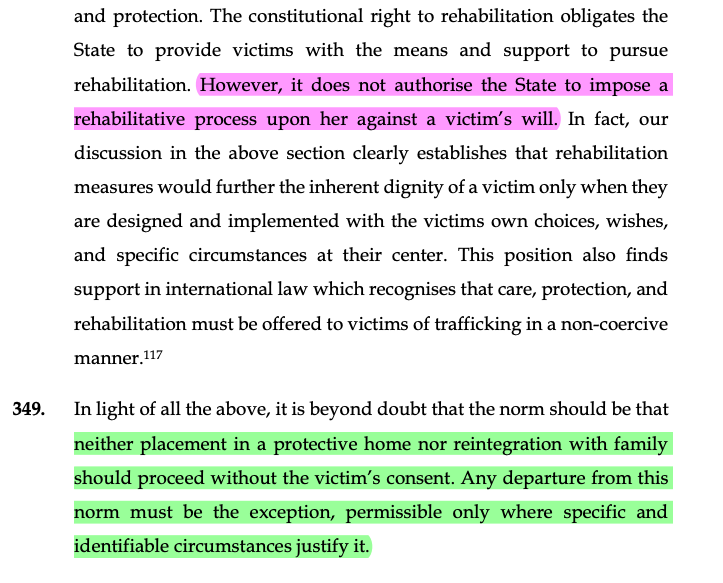
Immoral Traffic (Prevention) Act 1956- Section 17,19- Neither placement in a protective home nor reintegration with family should proceed without the victim’s consent. Any departure from this norm must be the exception, permissible only where specific and identifiable circumstances justify it. The constitutional right to rehabilitation obligates the State to provide victims with the means and support to pursue rehabilitation. However, it does not authorise the State to impose a rehabilitative process upon her against a victim’s will. (Para 348-349) A victim’s choice not to be placed under long-term safe custody shall not be treated as an adverse inference against her at any stage, present or future, and shall not preclude her from making an application under Section 19, ITPA should she later wish to avail for herself care, protection, or rehabilitation. (Page 222)
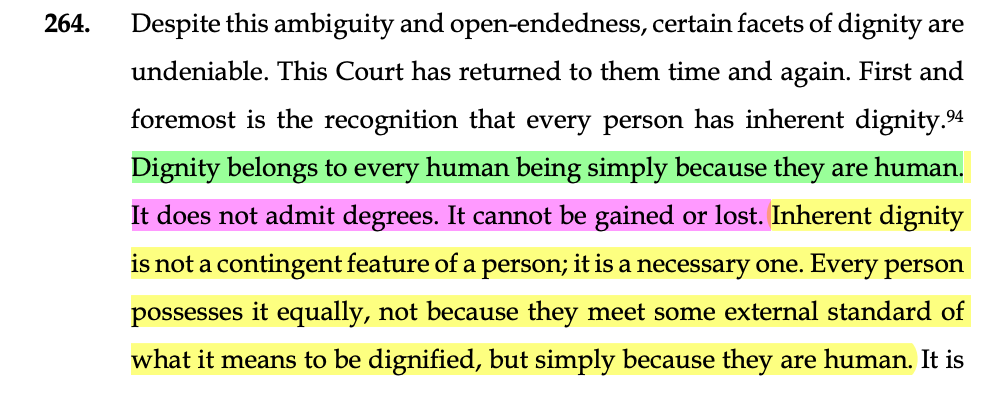
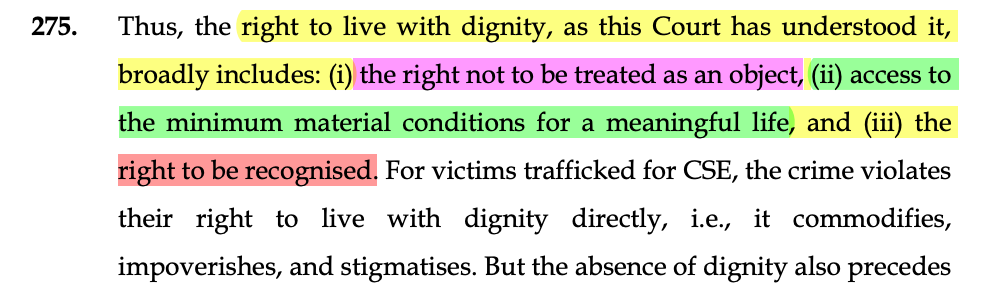
Constitution of India - Articles 21 - The right to live with dignity, as this Court has understood it, broadly includes: (i) the right not to be treated as an object, (ii) access to the minimum material conditions for a meaningful life, and (iii) the right to be recognised. (Para 275)
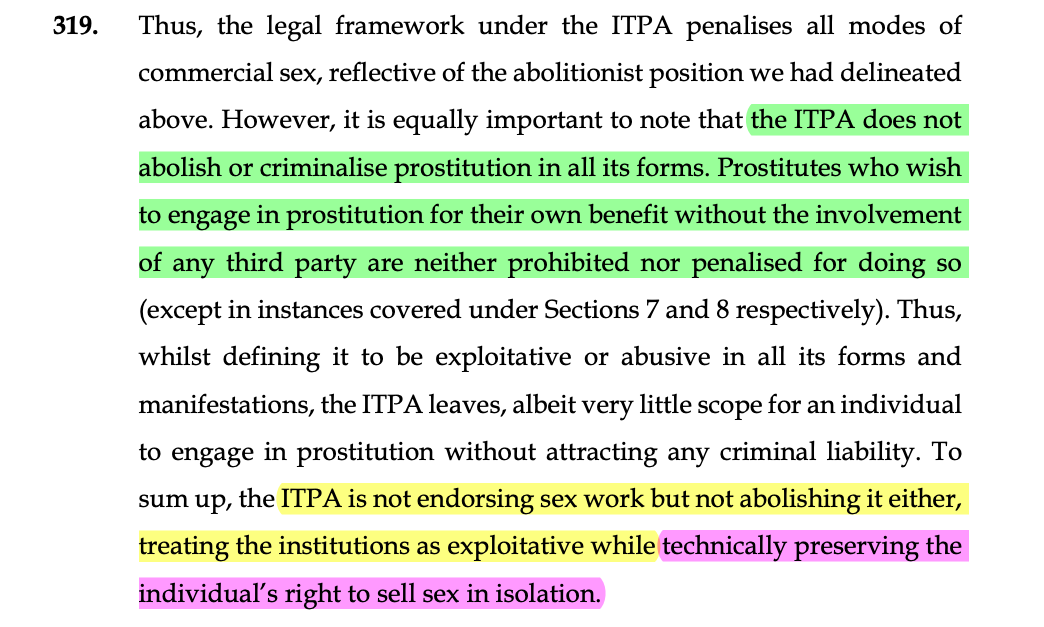
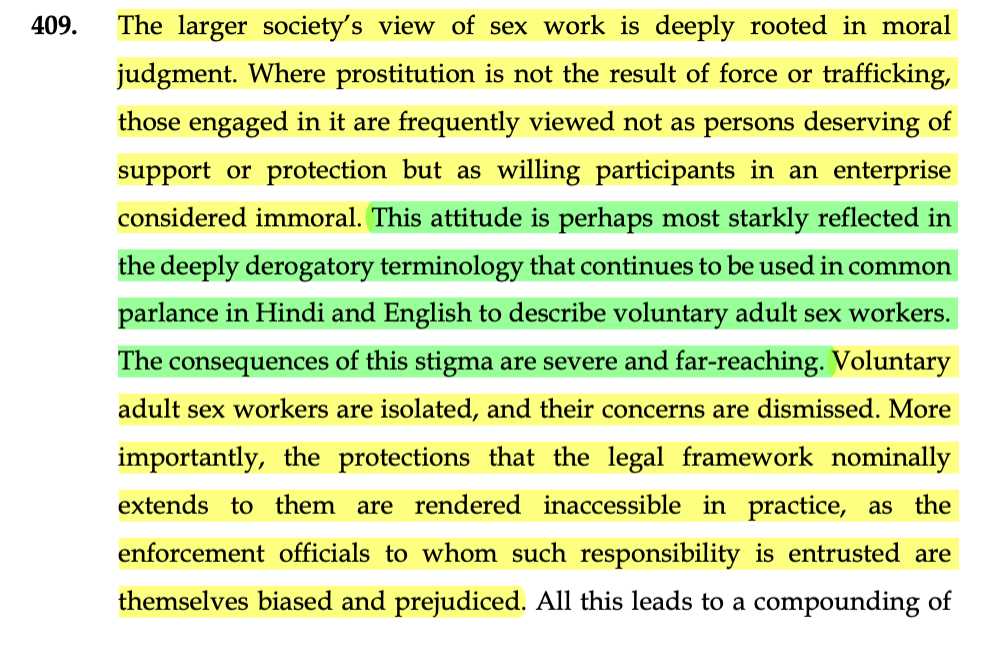
Immoral Traffic (Prevention) Act 1956- ITPA does not abolish or criminalise prostitution in all its forms. Prostitutes who wish to engage in prostitution for their own benefit without the involvement of any third party are neither prohibited nor penalised for doing so (except in instances covered under Sections 7 and 8 respectively). Thus, whilst defining it to be exploitative or abusive in all its forms and manifestations, the ITPA leaves, albeit very little scope for an individual to engage in prostitution without attracting any criminal liability- The ITPA is not endorsing sex work but not abolishing it either, treating the institutions as exploitative while technically preserving the individual’s right to sell sex in isolation. (Para 319)