Darubai v. Kamalabai 2026 INSC 613 – Hindu Succession Act, Tenants‑In‑Common Vs Joint Tenancy; Karta‑Ship Over Property

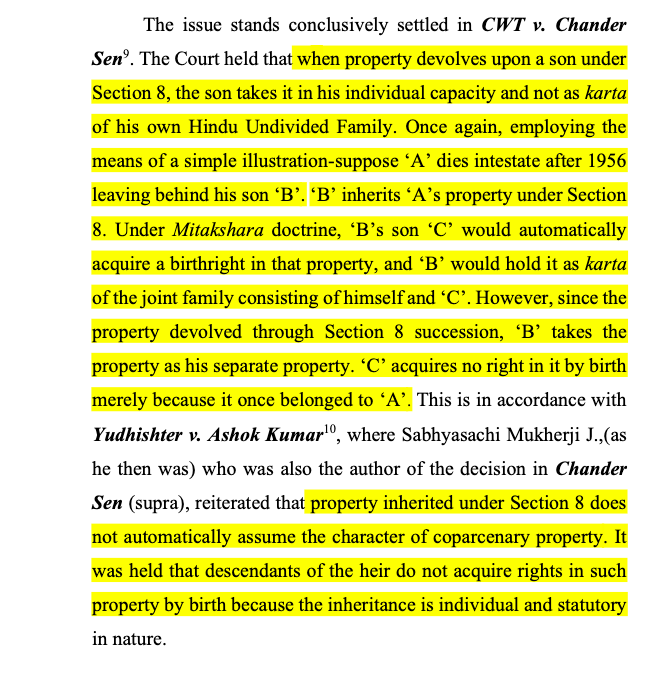
Hindu Succession Act, 1956 – Section 8 (read with Section 19) — When property devolves upon a son under Section 8, the son takes it in his individual capacity and not as karta of his own Hindu Undivided Family- Property inherited under Section 8 does not automatically assume the character of coparcenary property. It was held that descendants of the heir do not acquire rights in such property by birth because the inheritance is individual and statutory in nature. In the context of Section 8, the question of karta‑ship ordinarily does not arise merely because the property has come from a paternal ancestor, since the heirs succeed as tenants‑in‑common with definite and separate shares and the property devolves by succession rather than by survivorship. Illustration: Suppose ‘A’ dies intestate after 1956 leaving behind his son ‘B’. ‘B’ inherits ‘A’s property under Section 8. Under Mitakshara doctrine, ‘B’s son ‘C’ would automatically acquire a birthright in that property, and ‘B’ would hold it as karta of the joint family consisting of himself and ‘C’. However, since the property devolved through Section 8 succession, ‘B’ takes the property as his separate property. ‘C’ acquires no right in it by birth merely because it once belonged to ‘A’ (Para 7-8)
Hindu Succession Act, 1956 – Sections 8, 10 and 19 — Upon the death of a male Hindu whose property is his separate property, his widow and daughters become tenants‑in‑common with definite and separate shares, each to the tune of one‑fifth in the present case, and when each has a separate and identifiable share there arises no question of one heir acting as karta to sell off part of the property on account of legal necessity beyond her own share. (Page 11–12)
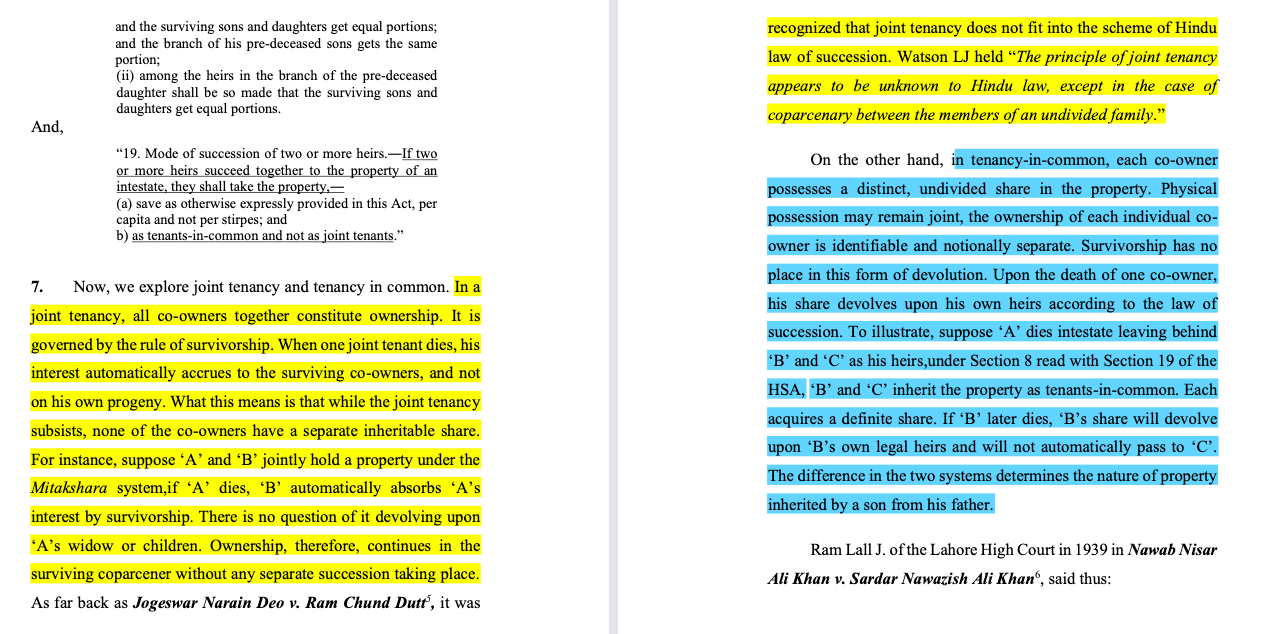
Joint tenancy and tenancy in common- In a joint tenancy, all co-owners together constitute ownership. It is governed by the rule of survivorship. When one joint tenant dies, his interest automatically accrues to the surviving co-owners, and not on his own progeny. What this means is that while the joint tenancy subsists, none of the co-owners have a separate inheritable share. For instance, suppose ‘A’ and ‘B’ jointly hold a property under the Mitakshara system,if ‘A’ dies, ‘B’ automatically absorbs ‘A’s interest by survivorship. There is no question of it devolving upon ‘A’s widow or children. Ownership, therefore, continues in the surviving coparcener without any separate succession taking place. Joint tenancy does not fit into the scheme of Hindu law of succession. In tenancy-in-common, each co-owner possesses a distinct, undivided share in the property. Physical possession may remain joint, the ownership of each individual coowner is identifiable and notionally separate. Survivorship has no place in this form of devolution. Upon the death of one co-owner, his share devolves upon his own heirs according to the law of succession. To illustrate, suppose ‘A’ dies intestate leaving behind ‘B’ and ‘C’ as his heirs,under Section 8 read with Section 19 of the HSA, ‘B’ and ‘C’ inherit the property as tenants-in-common. Each acquires a definite share. If ‘B’ later dies, ‘B’s share will devolve upon ‘B’s own legal heirs and will not automatically pass to ‘C’. The difference in the two systems determines the nature of property inherited by a son from his father. (Para 7)