Kulsum Nisha v. State of Uttar Pradesh 2026 INSC 617 – Marital Status, Gender Equality, Dependency, Purposive Construction

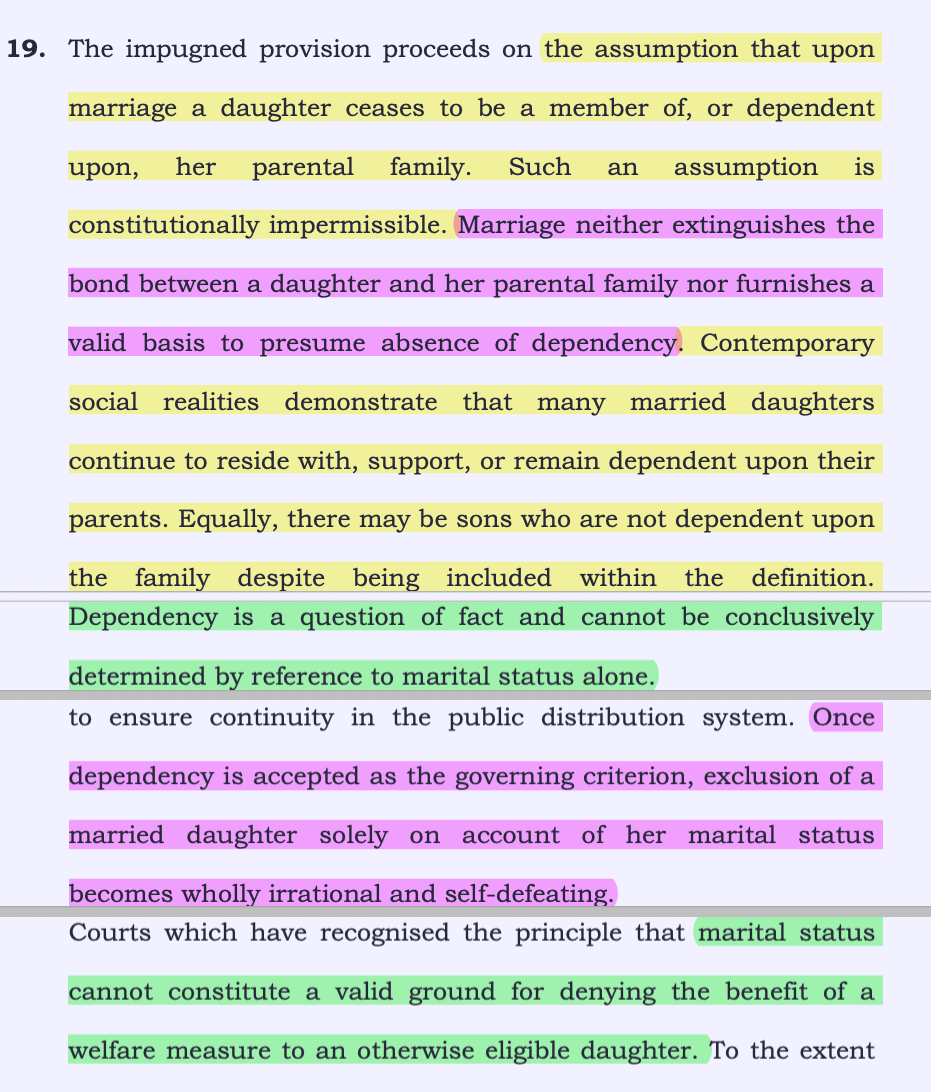
Constitution of India – Articles 14 and 15(1) - Welfare Measures- Marital status cannot constitute a valid ground for denying the benefit of a welfare measure to an otherwise eligible daughter. (Para 27) Assumption that upon marriage a daughter ceases to be a member of, or dependent upon, her parental family, is constitutionally impermissible. Marriage neither extinguishes the bond between a daughter and her parental family nor furnishes a valid basis to presume absence of dependency. Contemporary social realities demonstrate that many married daughters continue to reside with, support, or remain dependent upon their parents. Equally, there may be sons who are not dependent upon the family despite being included within the definition. Dependency is a question of fact and cannot be conclusively determined by reference to marital status alone. (Para 19) [Context: The Supreme Court held that exclusion of married daughters from the definition of “family” for compassionate allotment of fair price shops is unconstitutional as it rests on gender-based stereotypes and lacks rational nexus with the object of the scheme- The expression “daughter” in Clause 2(p) of Essential Commodities (Regulation of Sale and Distribution Control) Order, 2016, has to be read to include a married daughter provided she establishes the dependency on the deceased dealer and satisfies all other eligibility conditions prescribed under the G.O. including the requirement of local residence. ]
Interpretation of Statutes – Purposive Construction — The Court is supposed to attach that meaning to a provision which serves the purpose behind it, the basic approach being to ascertain is what the provision is designed to accomplish. When the language of an enactment is reasonably capable of more than one meaning, the Court is not merely permitted but is obliged to prefer that construction which promotes the provision and avoids a result that would be arbitrary or unjust. The Court should adopt purposive interpretation in cases where the literal interpretation may not serve the purpose or may lead to absurdity. (Para 24)