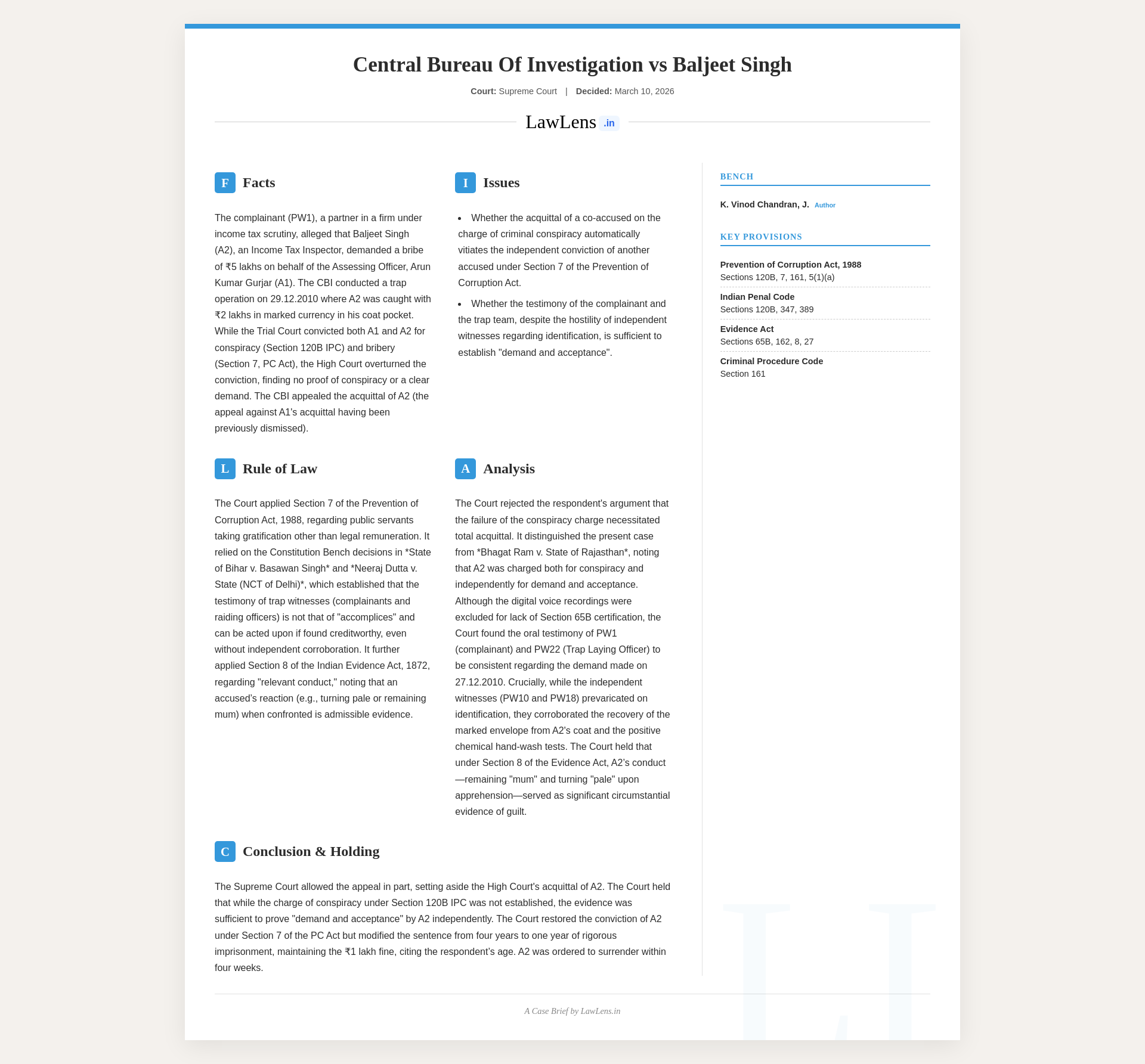
Central Bureau of Investigation v. Baljeet Singh 2026 INSC 221 - PC Act - Raiding Party - Interested Witness
"There is no inflexible rule of discarding the testimony of the persons in the raiding party, unless independent corroboration is available."

Criminal Trial - There is no inflexible rule of discarding the testimony of the persons in the raiding party, unless independent corroboration is available. The testimony of an interested or partisan witness has to be scrutinized with care, and it is not that of an accomplice. Neither is the complainant an accomplice, nor can the persons involved in the raiding party be considered to be interested since they are exercising a public duty without any personal rancour. (Para 27)
Indian Evidence Act 1872 - Section 8,27- When an accused person leads a police officer to a particular location where stolen articles and weapons are concealed, which have a connection with the offence alleged, on such recovery, the concealment would be admissible as relevant conduct under Section 8 of the Indian Evidence Act, 1872 irrespective of whether any statement by the accused contemporaneously with or antecedent to such conduct, falls within the purview of Section 27 of the Evidence Act. (Para 27)
Criminal Trial - Even if a witness is treated as “hostile” and is cross examined, his evidence cannot be written off altogether but must be considered with due care and circumspection and that part of the testimony which is creditworthy must be considered and acted upon. (Para 27)
Case Info
Case Information Extracted
Case name: Central Bureau of Investigation v. Baljeet Singh
Neutral citation: 2026 INSC 221
Court & Jurisdiction: Supreme Court of India, Criminal Appellate Jurisdiction, Criminal Appeal arising out of SLP (Crl.) No. 12486 of 2025
Coram:
- Justice Sanjay Kumar
- Justice K. Vinod Chandran (author of the judgment)
Judgment date: March 10, 2026
Case Laws and Citations Referred
- A. Srinivasulu v. State represented by the Inspector of Police, (2023) 13 SCC 705
- Dashrath Singh Chauhan v. Central Bureau of Investigation, (2019) 17 SCC 509
- Bhagat Ram v. State of Rajasthan, (1972) 2 SCC 466
- Prakash Chand v. State (Delhi Administration), (1979) 3 SCC 90
- State of Bihar v. Basawan Singh, AIR 1958 SC 500
- Bhanuprasad Hariprasad Dave Rajuji v. State of Gujarat, AIR 1968 SC 1323
- Neeraj Dutta v. State (Govt. of NCT of Delhi), (2023) 4 SCC 731
- Sat Paul v. Delhi Administration, (1976) 1 SCC 727
- Himachal Pradesh Administration v. Shri Om Prakash, (1972) 1 SCC 249
Statutes / Laws Referred
- Indian Penal Code, 1860 (IPC)
- Section 120B (Criminal conspiracy)
- Section 161 IPC (as discussed in cited precedents)
- Sections 347 and 389 IPC (in cited precedent Bhagat Ram)
- Prevention of Corruption Act, 1988 (PC Act)
- Section 7 (Public servant taking gratification other than legal remuneration)
- Code of Criminal Procedure, 1973 (CrPC)
- Section 161 (Statements to police)
- Indian Evidence Act, 1872
- Section 65B (Electronic evidence – mentioned as not complied with for DVR recordings)
- Section 8 (Relevant conduct)
- Section 27 (recovery based on information from accused – discussed in precedent)
Three‑Sentence Brief Summary
The Supreme Court held that while the alleged conspiracy between the Assessing Officer (A1) and Inspector Baljeet Singh (A2) was not proved, the independent charge under Section 7 of the PC Act against A2 stood established through the complainant’s evidence, corroborated by the trap laying officer and key aspects of the independent witnesses’ testimony, along with recovery of tainted money and positive phenolphthalein tests. The Court clarified that failure of the conspiracy charge and the acquittal of A1 did not bar conviction of A2, since the demand and acceptance of illegal gratification by A2 in his own capacity were clearly proved beyond reasonable doubt. Accordingly, it set aside the High Court’s acquittal of A2, restored his conviction under Section 7 of the PC Act, but reduced the sentence from four years’ rigorous imprisonment to one year with a fine of Rs. 1 lakh and three months’ default simple imprisonment.