Dinesh Biwaji Ashtikar v. State of Maharashtra 2026 INSC 56 - S.12 Right To Education Act -“Neighbourhood School” Obligation To Admit
You can read our notes on this judgment in our Supreme Court Daily Digests. If you are our subscriber, you should get it in our Whatsapp CaseCiter Community at about 9pm on every working day. If you are not our subscriber yet, you can register by clicking here:
Constitution of India - Article 21A ; Right of Children to Free and Compulsory Education Act, 2009 - Section 12- The obligation of a “neighbourhood school” to admit children belonging to weaker and disadvantaged sections of our society- It is necessary and compelling to formulate subordinate legislation by issuing necessary rules and regulations, prescribing the method and manner by which children of weaker and disadvantaged sections are to be admitted in neighbourhood schools. Without such enforceable rules and regulations, the object of Article 21A and the statutory policy under Section 12(1)(c) would be a dead letter - Supreme Court direct the appropriate authorities to prepare and issue, in consultation with the NCPCR and SCPCRs, as the case may be, as well as the National and State Advisory Councils, necessary rules and regulations under Section 38 of the Act for implementing the mandate of Section 12(1)(c) of the Act.
Constitution of India - Article 21A -The consequence of identifying the right to elementary education as a positive right is the recognition of corelative duties and identification of five duty bearers, being (i) the appropriate government, (ii) the local authority, (iii) the neighbourhood schools, (iv) the parents/guardians, and (v) the primary school teachers. (Para 6)
Constitution of India - Fraternity -A correct appreciation of fraternity must displace the traditional but mistaken view, often repeated in constitutional discourse, that it is not an enforceable value. Our constitutional jurisprudence compels us to read fraternity as a value requiring the State to structure institutions that nurture co-existence, mutual respect, and a sense of common membership. Unlike equality and liberty, which are frequently framed as individual rights-claims, fraternity is relational; it operates through institutional arrangements that enable individuals to “lose suspect identities” based on caste, class or other hierarchies and to form solidaristic bonds. (Para 8)
Case Info
Case Details
- Case name: Dinesh Biwaji Ashtikar v. State of Maharashtra & Ors.
- Neutral citation: 2026 INSC 56
- Coram: Pamidighantam Sri Narasimha, J.; Atul S. Chandurkar, J.
- Judgment date: January 13, 2026
- Procedural posture: Special Leave Petition (Civil) No. 10105 of 2017, Supreme Court of India, Civil Appellate Jurisdiction
Statutes/laws referred
- Constitution of India:
- Article 21A (Right to Education)
- Article 51A(k) (Fundamental duty of parents/guardians)
- Article 39(f) (Directive Principle regarding children’s development)
- Right of Children to Free and Compulsory Education Act, 2009:
- Section 2 (definitions, incl. clause (n))
- Section 3 (Right to free and compulsory education)
- Section 6 (Duty to establish neighbourhood schools)
- Section 7 (Financial responsibilities)
- Section 8 (Duties of appropriate government)
- Section 9 (Duties of local authority)
- Section 10 (Duty of parents/guardians)
- Section 12(1)(a)-(c), 12(2)-(3) (Extent of school’s responsibility; reimbursement; information)
- Section 31-32 (Monitoring; complaints/dispute resolution)
- Section 38 (Power to make rules)
- Commissions for Protection of Child Rights Act, 2005:
- Sections 3, 17 (establishment of NCPCR/SCPCRs)
- Sections 14, 15, 24 (powers and steps referenced under RTE Section 31)
- Policy/administrative references:
- NCPCR Standard Operating Procedure for Section 12(1)(c)
- GNCTD SOP dated 02.01.2025 (scrutiny teams)
- Kothari Commission Report (Common School System)
- MHRD policy statement on inclusive schooling and 25% rationale
Directions issued
- Rule-making: Appropriate authorities to frame enforceable rules/regulations under Section 38 to implement Section 12(1)(c), in consultation with NCPCR/SCPCRs and Advisory Councils.
- Impleadment and monitoring: NCPCR to be impleaded; to collate State/UT rule-making status and file affidavit by March 31, 2026.
- Next hearing: April 6, 2026.
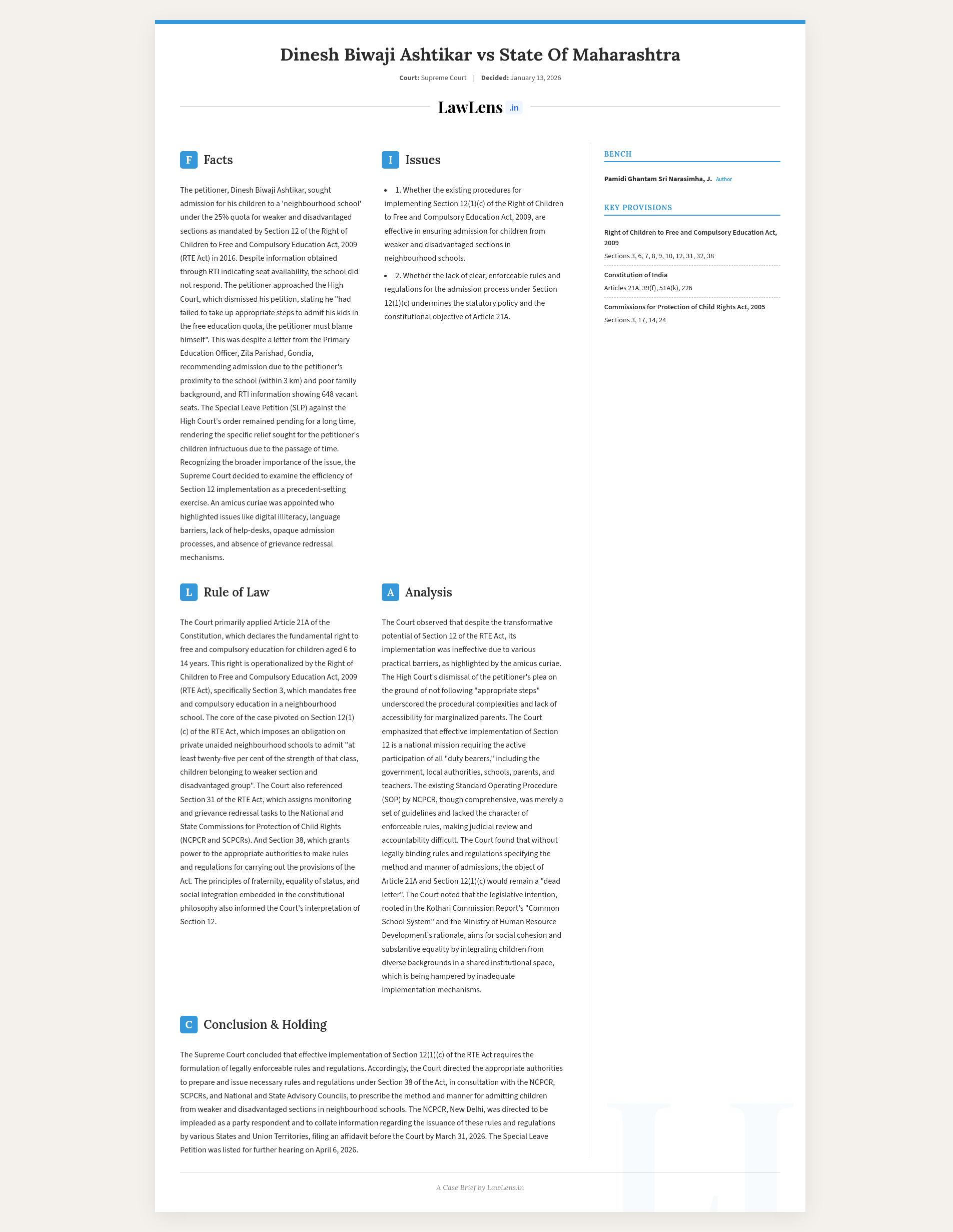
#SupremeCourt on how Section 12 RTE Act concretize the constitutional principle of fraternity : https://t.co/PMrNB6Hsjh pic.twitter.com/069u7bvZWv
— CiteCase 🇮🇳 (@CiteCase) January 13, 2026