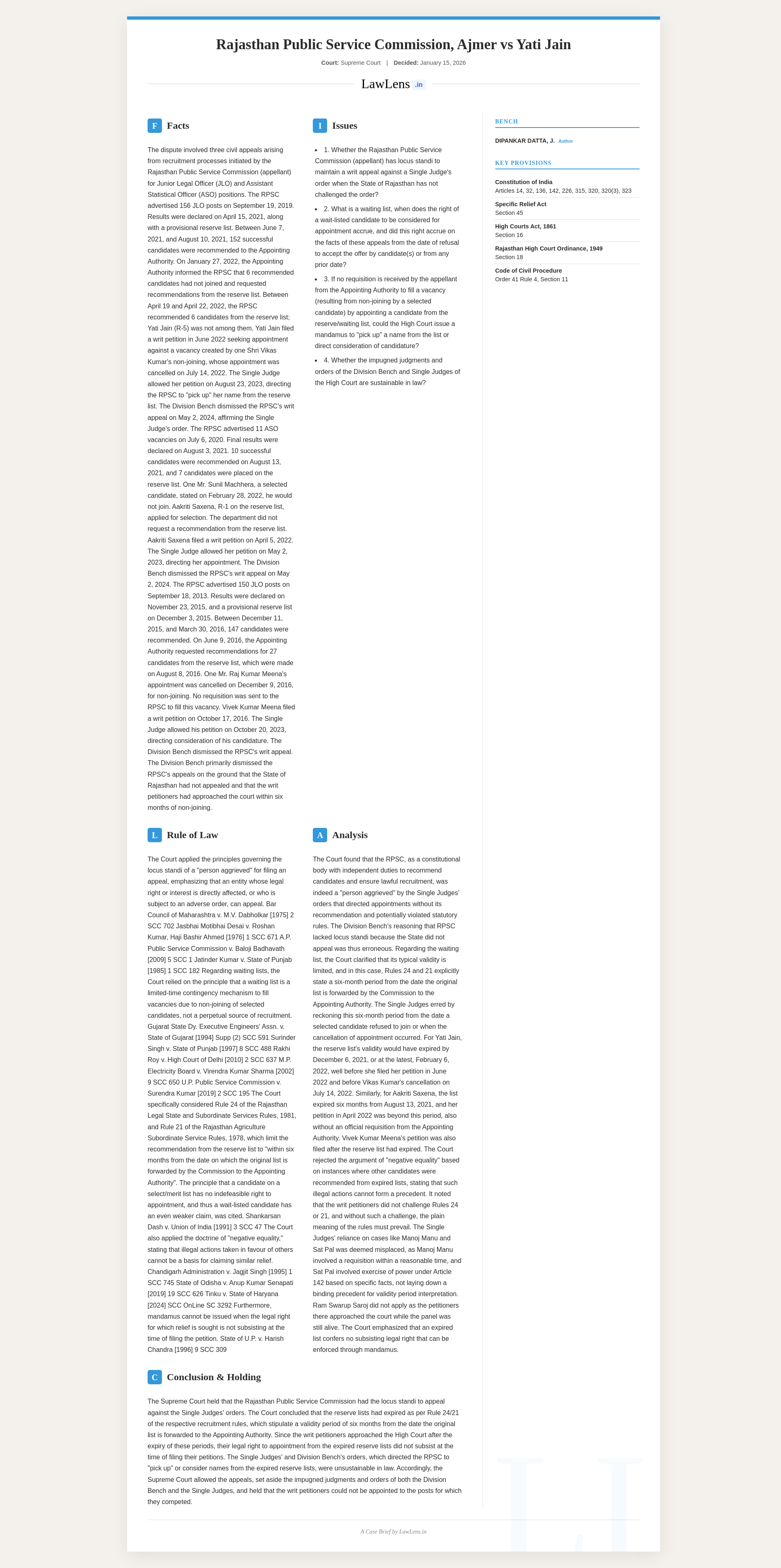
Rajasthan Public Service Commission v. Yati Jain ; 2026 INSC 64 - Waiting List - Writ Appeal -LPA

You can read our notes on this judgment in our Supreme Court Daily Digests. If you are our subscriber, you should get it in our Whatsapp CaseCiter Community at about 9pm on every working day. If you are not our subscriber yet, you can register by clicking here:
Service Law - Waiting List - The key aspects of a waiting list, in relation to service law disputes: (i) a waiting list is normally prepared after the select/merit list is drawn; (ii) it would include candidates who have qualified the recruitment examination but are not so meritorious such that they can be immediately appointed on the number of vacancies advertised; (iii) such list would operate like a merit-based queue for vacancies that remain unfilled after offers of appointment given to the candidates in the select/merit list are not accepted; (iv) a waiting list has a limited validity period; (v) validity period of a waiting list depends on the recruitment rules and should no such period be mentioned, it can bona fide be operated till the next advertisement is issued without, however, violating provisions in such rules, if any, requiring recruitment process to be initiated either semi-annually or annually; and (vi) an opportunity to a candidate in the waiting list for securing appointment arises only when vacancies remain unfilled after the process of appointing candidates from the select/merit list is over and hence, it is regarded as a procedural outcome which is part of a structured process rather than a fortuitous circumstance- A wait-listed candidate has no right of appointment, much less an indefeasible right, except when the governing recruitment rules permit a small window authorizing appointments therefrom in the specified exceptional circumstances and the appointing authority, for no good reason, denies or refuses an appointment or the reason assigned therefor is found to be arbitrary and/or discriminatory and that too, when the waiting list has not expired. (Para 86-90)
Constitution of India - Article 226 -Intra Court Jurisdiction - Letters patent appeal - A letters patent appeal, as permitted under the Letters Patent, is normally an intra-court appeal whereunder the Letters Patent Bench, sitting as a “Court of Correction”, corrects its own orders in exercise of the same jurisdiction as was vested in the Single Bench: Exercise of intra-court appellate jurisdiction could be called for if the judgment/order under challenge is palpably erroneous or suffers from perversity; but, it may not be exercised when two views are possible on a given set of facts and one of two views has been taken which is a plausible view. (Para 50-51) “Person aggrieved”: A writ appeal is a continuation of the original writ petition - anyone who may file a writ petition would have the locus standi to file a writ appeal albeit with some caveats: A person aggrieved having locus standi to prefer an appeal would be one who is directly affected or impacted by a judgment, order or decision even though the same does not directly require him to do something, or, one, who being a party to a suit, is adversely affected by the decree. To file an appeal, such a person typically needs to show affectation of a legal right or interest, or that he is likely to suffer a legal wrong as a result of its impact. A mere interest or concern in the subject matter decided by the original court would not be enough - the conditions that need to be satisfied before a person is entitled to maintain an appeal. These are: 1) that the appealing party has been a party in the proceedings from which the appeal has arisen; 2) that the definitive and conclusive ruling of the High Court on the rights of the parties in dispute is the subject of the appeal; and 3) that he is a ‘person aggrieved’, that is, a party who has been adversely affected by the determination. Condition (1) supra may, however, stand relaxed in given cases (Para 50- 67)
Appeal -An appeal is always a creature of statute - The right of appeal is the right of reaching out to a superior court, invoking its authority to have a relook at the facts vis-àvis the law applicable and to rectify the errors committed by a court inferior in the hierarchy. It is a very valuable right. Therefore, when the statute confers such a right of appeal, it is open to the person aggrieved to seek correction of the errors committed by the inferior court. (Para 45-46)
Public Service Commission - Although the recommendations made by a Public Service Commission are not binding and hence, may or may not be accepted by the Government of the State, one thing is clear: the latter has no authority to appoint anyone not recommended by the former. (Para 73)
Executive instructions - executive instructions may supplement, but not supplant, statutory rules and should be subservient to statutory provisions.
Constitution of India - Article 14,226 - Perpetuation of illegality ought to be shunned by any Court of law. This forms the basis for denying the plea of negative equality -The illegality in recommending some of the candidates figuring in the reserve list could not have been made the basis for issuance of a writ of mandamus citing Article 14 of the Constitution. (Para 101-102)
Constitution of India - Article 226 - Service Disputes - A substantial number of service-related disputes pending across the country are aggravated by protracted and recurring litigation, resulting in a state of perpetual flux for many candidates across the country. The judiciary would do well to remain circumspect of these practical realities, and interpret service rules in a manner that furthers the very object of a selection process, that is, the selection of the most suitable candidates from suitable candidates for appointment in a timely manner. (Para 123)
Summary: Appeal by the Rajasthan Public Service Commission against High Court orders that had directed the appointment of candidates from a reserve list after several originally selected individuals failed to join their posts - Allowing appeal, SC held that the Commission had the locus standi to appeal as a constitutional body ; wait-listed candidates possess no indefeasible right to appointment, particularly once the statutory validity period of the list has lapsed; the six-month validity of a reserve list under the relevant rules must be strictly calculated from the date the original list was forwarded rather than from the date a vacancy later arose due to non-joining
Case Info
Coram: Dipankar Datta, J.; Augustine George Masih, J.
Judgment date: January 15, 2026.
Neutral citation: 2026 INSC 64.
Case name: Rajasthan Public Service Commission, Ajmer v. Yati Jain & Ors.; with connected appeals against Aakriti Saxena & Ors. and Vivek Kumar Meena & Anr.
Caselaws and citations referred:
- Shalini Shyam Shetty v. Rajendra Shankar Patil, (2010) 8 SCC 329.
- Baddula Lakshmaiah v. Sri Anjaneya Swami Temple, (1996) 3 SCC 52.
- Committee of Management, Arya Nagar Inter College v. Sree Kumar Tiwary, (1997) 4 SCC 388.
- Bar Council of Maharashtra v. M.V. Dabholkar, (1975) 2 SCC 702.
- Jasbhai Motibhai Desai v. Roshan Kumar, (1976) 1 SCC 671.
- A.P. Public Service Commission v. Baloji Badhavath, (2009) 5 SCC 1.
- Office of the Odisha Lokayukta v. Dr. Pradeep Kumar Panigrahi, 2023 SCC OnLine SC 1753.
- Jatan Kumar Golcha v. Golcha Properties (P) Ltd., (1970) 3 SCC 57.
- State of Punjab v. Amar Singh, (1974) 2 SCC 70.
- Jatinder Kumar v. State of Punjab, (1985) 1 SCC 18.
- Gujarat State Dy. Executive Engineers’ Assn. v. State of Gujarat, 1994 Supp (2) SCC 591.
- Surinder Singh v. State of Punjab, (1997) 8 SCC 488.
- Rakhi Roy v. High Court of Delhi, (2010) 2 SCC 637.
- M.P. Electricity Board v. Virendra Kumar Sharma, (2002) 9 SCC 650.
- U.P. Public Service Commission v. Surendra Kumar, (2019) 2 SCC 195.
- Shankarsan Dash v. Union of India, (1991) 3 SCC 47.
- State of U.P. v. Harish Chandra, (1996) 9 SCC 309.
- State of Bihar v. Amrendra Kumar Mishra, (2006) 12 SCC 561.
- State of Orissa v. Rajkishore Nanda, (2010) 6 SCC 777.
- Chandigarh Administration v. Jagjit Singh, (1995) 1 SCC 745.
- State of Odisha v. Anup Kumar Senapati, (2019) 19 SCC 626.
- Tinku v. State of Haryana, 2024 SCC OnLine SC 329.
- Manoj Manu v. Union of India, (2013) 12 SCC 171.
- State of Jammu and Kashmir v. Sat Pal, (2013) 11 SCC 737.
- State of Uttar Pradesh v. Ram Swarup Saroj, (2000) 3 SCC 699.
- Purshottam v. Chairman, M.S.E.B., (1996) 6 SCC 49.
- A.P. Public Service Commission v. P. Chandra Mouleesware Reddy, (2006) 8 SCC 330.
- Union of India v. Ashok Kumar Aggarwal, (2013) 16 SCC 147.
Statutes/laws referred:
- Constitution of India: Articles 226, 315, 320, 323, 136, 142.
- Rajasthan High Court Ordinance, 1949, Section 18; Rules of the High Court of Judicature for Rajasthan, 1952 (Special Appeal).
- Rajasthan Legal State and Subordinate Services Rules, 1981, Rule 24.
- Rajasthan Agriculture Subordinate Service Rules, 1978, Rule 21.
- Department of Personnel, Government of Rajasthan Circulars: 19 Jan 2001; 13 Jan 2016; 26 Apr 2018.
- Code of Civil Procedure, 1908, Order 41 Rule 4.
- Specific Relief Act, 1877, Section 45 (historical discussion).
- Letters Patent (general intra‑court appeal context).