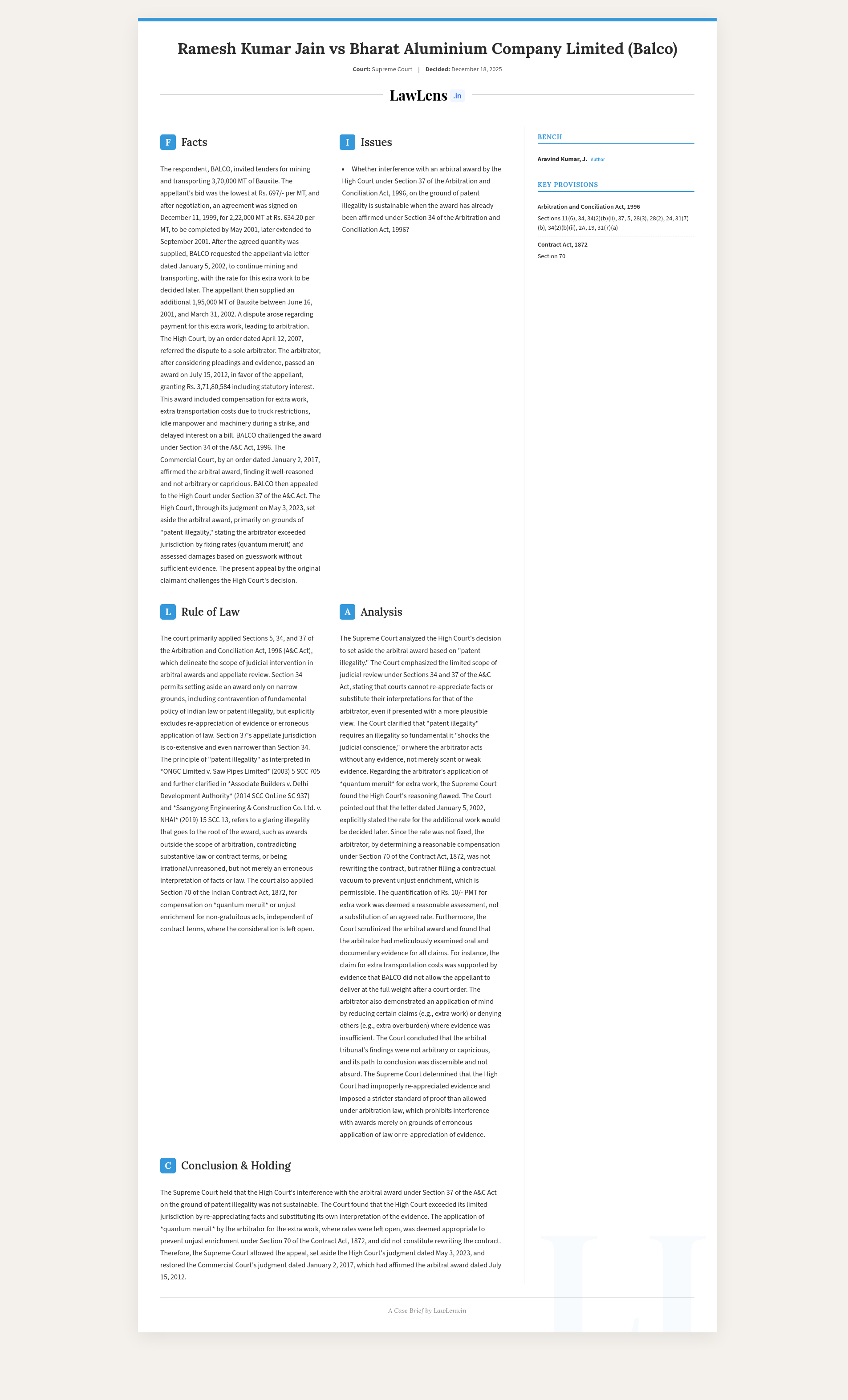
Ramesh Kumar Jain v. Bharat Aluminium Company Limited (BALCO); 2025 INSC 1457 - S.34 Arbitration Act - S.70 Contract Act

You can read our notes on this judgment in our Supreme Court Daily Digests. If you are our subscriber, you should get it in our Whatsapp CaseCiter Community at about 9pm on every working day. If you are not our subscriber yet, you can register by clicking here:
Arbitration and Conciliation Act 1996- Section 34,37 - Scope discussed - Patent Illegality - The terminology of ‘patent illegality’ indicates more than one scenario such as the findings of the arbitrator must shock the judicial conscience or the arbitrator took into account matters he shouldn’t have, or he must have failed to take into account vital matters, leading to an unjust result; or the decision is so irrational that no fair or sensible person would have arrived at it given the same facts. A classic example for the same is when an award is based on “no evidence” i.e., arbitrators cannot conjure figures or facts out of thin air to arrive at his findings. If a crucial finding is unsupported by any evidence or is a result of ignoring vital evidence that was placed before the arbitrator, it may be a ground the warrants interference. However, the said parameter must be applied with caution by keeping in mind that “no evidence” means truly no relevant evidence, not scant or weak evidence. If there is some evidence, even a single witness’s testimony or a set of documents, on which the arbitrator could rely upon or has relied upon to arrive at his conclusions, the court cannot regard the conclusion drawn by the arbitrator as patently illegal merely because that evidence has less probative value. This thin line is stood crossed only when the arbitral tribunal’s conclusion cannot be reconciled with any permissible view of the evidence. (Para 35) where the contract is simply silent on a legitimate claim which is inherently linked to the natural corollary of contractual obligation of the parties the arbitrator will be well within his powers to interpret the contract in the light of principles of the contractual jurisprudence and apply the equity to that situation. (Para 36)
Indian Contract Act 1872 - Section 70 - This provision creates a statutory right independent of contract, often termed quantum meruit or unjust enrichment remedy. It comes into play when one party confers a benefit on another in circumstances not governed by a contract, without intent to act gratuitously. Hence in such situation, the party taking the benefit is bound to pay compensation to the party who had gratuitously taken the benefits and the courts including arbitral tribunals, can award compensation under Section 70 if the conditions are met. (Para 36-37)
Case Info
Case Details
- Case name: Ramesh Kumar Jain v. Bharat Aluminium Company Limited (BALCO).
- Neutral citation: 2025 INSC 1457.
- Coram: Justice Aravind Kumar; Justice N.V. Anjaria.
- Judgment date: December 18, 2025.
Caselaws and Citations
- ONGC Ltd. v. Saw Pipes Ltd., (2003) 5 SCC 705.
- MMTC Ltd. v. Vedanta Ltd., (2019) 4 SCC 163.
- Delhi Airport Metro Express Pvt. Ltd. v. DMRC, (2022) 1 SCC 131.
- Hindustan Construction Co. Ltd. v. NHAI, (2024) 2 SCC 613; also 2023 INSC 768 referenced.
- Konkan Railway Corp. Ltd. v. Chenab Bridge Project Undertaking, (2023) 9 SCC 85.
- Larsen Air Conditioning & Refrigeration Co. v. Union of India, (2023) 15 SCC 472.
- Punjab State Civil Supplies Corp. Ltd. v. Sanman Rice Mills, 2024 INSC 742.
- Batliboi Environmental Engineers Ltd. v. Hindustan Petroleum Corp. Ltd., 2023 INSC 850.
- Associate Builders v. Delhi Development Authority, (2015) 3 SCC 49; 2014 SCC OnLine SC 937 referenced.
- SsangYong Engineering & Construction Co. Ltd. v. NHAI, (2019) 15 SCC 131.
- Mahanagar Telephone Nigam Ltd. v. Tata Communications Ltd., (2019) 5 SCC 341.
- Kailash Nath Associates v. Delhi Development Authority, (2015) 4 SCC 136.
- Satyanarayan Construction Co. v. Union of India, (2011) 15 SCC 101.
- Alopi Parshad v. Union of India, AIR 1960 SC 588.
- Construction and Design Services v. Delhi Development Authority, (2015) 14 SCC 263.
- Parsa Kente Collieries Ltd. v. RRVUN Ltd., (2019) 7 SCC 236.
Statutes/Laws Referred
- Arbitration and Conciliation Act, 1996: Sections 5, 19, 28(2)-(3), 31(7)(a)-(b), 34 (incl. 34(2), 34(2A) & proviso), 37.
- Contract Act, 1872: Section 70 (quantum meruit/unjust enrichment).
- Public policy/patent illegality doctrine as interpreted in case law (post-2015 amendments).