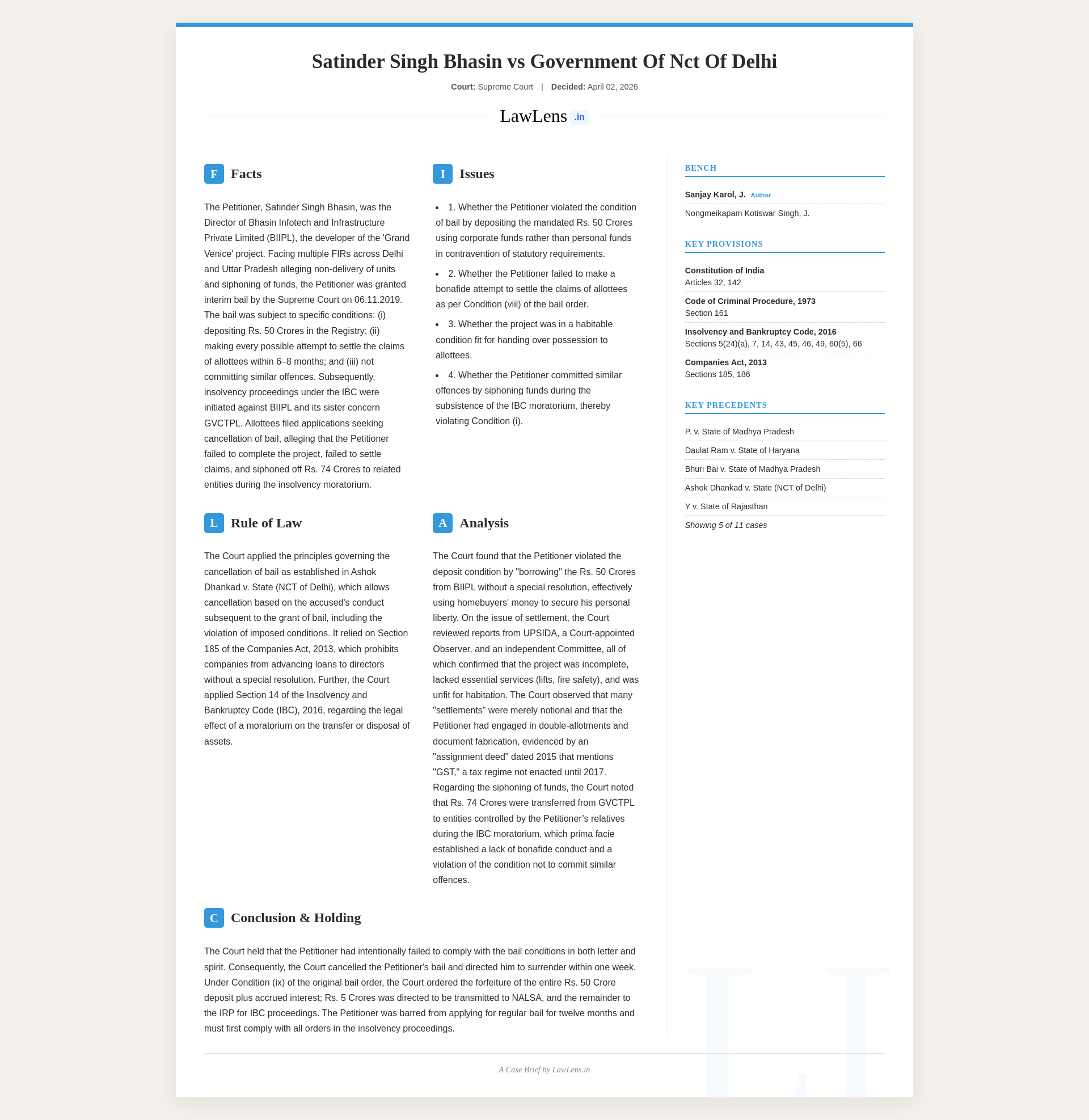
Satinder Singh Bhasin v. Government of NCT of Delhi 2026 INSC 310 - Companies Act - IBC
A company cannot directly or indirectly give a loan to its director without passing a special resolution in a general meeting or unless the funds correlate to the principal business activities of the company.

Companies Act, 2013 - Section 185 - A company cannot directly or indirectly give a loan to its director without passing a special resolution in a general meeting or unless the funds correlate to the principal business activities of the company. (Para 48)
Insolvency and Bankruptcy Code 2016 - Sections 49 and 66 - No time limit has been specified for transactions which are intended to defraud creditors. (Para 50)
Practice and Procedure - 2-judge Benches of Supreme Court have modified or altered 3-judge Bench decision. (Para 124)
Case Info
Key case details
Case name and neutral citation:Satinder Singh Bhasin v. Government of NCT of Delhi & Ors., 2026 INSC 310 (M.A. No. 239 of 2024 in W.P. (Crl.) No. 242 of 2019)
Coram:Hon’ble Mr. Justice Sanjay KarolHon’ble Mr. Justice Nongmeikapam Kotiswar Singh
Judgment date:2 April 2026 (as reflected in the header and closing line “New Delhi April 2, 2026”)
Case law and citations referred
Within this extracted text, the Court explicitly cites and relies on, among others:
- P. v. State of Madhya Pradesh (2022) 15 SCC 211
- Daulat Ram v. State of Haryana (1995) 1 SCC 349
- Bhuri Bai v. State of Madhya Pradesh 2022 SCC OnLine SC 1779
- Ashok Dhankad v. State (NCT of Delhi) 2025 SCC OnLine SC 1690
- Y v. State of Rajasthan (citation referred as “Y v. State of Rajasthan (Supra)”)
- Jaibunisha v. Meherban (2022) 5 SCC 465
- Bhagwan Singh v. Dilip Kumar @ Deepu (2023) 13 SCC 549
- Amish Devgan v. Union of India & Ors. (referred to for principles on clubbing FIRs)
- Satinder Singh Bhasin v. Col. Gautam Mullick and Ors. (Civil Appeal Nos. 13779 & 13812 of 2025; judgment dated 02.02.2026)
- Arjun Gopal v. Union of India (2017) 16 SCC 280
- All India Judges Association 2025 SCC OnLine SC 2574
There are also references to earlier Delhi High Court proceedings (including a Commissioner’s Report of 17.05.2018 in an earlier winding‑up matter), but the full case titles/citations for those are not fully set out in this extract.
Statutes and legal provisions referred
From the portions provided, the judgment expressly refers to:
- Constitution of India
- Article 32 (writ jurisdiction under which the original petition was filed)
- Article 142 (power used to club/consolidate FIRs)
- Code of Criminal Procedure, 1973
- Section 161 CrPC (statements treated as part of composite chargesheet)
- Companies Act, 2013
- Section 185 (loans to directors) – discussed at length on the Rs 50 crore deposit
- Section 186 (inter‑corporate loans/investments – referred to in arguments on “commercial advances”)
- Insolvency and Bankruptcy Code, 2016 (IBC)
- Section 7 (initiation of CIRP by allottees)
- Section 14 (moratorium)
- Sections 43 and 45 (look‑back periods for preferential/avoidance transactions – discussed in argument)
- Sections 49 and 66 (transactions defrauding creditors and fraudulent trading/wrongful trading – relied on to say no limitation for such fraudulent transactions)
- Section 5(24)(a) (definition of “related party”)
- Section 60(5) (jurisdiction of NCLT for certain applications, combined with Section 14)
- Other references
- References to National Company Law Tribunal (NCLT) and National Company Law Appellate Tribunal (NCLAT) orders (including NCLAT’s 07.12.2023 “no further steps” order and 07.03.2025 clarification)
- References to the Allahabad High Court writs concerning UPSIDA FAR dues and conversion from leasehold to freehold.
Three‑sentence brief summary
The Supreme Court cancelled the bail earlier granted to developer Satinder Singh Bhasin in the “Grand Venice” project cases, holding that he had not complied in letter and spirit with key bail conditions, especially the requirement to make every possible attempt to settle allottees’ claims. The Court found that the Rs 50‑crore bail deposit had been sourced through unlawful, undocumented loans from his own company and group entities, that the project was still incomplete and not fit for lawful possession, that settlements with investors largely remained unimplemented, and that his conduct (including fabrication of documents and non‑cooperation with the IRP and court‑appointed committee) showed lack of bona fides. Consequently, bail was cancelled with a direction that he surrender within a week, the entire Rs 50 crores plus interest was forfeited (part to NALSA and the rest to the IRP for CIRP purposes), and liberty was reserved to seek fresh bail after twelve months subject to compliance with insolvency orders.