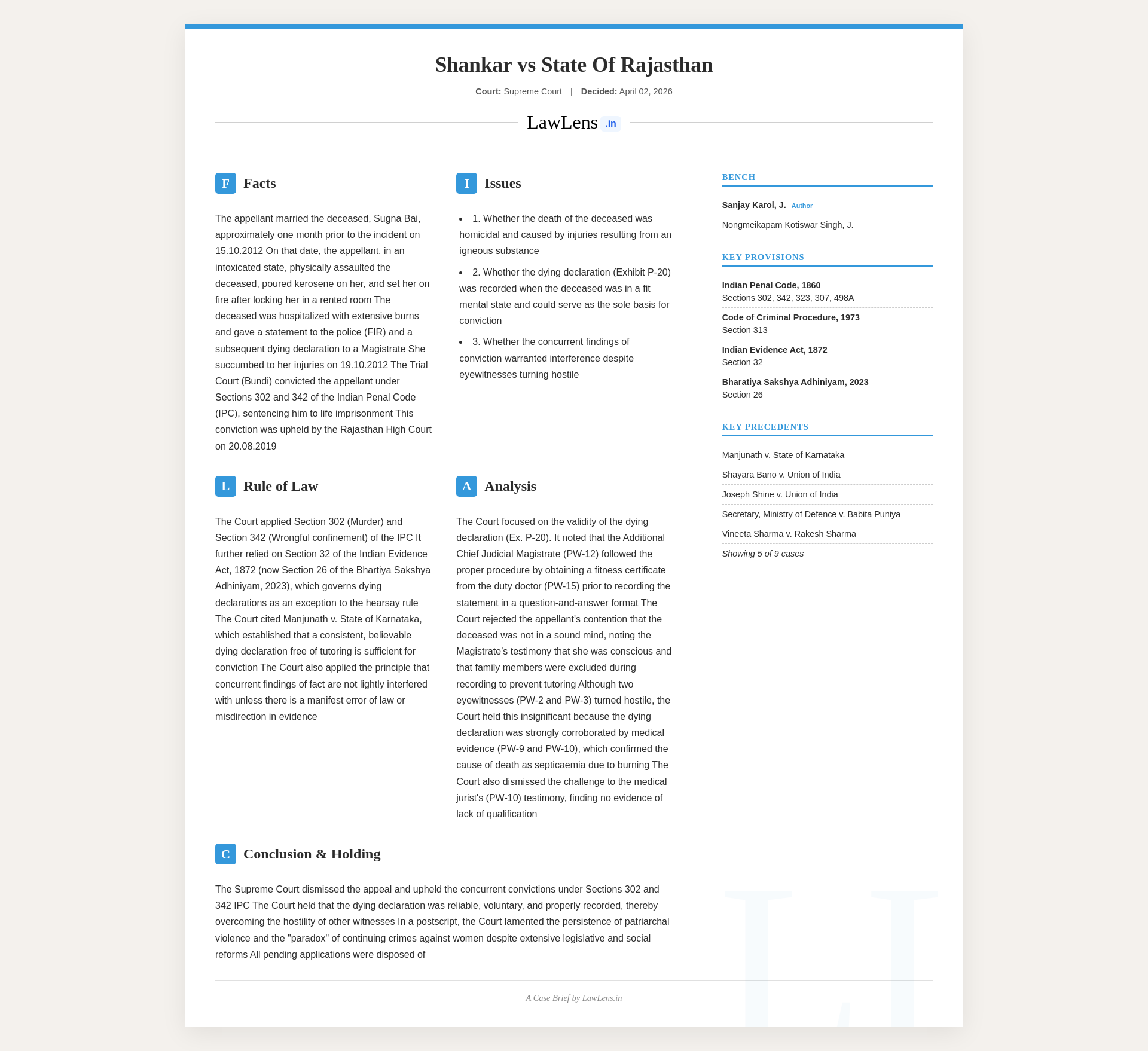
Shankar v. State of Rajasthan 2026 INSC 315 - Gender Justice - Dying Declaration - Medical Evidence
One cannot assume that all house-hold related work falls to the woman, whereas it is only the male who is tasked with bread winning.

Gender Justice - One cannot assume that all house-hold related work falls to the woman, whereas it is only the male who is tasked with bread winning. Yet, in rural and semi-urban scenarios, patriarchy remains a facet of everyday life. Authority within the household is still overwhelmingly male, and women’s autonomy is often conditional and constrained. Even if the woman earns, it would still be expected of her that she would set the house right before leaving for work, and busily engage herself in similar work including preparation of meals, when she returns from work- After decades of laws, schemes, reforms, and judicial recognition of equality across workplaces, homes, personal relationships, and even the armed forces, why does the control over women’s bodies, choices, and lives still persist so deeply within society? Perhaps, the answer lies only with “We, the People of India”.
Indian Evidence Act 1872- Section 32 - When a person is about to meet his maker or in other words the oncoming of death and its finality is imminent, considerations which may force a person to speak other than the truth pale into insignificance and what does fall from them would, therefore, be only the truth. They are exceptions to the rule of hearsay and, if a Court finds them consistent, believable and free of tutoring, it can convict the person named therein. (Para 9)
Criminal Trial -Medical evidence - Merely for the reason that witness was not a practicing doctor and was only a ‘medical jurist', it cannot be a reason to disregard his testimony. (Para 12)
Constitution of India - Article 136 - The scope of interference in concurrent findings of conviction is fairly restricted. It would only be permissible for this Court to do so if the Courts below had committed manifest errors in law, misdirected itself in appreciating evidence, or completely missed out crucial pieces of evidence that would have bearing on the overall outcome of the case. (Para 7)
Summary: The Supreme Court upheld the concurrent conviction of Shankar for murdering his wife Sugna Bai by pouring kerosene over her and setting her on fire, affirming the Trial Court’s findings under Sections 302 and 342 IPC and the High Court’s judgment. The Court found the dying declaration to be reliable, duly certified by the doctor, properly recorded by the Magistrate, and corroborated by medical evidence, rejecting all objections about the victim’s mental condition or alleged tutoring and noting that hostile witnesses did not dent the prosecution case.
Case Info
Case Information
Case name: Shankar v. State of RajasthanNeutral citation: 2026 INSC 315
Coram:Justice Sanjay KarolJustice Nongmeikapam Kotiswar Singh
Judgment date: 2 April 2026 (New Delhi)
Statutes / Laws Referred
Indian Penal Code, 1860:
- Section 302 (Murder)
- Section 342 (Wrongful confinement)
- Section 498A (Cruelty by husband or relatives – referred in policy discussion)
Code of Criminal Procedure, 1973:
- Section 313 (Examination of accused)
Evidence law:
- Section 32, Indian Evidence Act, 1872 (Dying declaration)
- Section 26, Bharatiya Sakshya Adhiniyam, 2023 (successor provision on dying declaration)
Special/statutory schemes and laws in the policy discussion:
- Dowry Prohibition Act, 1961
- Protection of Women from Domestic Violence Act, 2005
- Sexual Harassment of Women at Workplace (Prevention, Prohibition and Redressal) Act, 2013
Government schemes (contextual):
- Beti Bachao, Beti Padhao
- Sukanya Samriddhi Yojana
- Ujjwala Yojana
Case Law and Citations Referred
- Manjunath v. State of Karnataka, 2023 SCC OnLine SC 1421
- Shayara Bano v. Union of India, (2017) 9 SCC 1
- Joseph Shine v. Union of India, (2018) 2 SCC 189
- Secretary, Ministry of Defence v. Babita Puniya, (2020) 7 SCC 469
- Vineeta Sharma v. Rakesh Sharma, (2020) 9 SCC 1
- Arnesh Kumar v. State of Bihar, (2014) 8 SCC 273
- Hiral P. Harsora v. Kusum Narottamdas Harsora, (2016) 10 SCC 165
- Shakti Vahini v. Union of India, (2018) 7 SCC 192
- Shafin Jahan v. Asokan K.M., (2018) 16 SCC 368
Brief Summary (Three Sentences)
The Supreme Court upheld the concurrent conviction of Shankar for murdering his wife Sugna Bai by pouring kerosene over her and setting her on fire, affirming the Trial Court’s findings under Sections 302 and 342 IPC and the High Court’s judgment. The Court found the dying declaration to be reliable, duly certified by the doctor, properly recorded by the Magistrate, and corroborated by medical evidence, rejecting all objections about the victim’s mental condition or alleged tutoring and noting that hostile witnesses did not dent the prosecution case. In a detailed postscript, the Court reflected on the persistence of domestic and gender‑based violence despite decades of constitutional guarantees, legislative reforms, welfare schemes, and landmark judgments for women’s rights, calling it symptomatic of a deeply patriarchal social order.