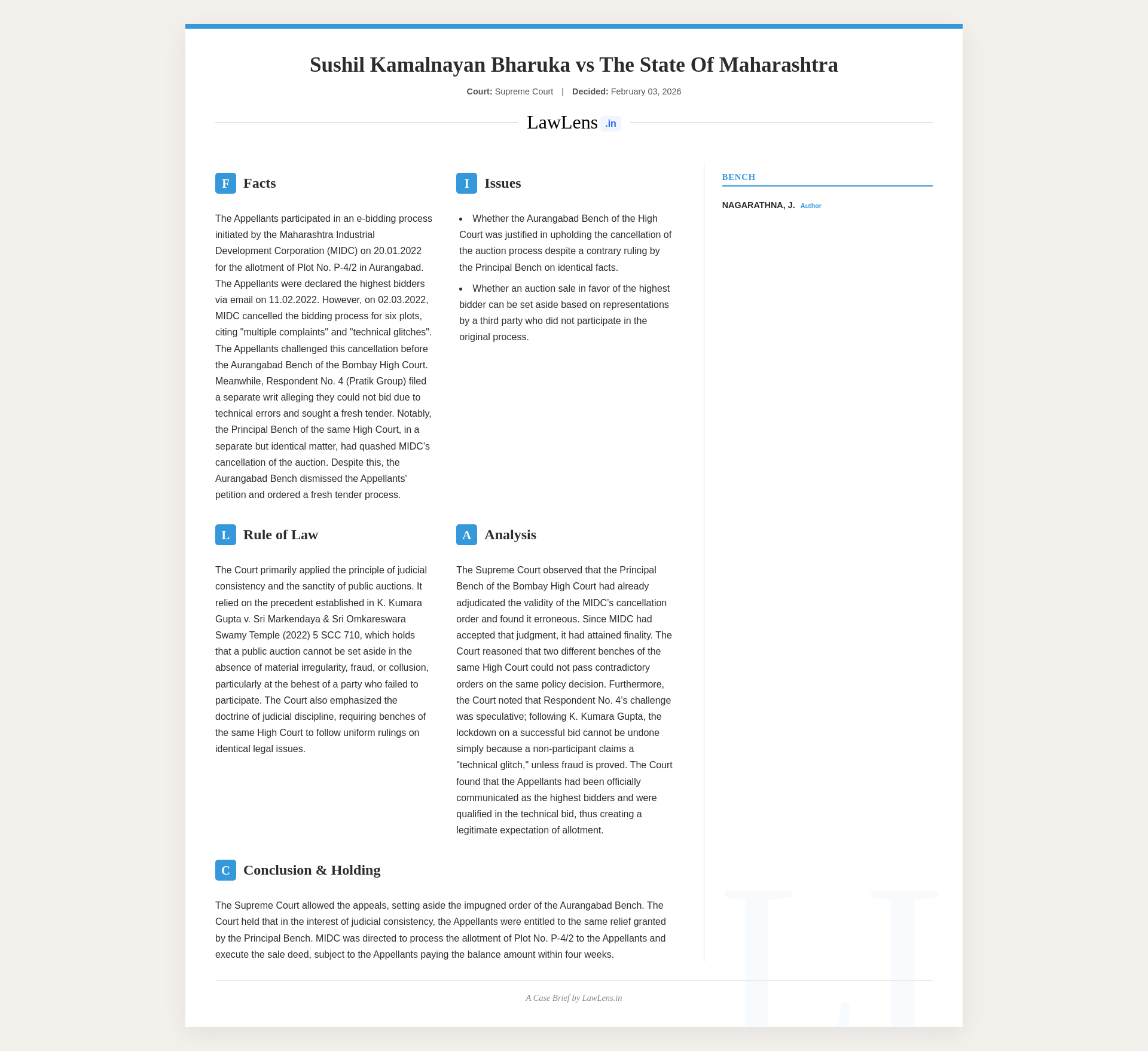
Sushil Kamalnayan Bharuka v. State of Maharashtra 2026 INSC 168 Public Auction - Highest Bid
Constitution of India - Article 226 - Public Auction ; Precedent - Contradictory Orders

Constitution of India - Article 226 - Public Auction - Unless and until it was found that there was any material irregularity and/or illegality in holding the public auction and/or the auction was vitiated by any fraud or collusion, it is not open to set aside the auction or sale in favour of the highest bidder on the basis of some representation made by a third party who did not even participate even in the auction proceedings and did not make any offer. If there is repeated interference in the auction process, the object and purpose of holding public auction and its sanctity would be frustrated. That unless there are allegations of fraud, collusion, etc., the highest offer received in the public offer should be accepted as a fair value. Otherwise, there shall not be any sanctity of any public auction.
Precedent - There cannot be two contradictory orders of different benches of the High Court on the very same issue. (Para 22)
Case Info
Case Information
Case name: Sushil Kamalnayan Bharuka & Others v. State of Maharashtra & Others
Neutral citation: 2026 INSC 168
Coram:Justice B.V. Nagarathna and Justice Ujjal Bhuyan
Judgment date: 03 February 2026
Case laws and citations referred
- K. Kumara Gupta v. Sri Markendaya & Sri Omkareswara Swamy Temple, (2022) 5 SCC 710 – cited for the principle that, absent material irregularity, illegality, fraud or collusion, a duly conducted public auction in favour of the highest bidder should not be set aside, and that repeated interference undermines the sanctity of public auctions.
Statutes / laws referred
The judgment is primarily based on principles of administrative law and judicial consistency in the context of public auction by a statutory corporation (MIDC). No specific statutory provision (section or Act) is expressly cited in the text you provided; the Court proceeds on general public law principles governing cancellation of auctions and fairness in tender processes.
Brief three‑sentence summary
MIDC conducted an e‑auction of industrial plots, in which the appellants were declared highest bidders for Plot No. P‑4/2 at Chikhalthana, Aurangabad, but later cancelled the entire bidding citing complaints and technical glitches. While the Principal Bench of the Bombay High Court had already quashed a similar cancellation in respect of other plots and restored the auction in favour of highest bidders, the Aurangabad Bench dismissed the appellants’ writ petition and ordered a fresh tender, thereby creating conflicting decisions on the same issue. The Supreme Court held that such inconsistency could not stand, applied the earlier Bombay High Court view, set aside the Aurangabad Bench’s order, and directed MIDC to process allotment and execute the sale deed in favour of the appellants subject to payment of the balance consideration within four weeks.